


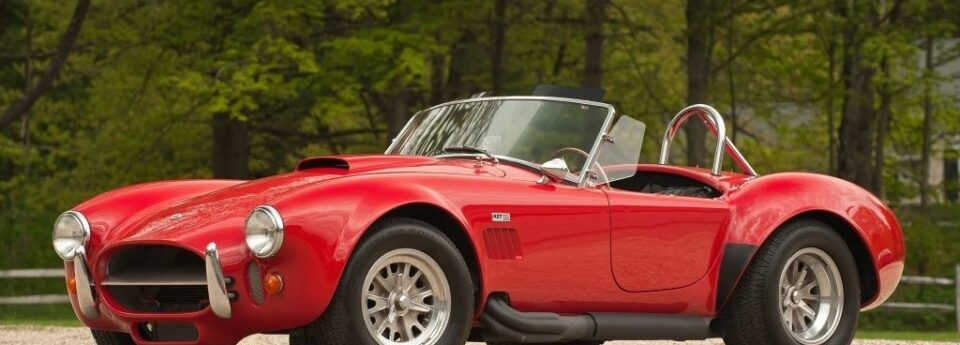
AC & Shelby Cobra – Legendary Performance Car | Timeless Classic Car
AC Cobra / Shelby Cobra: The Iconic Classic Car That Redefined Automotive History
There are fast cars. There are iconic cars. And then there is the AC Cobra — a machine that sits so far above both categories that it practically invented a category of its own. Born from British craftsmanship and American muscle, the Cobra remains one of the most revered sports cars ever produced. Decades after its debut, it still turns heads, stops conversations, and commands million-pound price tags at auction. This is no accident. This is legacy.
A British Body, An American Heart
The story of the AC Cobra begins in Thames Ditton, Surrey, where British manufacturer AC Cars had been quietly producing its elegant AC Ace roadster since 1953. The Ace was a beautiful, hand-built two-seater — light, nimble, and made from aluminium panels shaped by skilled craftsmen using English wheeling machines. It was a proper driver’s car, but it was missing one thing: raw, ear-splitting power.
Enter Carroll Shelby — a Texas-born racing driver with a vision and a Ford V8 engine looking for a home.
In late 1961, Shelby convinced Ford to supply two of its new small-block V8 engines, one of which was shipped to AC Cars in England. The chassis was modified, strengthened, and then air-freighted back to Los Angeles. Shelby’s team dropped the engine in within hours. The Cobra was born.
The Mk I and Mk II — Small Block, Big Statement
The first 75 Cobras — known as the Mk I — were fitted with a 4.3-litre (260 cu in) Ford V8, making them genuinely quick for the early 1960s. But Shelby never believed in “quick enough,” and the engine was soon swapped for the larger 4.7-litre (289 cu in) unit — an engine so punchy that most early owners upgraded their cars immediately.
The Mk II continued with the 289, refining the original formula while adding more competition pedigree. These cars went racing at Sebring, Le Mans, and across the United States, building a reputation as a scrappy, fearless competitor. They weren’t always the most refined cars on the circuit, but they had heart — and they had speed.
The 427 — When Power Became Legendary
If the 289 made people take notice, the Mk III 427 made them pull over in disbelief.
Introduced in 1965, the Mk III was a completely reworked machine. The chassis was redesigned with wider tracks, larger diameter tubing, and coil springs all round to handle the brutal power of Ford’s 7.0-litre (427 cu in) FE “side oiler” V8 engine. In standard form it produced 425 bhp. In semi-competition (S/C) trim, that climbed to 485 bhp — an almost absurd figure for a road car weighing little more than a tonne.
The numbers tell only part of the story:
- 0–60 mph in approximately 4 seconds
- Top speed of around 164 mph (standard) and 185 mph (S/C)
- Quarter mile in the low 12-second range
- Engine: 7.0-litre Ford FE V8, side-oiler configuration
- Kerb weight: approximately 1,000 kg
Carroll Shelby was so confident in the car’s ferocious acceleration that he used to tape a $100 bill to the dashboard during test drives and tell passengers they could keep it — if they could reach out and grab it. Nobody ever could.
For over 20 years — from 1965 until the arrival of the Porsche 959 — the Cobra held the title of the world’s fastest-accelerating production road car. That is not a marketing claim. That is history.
Design That Never Ages
Part of what makes the Cobra so timeless is its design. Unlike many 1960s cars that feel dated today, the Cobra’s wide, muscular body, flared arches, swooping bonnet, and side-exit exhausts look just as dramatic now as they did sixty years ago.
The open cockpit, the single roll hoop, the stubby tail — every line was functional, every curve was deliberate. There was no excess weight, no unnecessary complexity. Just aluminium bodywork, a steel ladder chassis, a thundering V8, and four wheels. It was honest, uncompromising, and brutally effective.
Today, original Cobras are among the most valuable classic cars in the world, regularly fetching well over £1 million at auction. Pristine examples — particularly 427 S/C competition cars — have sold for several million pounds.
The Cobra’s Racing Legacy
The Cobra didn’t just look fast — it went racing, and it won. The Shelby Daytona Coupé, a streamlined closed version of the Cobra, took on Ferrari’s dominance in GT racing in the mid-1960s. In 1965, the Cobra-based Shelby team won the FIA World Manufacturers’ Championship in the GT class — a remarkable achievement that ended Ferrari’s streak and cemented the Cobra’s place in motorsport history.
The legendary Dragon Snake drag racing package also proved the Cobra’s versatility, winning multiple NHRA National events and becoming a favourite among American drag racing fans.
Why the Cobra Still Matters
The AC Cobra / Shelby Cobra is not just a car — it is a cultural touchstone. It represents the moment when British elegance and American muscle collided and created something completely new. It inspired generations of sports car designers, engineers, and drivers. It still inspires the Cobra nameplate today, with modern continuation cars like the CSX10000 carrying forward the tradition with Ford’s 5.0-litre Coyote V8.
Whether you own an original, a continuation model, or a high-quality replica, the Cobra demands respect — and it demands proper care when it comes to transportation.
Shipping Your AC Cobra / Shelby Cobra with Ship Cars Ltd
At Ship Cars Ltd, we understand that your Cobra isn’t just a car — it’s an investment, a passion, and in many cases, a piece of history. Our team specializes in the safe, secure transportation of classic and high-value vehicles across the UK and internationally. Whether you’re moving your Cobra to a new home, heading to a show, attending an auction, or exporting abroad, we handle every vehicle with the care it deserves. We offer enclosed transport options, expert loading and securing procedures, and fully insured shipping — so your Cobra arrives exactly as it left. Trust Ship Cars Ltd to protect your legend.
Call us: 01495 320540 WhatsApp: +44 (0)7513 898320 Visit: www.shipcars.co.uk


