


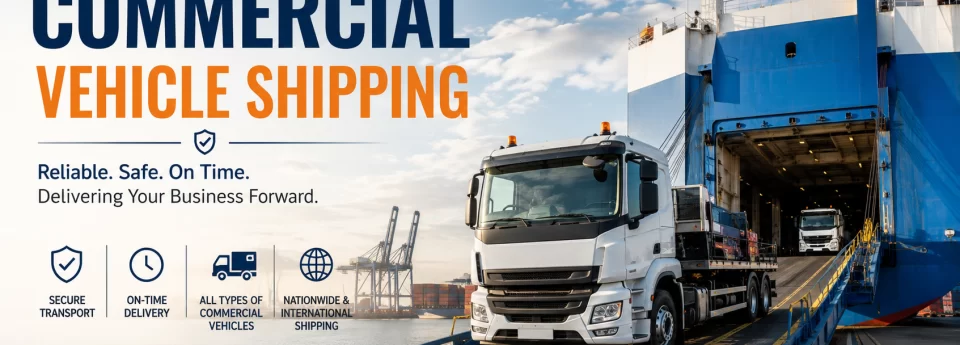
Commercial Vehicle Shipping
Quick Answer: Ship Cars Ltd ships commercial vehicles internationally from the UK by RoRo, container, and European road freight. We handle vans, pickup trucks, tipper trucks, agricultural machinery, construction plant, ambulances, and fleet consignments to over 50 destinations. RoRo suits standard roadworthy vehicles; dedicated and open-top containers handle oversized, non-running, or high-value units. European road freight delivers in 2–7 working days. One point of contact manages your shipment from UK collection to destination clearance.
What Types of Commercial Vehicle Can We Ship?
Commercial vehicles are built for work. They are heavier, taller, longer, and more complex to ship than a standard passenger car and the consequences of getting the shipping arrangements wrong are rarely just inconvenient. For a business waiting on a tipper truck, a contractor expecting a fleet of pickups, or an operator who has purchased specialist equipment overseas, delays at the port mean lost income and disrupted operations.
At Ship Cars Ltd , commercial vehicle shipping is a service we have developed specifically to handle the demands that commercial operators bring to us. We ship vans, pickup trucks, minibuses, tippers, curtainsiders, flatbeds, plant machinery, agricultural equipment, and everything in between to destinations across the world and across Europe, every week. Our team understands the documentation, the port requirements, the dimension restrictions, and the customs processes that commercial vehicle shipments involve. We deal with it every day.
Whether you are exporting a single van to a buyer in West Africa, sending a fleet of pickups to a construction project in the Middle East, or importing specialist machinery from the USA, this page explains how we handle commercial vehicle shipping and what you can expect when you work with us.
What Counts as a Commercial Vehicle?
Commercial vehicles cover a broad range of types, and the shipping requirements vary accordingly. At Ship Cars Ltd, we regularly ship:
- Vans and panel vans — small, medium, and large; transit-style vans up to Luton box van size
- Pickup trucks — single cab, double cab, and flatbed configurations including high-demand models such as Toyota Hilux, Ford Ranger, Mitsubishi L200, and Isuzu D-Max
- Minibuses and people carriers — including wheelchair-accessible and adapted vehicles
- Tipper trucks — two-axle and three-axle configurations
- Curtainsider and box trucks — subject to container height and weight restrictions
- Refrigerated vehicles — reefer units and temperature-controlled vans
- Flatbed and dropside trucks
- 4×4 utility vehicles — Land Cruisers, Defenders, and similar working vehicles commonly shipped to Africa, the Middle East, and South Asia
- Ambulances and emergency vehicles — including both new and used units destined for overseas operators
- Agricultural machinery — tractors, telehandlers, combines, and attachments
- Construction plant — excavators, dumpers, rollers, and compact machinery
- Specialist equipment and non-standard vehicles — including anything that does not fit a standard category
If you are not sure whether we can ship your vehicle or machine, contact us and we will tell you honestly. If we can handle it, we will. If something is beyond our scope, we will say so.
Shipping Methods — RoRo, Container, and Road Freight

Commercial vehicle shipping uses three primary methods. The right choice depends on the type of vehicle, the destination, the dimensions, and the operator’s specific requirements.
RoRo (ROLL-ON/ROLL-OFF) vehicle shipping is the most widely used method for standard commercial vehicles that are in working order, fully operational, and within the height and weight parameters of RoRo terminal handling. On a RoRo service, the vehicle is driven directly onto a specialist vessel at the UK port and driven off at the destination port. No container is required.
RoRo is well-suited for:
- Vans, pickup trucks, and minibuses in working order with standard dimensions
- Light commercial vehicles shipping to destinations with established RoRo terminals
- High-frequency, cost-effective movements on well-served trade routes including West Africa, the Middle East, and parts of the Caribbean
The practical limitations of RoRo for commercial vehicles are worth understanding. Vehicles must be self-propelled and driveable. Height restrictions at most RoRo terminals apply — typically a maximum of around 4.5 metres, though this varies by vessel and terminal. Oversized or overweight vehicles that exceed RoRo handling parameters need alternative arrangements, and that is where container shipping comes in.
Real-world example: A UK-based NGO shipped six Toyota Land Cruiser 79-series pickup trucks to Mombasa, Kenya, via RoRo from the port of Tilbury. All six vehicles were in working order and within standard RoRo parameters. They were driven onto the vessel at Tilbury, sailed with a transit time of approximately 24 days, and arrived at Mombasa port on schedule. Local clearance was handled by our established Kenyan agent. All six vehicles were released and operational within eight working days of arrival.
Container Shipping for Commercial Vehicles
For commercial vehicles that are too large, too heavy, non-running, or otherwise unsuitable for RoRo, container shipping is the answer. We use both standard 20ft and 40ft containers, as well as high-cube containers (which provide an additional 30cm of internal height) and open-top containers for vehicles or machinery that exceeds standard container height.
Container configurations for commercial vehicles typically work as follows:
- Standard van or pickup — fits in a 20ft container, though a 40ft provides more loading flexibility for taller or longer configurations
- High-roof van or Luton box van — requires a high-cube container
- Two pickup trucks or vans — often loadable in a single 40ft container, reducing per-vehicle cost significantly on fleet shipments
- Tippers, flatbeds, and larger trucks — assessed individually; open-top containers or flat-rack container services are available for oversized configurations
- Agricultural and plant machinery — varies enormously by type; our team will advise on the most appropriate container configuration at the point of enquiry
For non-running commercial vehicles — vehicles that cannot be started or driven — we use forklift or winch loading at our depot. We will confirm the handling method appropriate for your vehicle when you contact us.
Customer experience: A dealership in the West Midlands regularly exports used Toyota Hilux double-cabs to buyers in Dubai via 40ft container from Felixstowe — typically two vehicles per container. Our team manages the UK export customs clearance, loading and securing, Bill of Lading instructions, and destination agent coordination at Jebel Ali on every shipment. The dealership’s comment: “Straightforward every time. We know the trucks will arrive in the condition they left in.”
Marine Insurance: Total Loss cover at 1% of declared vehicle value; Comprehensive cover at 1.5% (vehicles under 10 years). For agricultural machinery and plant equipment, specialist cargo insurance may be required — our team will advise at the point of booking.
Road Freight — Commercial Vehicle Shipping to Europe

For commercial vehicles being shipped to European destinations — including France, Germany, the Netherlands, Belgium, Spain, Italy, Poland, and beyond — road freight is typically the fastest and most practical method.
We arrange road freight collection from any UK address, with transit to European destinations typically taking between 2 and 7 working days depending on the destination country and service level. Both standard and express options are available.
Road freight for commercial vehicles to Europe does not require container loading or port processing. The vehicle is collected, transported directly by road freight carrier to the European destination, and delivered. Post-Brexit customs documentation for commercial vehicle exports to the EU — including export declarations, commercial invoices, and CMR consignment notes — is handled in full by our team.
Road freight is particularly well-suited for:
- Urgent or time-sensitive commercial vehicle deliveries to European buyers or operators
- Fleet movements to European construction sites or operations
- Single vans, trucks, or pickups where speed of delivery is the priority
- Non-RoRo-eligible vehicles heading to European destinations where a container port booking is unnecessary
Fleet Shipping — Multiple Vehicles, One Coordinator
One of the most common requirements we handle for commercial operators is fleet shipping — moving multiple vehicles to the same destination as part of a single project or ongoing export programme. Fleet shipments introduce a layer of planning complexity that single-vehicle movements do not: co-ordinating collection dates, ensuring all vehicles are export-ready simultaneously, managing shared container loading to maximise efficiency, and making sure every vehicle in the consignment clears destination customs without delay.
At Ship cars ltd we manage fleet shipments as a single coordinated operation. One point of contact, one document set, one Bill of Lading covering the consignment — and a team that monitors the movement from UK collection through to destination release.
We have handled fleet shipments ranging from two vehicles to over twenty, covering destinations including West Africa, the Middle East, East Africa, the Caribbean, and South Asia. For repeat operators — dealerships, NGOs, construction companies, and plant hire businesses — we work on an ongoing basis, handling each new consignment as a continuation of an established process rather than starting from scratch every time.
Real-world example: An agricultural equipment supplier in Lincolnshire shipped a consignment of four Massey Ferguson tractors and two telehandlers to Dar es Salaam, Tanzania, via flat-rack and open-top container services from Tilbury. Our team arranged appropriate container types for each unit, managed export customs clearance for the full consignment, and coordinated with our Tanzanian agent for port clearance and delivery. The full consignment was released from Dar es Salaam port within eleven working days of arrival.
What Documents Do I Need for a Commercial Vehicle Export?
Every commercial vehicle export from the UK requires a clear and accurate document set. The specific requirements vary by destination, but the core documentation for most international commercial vehicle shipments includes:
- V5C Logbook — proof of ownership and vehicle registration details; Section 11 completed for DVLA permanent export notification
- Bill of Sale / Commercial Invoice — required for UK export customs clearance and destination duty assessment; must accurately reflect the transaction value
- EORI Number — required for all commercial exporters making export declarations to HMRC; if you do not have one, our team will advise on registration
- Passport or Company ID — for both exporter and consignee
- Packing List — for container shipments declaring the vehicle(s) and any additional cargo
- Dangerous Goods Declaration — required for vehicles with large fuel tanks, electric drivetrains, or hydraulic systems that classify as hazardous under international maritime regulations
For destination-specific requirements — including import licences, pre-shipment inspection certificates (required for several African and South Asian destinations), and destination customs forms — our team will provide a full checklist for your route at the point of booking. Getting the paperwork right the first time is the single most effective way to avoid delays at the destination port.
Which Commercial Vehicle Shipping Routes Do You Serve?
We handle commercial vehicle shipments on regular weekly sailing schedules from UK ports including Tilbury, Felixstowe, and Southampton. Our most active commercial vehicle shipping routes include:
| Destination | Method | Approx. Sea Transit |
|---|---|---|
| Lagos / Apapa, Nigeria | RoRo or Container | 15–21 days |
| Mombasa, Kenya | RoRo or Container | 24–27 days |
| Dar es Salaam, Tanzania | Container | 21–41 days |
| Jebel Ali (Dubai), UAE | RoRo or Container | 18–28 days |
| Karachi, Pakistan | Container | 20–28 days |
| Chittagong, Bangladesh | Container | 25–35 days |
| Houston / New York, USA | Container | 9–10 days |
| Kingston, Jamaica | RoRo or Container | 21 days |
| Durban, South Africa | Container | 22-46 days |
| Colombo, Sri Lanka | Container | 25–32 days |
Transit times shown are sea voyage only and do not include UK collection, port processing, or destination customs clearance. Our team will always provide a realistic door-to-door timeline at the point of enquiry.
Why Choose Ship Cars for Commercial Vehicle Shipping?
We are a specialist vehicle shipping company. Commercial vehicles are not a secondary service we offer alongside general freight — they are a core part of what we do, and the experience we have built across commercial vehicle shipping routes, documentation requirements, and destination port processes reflects that.
When you work with us, you get a team that knows the difference between a standard RoRo movement and a flat-rack container booking. A team that understands what a pre-shipment inspection certificate is and which destinations require one. A team that has handled fleet movements for NGOs, dealerships, construction businesses, and plant operators — and knows what it takes to get a consignment through the port cleanly at the other end. Straight talking. Accurate pricing. No surprises. That is what commercial operators need — and that is what we deliver.
Explore our specialised shipping pages:
-
For secure, versatile transport options: International Container Shipping
-
Learn essential preparation steps: How to Prepare Your Car for Shipping and Preparing Your Car for Export
-
Understand potential challenges: Top 10 Mistakes People Make During International Car Shipping
-
Ensure safe transit: How to Avoid Damage with International Shipping
Frequently Asked Questions — Commercial Vehicle Shipping
What types of commercial vehicle can Ship Cars ship internationally?
We ship vans and panel vans, pickup trucks (Toyota Hilux, Ford Ranger, Mitsubishi L200, Isuzu D-Max), minibuses, tipper trucks, curtainsider and box trucks, refrigerated vehicles, flatbed and dropside trucks, 4×4 utility vehicles, ambulances, agricultural machinery (tractors, telehandlers, combines), and construction plant (excavators, dumpers, rollers). Contact us for specialist or non-standard vehicles — if we can handle it, we will tell you clearly.
Can I ship a van or pickup truck via RoRo?
Yes — most standard roadworthy vans and pickup trucks qualify for RoRo. The vehicle must be driveable and within the height parameters for the specific RoRo terminal and route. Oversized vehicles, non-runners, or units exceeding standard deck clearance require container shipping. Contact us with your vehicle’s dimensions and we’ll confirm the right method for your route.
Can you ship non-running or oversized commercial vehicles?
Yes. Non-running vehicles are loaded by forklift or winch at our UK depot and shipped by dedicated container. Oversized vehicles including large agricultural machinery and construction plant are handled using flat-rack or open-top containers. Contact us with your vehicle’s dimensions, weight, and destination for a bespoke loading and routing assessment.
How do you handle fleet shipments of multiple commercial vehicles?
Fleet shipments are managed as a single coordinated operation — one point of contact, one document set, and one Bill of Lading covering the full consignment. We coordinate UK collection dates, shared container loading to maximise efficiency, full UK export customs clearance, and destination agent coordination. We have handled fleets from two vehicles to over twenty on a single shipment.
How long does commercial vehicle shipping take from the UK?
Sea freight transit times from UK ports: Nigeria (Apapa) 18–25 days; Kenya (Mombasa) 22–28 days; Tanzania (Dar es Salaam) 25–30 days; UAE (Jebel Ali) 18–28 days; Pakistan (Karachi) 20–28 days; USA 15–22 days; South Africa (Durban) 25–35 days. European road freight: 2–7 working days. All sea freight times are port-to-port only — door-to-door timelines are confirmed at the point of booking.
What documents do I need to export a commercial vehicle from the UK?
Core requirements: V5C logbook (Section 11 for DVLA permanent export notification); Bill of Sale/commercial invoice with declared value; EORI number (register free at gov.uk/eori); passport or company ID; packing list for container shipments; Dangerous Goods Declaration for vehicles with large fuel tanks, EV drivetrains, or hydraulic systems. Destination-specific requirements — pre-shipment inspection certificates, import licences — are confirmed at the point of booking.
Do I need an EORI number to export a commercial vehicle from the UK?
Yes. An EORI number is required for all commercial vehicle exports from the UK. Register for free at gov.uk/eori — typically takes a few days. If your business doesn’t have one yet, our team will flag this at the booking stage and guide you through the registration process.
Can you deliver a commercial vehicle to Europe without a container?
Yes. For European destinations — France, Germany, the Netherlands, Belgium, Spain, Italy, Poland, and beyond — we arrange direct enclosed road freight in 2–7 working days. No container or port processing is required. Post-Brexit export documentation including export declarations, commercial invoices, and CMR consignment notes is handled in full by our team.


