


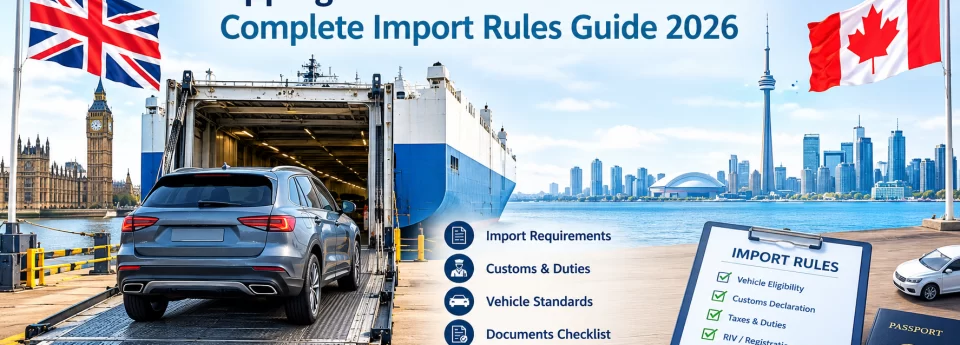
Shipping a Car From The UK to Canada: Complete Import Rules Guide 2026
Shipping a car from the UK to Canada involves two separate compliance processes: Canadian customs clearance with the CBSA, and a federal safety inspection under the Registrar of Imported Vehicles (RIV) programme for vehicles under 15 years old. Vehicles manufactured 15 or more years ago bypass most compliance requirements. UK right-hand drive vehicles are not universally prohibited but face additional provincial scrutiny — check your specific destination province before shipping. ShipCars operates RoRo services to Halifax, Canada’s closest major port to the UK at 6 to 11 days ocean transit.
Shipping Your Vehicle To Canada: Regulations & Restrictions
Shipping your vehicle to Canada involves navigating a well-defined set of federal regulations designed to protect public safety and the environment. Unlike some destinations, Canada’s restrictions are less about biosecurity and more about vehicle compliance, safety standards, and import admissibility.
At ShipCars, we specialise in guiding customers through the precise requirements of Transport Canada and the Canada Border Services Agency (CBSA). This definitive guide details the critical restrictions and compliance rules you must understand for a successful vehicle importation. ShipCars operates RORO services from UK ports to Halifax (Nova Scotia) — the fastest North America port at 6 to 11 days ocean transit. Halifax is also significantly closer to most Canadian population centres than US East Coast alternatives.
For a confirmed UK-to-Canada shipping rate, contact ShipCars at 01495 320540 or use the quote form. Rates depend on vehicle size, departure date, and whether RoRo or container shipping is used.
How Does The Governing Bodies Work For Import
Two primary federal agencies oversee the import of vehicles into Canada. Knowing their roles is the first step.
- Transport Canada: This department sets the Motor Vehicle Safety Standards that all vehicles driven in Canada must meet. They determine if a vehicle is eligible for import.
- Registrar of Imported Vehicles (RIV): This is the body appointed by the Canadian government to administer the federal inspection process for most imported vehicles. The RIV program ensures your vehicle is modified to meet Canadian standards.
- Canada Border Services Agency (CBSA): This agency handles the customs clearance, collects any applicable duties and taxes, and verifies your vehicle’s admissibility at the port of entry.
- Canadian import duty on UK vehicles: Most passenger vehicles imported from the UK attract Canadian customs duty of 6.1% of the vehicle’s customs value, plus 5% federal GST. Provincial sales tax is assessed separately at registration. Verify the current applicable rate with a CBSA licensed customs broker as rates are subject to change.
Authority Links:
- Transport Canada – Importing a Vehicle
- Registrar of Imported Vehicles (RIV) – Official Website
- Canada Border Services Agency (CBSA)
The 15-Year Import Rule: The Most Significant Restriction
Canada’s most famous and often misunderstood regulation is the “15-Year Rule.” This is not a blanket ban but a specific exemption from certain compliance requirements.
What the Rule Actually States
The Motor Vehicle Safety Regulations generally prohibit the importation of vehicles that do not conform to Canadian Motor Vehicle Safety Standards (CMVSS). However, a vehicle that is 15 years old or older (calculated from the month and year of its manufacture) is exempt from complying with most of these specific standards.
- What it means for you: If your vehicle was manufactured 15 or more years ago, it is typically much easier to import. It is generally not required to be modified to meet Canadian safety standards and does not need to go through the full RIV inspection process.
- Key Consideration: The vehicle must still be in safe operating condition to be licensed and insured in its destination province. It must also comply with any provincial regulations.
Vehicles Under 15 Years Old
For vehicles less than 15 years old, the rules are strict. They must comply with the CMVSS at the time of manufacture. For most modern vehicles from the UK, EU, and US, this is often possible but requires verification and potentially modifications.
What Are The Steps For Registrar of Imported Vehicles (RIV)
For vehicles under 15 years old, the RIV process is mandatory. It is a step-by-step procedure that must be followed precisely.
Step 1: Check RIV Admissibility Before Shipping
The single most important step is to verify your vehicle is on the RIV List of Eligible Vehicles. This list details the makes, models, and model years that are admissible for import into Canada.
- Action: Use the search tool on the RIV website to confirm your vehicle’s eligibility. Shipping a non-admissible vehicle will result in it being refused entry and you being forced to re-export it at your own cost.
Authority Link: RIV – List of Eligible Vehicles
Step 2: US-Specification Vehicles Restriction
This is a critical restriction. With very few exceptions (e.g., vehicles owned for 12+ months while residing in the US), you cannot import a vehicle originally manufactured for the US market into Canada unless it is already compliant with Canadian standards. This is due to a mutual recognition agreement between the two countries. Most UK and European-specification vehicles are admissible, provided they are on the RIV list.
Step 3: Required Documentation
You must present the following documents to the CBSA officer at the border:
- Proof of Ownership: The original vehicle title (V5C logbook for UK vehicles) or a certified copy.
- Bill of Lading: The shipping document provided by us, proving how the vehicle arrived.
- Vehicle Recall Clearance: For vehicles from the United States, you must provide proof from the manufacturer that there are no outstanding safety recalls. For vehicles from other countries, this may not be required, but it is best to check.
- RIV Form 1: This form will be provided by the RIV once you have paid their fees and started the process. The CBSA officer will stamp this form.
For the UK-side export process — DVLA notification, HMRC export declaration, and UK port handling — see the complete guide to exporting a car from the UK.
Step 4: The Federal Inspection
After the vehicle clears customs, you have 45 days to get it to a designated RIV inspection station (often a Canadian Tire location) for a federal inspection. This inspection verifies that:
- The Vehicle Identification Number (VIN) matches the documentation.
- All required modifications (e.g., daytime running lights, child seat anchorages, speedometer in km/h) have been completed.
- The vehicle is in a safe condition.
Once it passes, the RIV will issue a federal inspection sticker, which must be affixed to the vehicle.
Not sure if your specific vehicle qualifies for Canadian import? ShipCars can check your vehicle against the RIV eligible vehicles list and advise on likely modifications before you commit to shipping.
Call 01495 320540 or use the free quote form; we respond within 30 minutes during business hours.
What Are The Vehicle Modification Requirements For Shipping To Canada
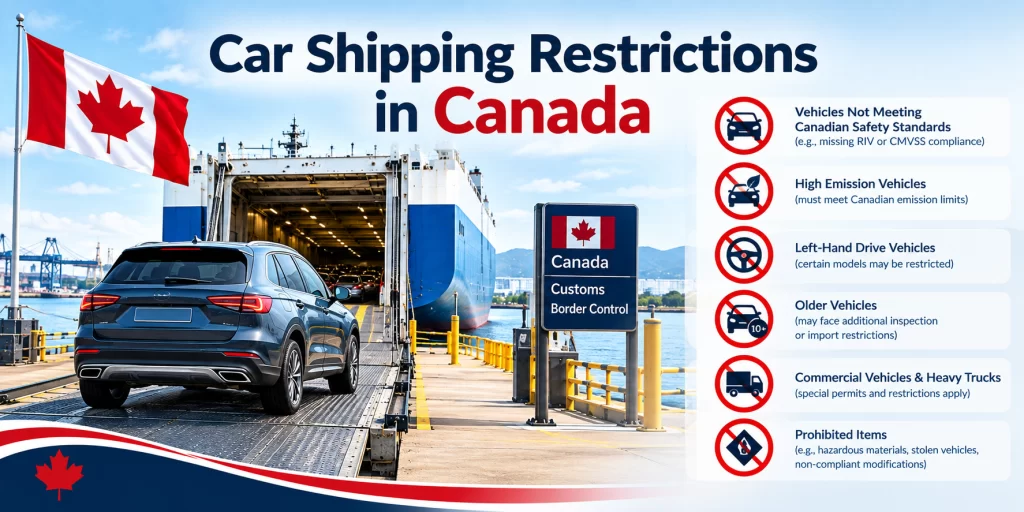
For vehicles under 15 years old to pass the RIV inspection, they often require specific modifications to comply with CMVSS. The most common include:
- Daytime Running Lights (DRLs): Most vehicles must be equipped with DRLs that automatically activate when the vehicle is started.
- Child Seat Tether Anchorages: For vehicles manufactured after September 1, 1999, specific anchorages for child restraint systems are mandatory.
- Speedometer: The primary scale on the speedometer must display kilometres per hour (km/h). Miles per hour (mph) can be present on a secondary scale.
- French Labels: Certain safety information labels (e.g., for airbags, sun visor warnings) may need to be in both English and French.
- Anti-Theft Standards: The vehicle must meet Canadian anti-theft standards, which may require an immobiliser or alarm system.
Provincial Registration & Licensing
Passing the federal RIV inspection is only one part of the process. You must also register and license the vehicle in your province of residence (e.g., British Columbia, Ontario, Alberta). This involves:
- Provincial Safety Inspection: Most provinces require their own, more detailed, mechanical safety inspection. This is separate from the federal RIV inspection and often more comprehensive.
- Insurance: You must secure Canadian auto insurance before you can register the vehicle.
- Paying Provincial Sales Tax (PST/HST): You will be required to pay the provincial sales tax (or Harmonised Sales Tax) based on the vehicle’s value when you register it.
Prohibited & Restricted Vehicles
Certain types of vehicles are extremely difficult or outright prohibited from being imported.
- Vehicles Not on the RIV List: As stated, this is the primary reason for refusal.
- Stolen Vehicles: Any vehicle reported as stolen will be seized.
- Irreparably Damaged or Unsafe Vehicles: Vehicles that are unfit for safe operation will be denied entry.
Right-Hand Drive (RHD) Vehicles from the UK
All UK-registered vehicles are right-hand drive. Canada drives on the right, which raises a legitimate question every UK buyer has before committing to a shipment.
The federal position is that RHD vehicles are not universally prohibited in Canada. However, the situation at provincial level is more nuanced and varies significantly:
Ontario, Quebec, and most prairie provinces generally allow RHD vehicles to be registered with additional inspection requirements. British Columbia has historically been the most accommodating province for RHD vehicles, and many Japanese domestic market imports have been registered there. Alberta has specific requirements around RHD compliance that must be checked before shipping.
The practical implication for UK buyers is this: verify with the specific province you intend to register in before shipping your right-hand drive UK vehicle. Do not assume federal admissibility means provincial registration will be straightforward. ShipCars recommends contacting a Canadian customs broker with provincial expertise before proceeding with any RHD shipment from the UK.
What Should Be The Pre-Shipment Action Plan for Canada
To ensure your vehicle clears Canadian customs and is legal for the road, follow this essential checklist:
- VERIFY ELIGIBILITY: Use the official RIV website to confirm your vehicle’s make, model, and year are on the List of Eligible Vehicles. Do not ship until this is confirmed.
- CHECK THE VEHICLE’S AGE: If it is 15 years or older, your process will be significantly simpler, primarily involving customs clearance.
- RESEARCH MODIFICATIONS: For vehicles under 15 years, identify what modifications (DRLs, speedometer, etc.) will be required to pass the RIV inspection and budget for them.
- GATHER DOCUMENTATION: Ensure you have the original title (V5C), bill of lading, and any other relevant ownership history.
- CONSULT YOUR PROVINCE: Research the specific safety inspection, insurance, and tax requirements for your destination province.
- INFORM YOUR SHIPPER: Provide us with all vehicle details and documentation so we can ensure a smooth customs brokerage process.
Ship Your Car to Canada With ShipCars
The team at Ship Cars Ltd is well-versed in the intricacies of the RIV program and CBSA procedures. We can advise on vehicle eligibility, handle the ocean freight, and work with our trusted Canadian customs brokers to ensure your vehicle’s entry is processed correctly. Our car shipping services from the UK to Canada via RoRo to Halifax and container shipping to Saint John. Fortnightly sailings take approximately 6–7 days transit . RoRo starts from £1,105 for a standard car.
Contact us today for a definitive shipping quote and let our expertise guide you through Canada’s vehicle import restrictions. Contact us today for further information or visit our sailing schedule and get an instant quote to schedule your car shipping with us.
FAQs — Car Shipping To Canada
What is the 15-year rule for importing a car to Canada?
Vehicles manufactured 15 or more years ago, calculated from the month and year of manufacture, are exempt from most Canadian Motor Vehicle Safety Standards compliance requirements. This means they generally do not need to go through the full RIV inspection programme and are significantly easier to import. They still require CBSA customs clearance and provincial registration. Verify the manufacture date against the month and year — not the registration date — when calculating eligibility.
Do I need an RIV inspection when importing a UK car to Canada?
Yes, if the vehicle is less than 15 years old. The RIV inspection is a federal requirement administered by the Registrar of Imported Vehicles. After customs clearance, you have 45 days to present the vehicle at a designated inspection station (commonly a Canadian Tire location) where the VIN is verified and required modifications are checked. Vehicles 15 years old or older are generally exempt from the full RIV process.
Can I import a right-hand drive UK car to Canada?
RHD vehicles are not universally prohibited at the federal level in Canada, but provincial registration requirements vary significantly. British Columbia has historically been more accommodating of RHD vehicles. Ontario and Quebec allow registration with additional requirements. Always confirm with your destination province’s vehicle registration authority before shipping a right-hand drive UK car to Canada — federal admissibility does not guarantee provincial registration.
How long does it take to ship a car from the UK to Canada?
ShipCars operates RoRo services to Halifax, Nova Scotia — the closest major Canadian port to the UK at 6 to 11 days ocean transit. For other Canadian destinations, vehicles typically continue by road from Halifax. Total time from UK booking to vehicle being available for provincial registration is typically 6 to 10 weeks, including customs clearance and RIV inspection scheduling.
What modifications are typically required for UK cars under 15 years old importing to Canada?
The most common modifications required to pass the RIV federal inspection include: daytime running lights that activate automatically with the ignition, a speedometer with kilometres per hour as the primary display (mph can appear as a secondary scale), child seat tether anchorages for post-1999 vehicles, French-language safety labels in some cases, and anti-theft compliance. The specific requirements depend on the vehicle’s make, model, and year — check the RIV list and consult a Canadian compliance specialist before shipping.
What is Canadian import duty on a UK car?
Most passenger vehicles imported from the UK attract Canadian customs duty of 6.1% of the vehicle’s customs value, plus 5% federal GST. Provincial sales tax is assessed separately at the time of registration in your destination province. Verify the current applicable rate with a CBSA-licensed customs broker before your shipment, as rates are subject to change.


