


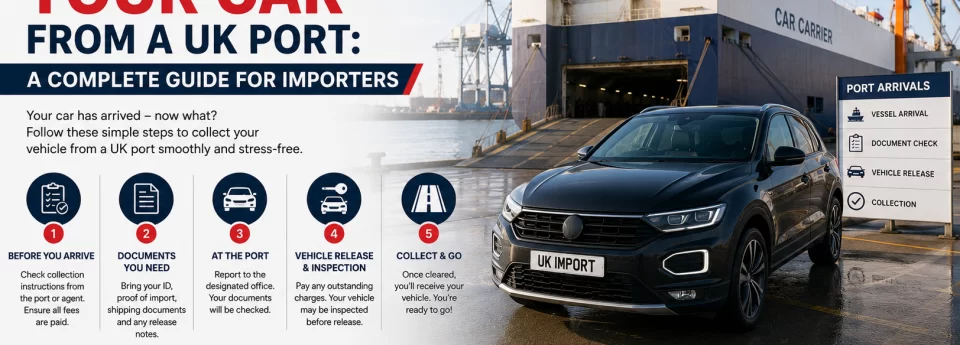
Collecting Your Car from a UK Port: A Complete Guide for Importers
Collecting an imported car from a UK port involves three stages: customs clearance by HMRC (24–72 hours with correct documents), choosing between a trade plate driver or vehicle transporter depending on your vehicle’s MOT status, and completing DVLA registration once the vehicle is with you. Vehicles over three years old require a valid MOT before being driven on UK roads. Port storage charges accrue daily once the free storage period ends — typically 3–5 days depending on the port.
At Ship Cars Ltd, we ensure our customers are fully informed. This definitive guide explains everything you need to know about collecting your imported vehicle from a UK port, including customs clearance times, MOT requirements, and the critical choice between driving it away or using a transporter.
The Customs Clearance Process: What to Expect
Before you can even see your vehicle, it must be cleared by HM Revenue and Customs (HMRC). This is a non-negotiable legal requirement.
How Long Does Customs Clearance Take?
This is the most common question, and the answer depends entirely on your preparation.
- With Complete & Correct Documentation: If all required documents are submitted accurately and in advance, clearance can be surprisingly swift, often taking as little as 24 to 72 hours after the ship arrives and the documents are presented.
- Causes for Delays: Clearance can be delayed by several days or even weeks if:
- Documents are incorrect, illegible, or missing.
- There is a discrepancy in the vehicle’s declared value.
- The vehicle requires a physical inspection by Border Force (this is random or triggered by risk factors).
- Payment of VAT and duty is delayed.
Proactive Tip: Work with a reputable shipping agent (like Ship Cars Ltd) who handles customs brokerage. We ensure all documentation is pre-checked and submitted correctly to minimise delays.
Authority Link: GOV.UK – Importing vehicles into the UK
Does Your Vehicle Need an MOT?
The need for an MOT is the primary factor determining how you can collect your vehicle. The rules are specific and must be followed precisely.
Vehicles That DO NEED a Valid MOT to be Driven from the Port
You must have a valid MOT certificate to drive the vehicle on public roads if:
- The vehicle is over 3 years old from the date of its first registration.
- You are driving it from the port to a destination that is not the nearest MOT testing centre (see exception below).
Consequence of Driving Without MOT: Driving without a valid MOT is illegal. You could be fined up to £1,000, have your insurance invalidated, and the police may seize the vehicle. You cannot tax the vehicle without an MOT.
The MOT Exemption for Direct Travel to a Pre-Booked Test
There is a single, strict exemption that allows you to drive a vehicle without an MOT to a testing centre.
- The Rule: You may drive a vehicle to a pre-booked MOT test appointment.
- The Conditions:
- You must have a confirmed, pre-booked appointment at an MOT testing centre.
- You are taking the direct route from the port (or storage location) to the test centre.
- You are not using this exemption as a pretext for a longer journey. Driving to your home or garage first is not permitted.
Authority Link: GOV.UK – MOT Guidance
Your Collection Options: Trade Plate Driver vs. Transporter
This is the core decision you need to make. The right choice depends on your vehicle’s MOT status, its condition, and your personal preference.
Option 1: Trade Plate Driver
This involves a professional driver using trade plates to collect and drive your vehicle to your specified address.
| Aspect | Description |
|---|---|
| How it Works | A licensed driver uses temporary trade plates, which provide third-party insurance cover, to drive your vehicle on public roads. |
| Best For | Vehicles that are road legal and have a valid MOT. Ideal for modern, running cars in good condition. |
| Pros | • Often more cost-effective than a transporter for a single vehicle. • Faster for direct journeys. • Vehicle arrives ready to use. |
| Cons | • Not suitable for vehicles without MOT (unless going directly to a pre-booked test). • Puts initial road miles on the vehicle. • Not suitable for non-runners or damaged vehicles. |
Option 2: Vehicle Transporter (Recovery Truck/Low Loader)
This involves having your vehicle collected on the back of a specialised transporter truck.
| Aspect | Description |
|---|---|
| How it Works | The vehicle is winched or driven onto a transporter truck and carried to its destination. |
| Best For | • Vehicles without an MOT. • Non-running vehicles (projects, non-starters). • High-value, classic, or fragile cars you do not wish to drive. • Vehicles arriving without UK-specifications (e.g., headlights). |
| Pros | • Completely legal for any vehicle, regardless of MOT status. • Zero wear and tear or road miles. • Highest level of protection and security. |
| Cons | • Generally more expensive than a trade plate driver for a single, running car. • Requires more coordination for loading/unloading. |
Summary: If your vehicle has an MOT and is driveable, a trade plate driver is a good option. For any vehicle without an MOT, a transporter is your only legal and safe choice (unless going directly to a pre-booked MOT test).
How to Avoid Port Storage Charges
Once your vehicle arrives at the UK port, a free storage period begins — typically 7 days for RoRo shipments and 7 days for container shipments, though this varies by port and terminal operator. After the free period ends, daily storage charges accumulate automatically. At major UK ports including Sheerness and Southampton, container storage charges typically start at £75–£90 per day and increase after the first week. On a busy shipment with documentation delays, these charges can add several hundred pounds to your total cost.
How to avoid storage charges:
- Ensure all customs documentation is submitted to your shipping agent before the vessel arrives — not after
- Appoint a customs broker in advance so there is no delay between vessel arrival and clearance submission
- Book your trade plate driver or transporter in advance for the day customs clearance is expected — not after you receive the notification
- If your vehicle needs an MOT, book the appointment before arrival so transport can be arranged immediately on clearance
Ship Cars notifies customers as soon as customs clearance is granted, with same-day or next-day collection arrangements to minimise storage exposure.
Who is Allowed to Collect the Vehicle?
You cannot simply turn up at the port and drive away. Ports are high-security commercial areas.
- The Shipping Agent or Customs Broker: This is the most common method. As your appointed agent, we will handle the entire collection process on your behalf. We instruct the trade plate driver or transporter, who will have the necessary paperwork and port access permits.
- A Professional Driver/Transporter Company: You can instruct a separate company, but they must be approved by the port authority and have the correct documentation, including:
- The Bill of Lading (or a delivery order).
- Proof of identity.
- Vehicle collection note from the agent.
- The Owner (You): It is highly unusual and often impractical for a private individual to collect a vehicle directly from the port terminal. You would need prior arrangement, a port pass, and all the original shipping documents. Most ports strongly discourage this due to security, insurance, and safety protocols. We handle this professionally to avoid any issues.
Your Step-by-Step Action Plan for a Smooth Car Collection
- Pre-Arrival: Confirm Documentation & MOT Status
- Ensure you have provided all necessary documents to your shipping agent for customs clearance (e.g., proof of ownership, commercial invoice).
- Determine your vehicle’s MOT requirement. If it needs one, book your test appointment in advance for shortly after the expected collection date.
- Customs Clearance: Await Release
- Your shipping agent will notify you once HMRC has cleared the vehicle and any VAT/duties have been paid.
- Do not attempt to arrange collection until you have received this “clearance” notification.
- Arrange Collection: Choose Your Method
- With MOT: Decide between a trade plate driver or transporter.
- Without MOT: Your only practical and legal option is to book a transporter.
- Vehicle Handover & Inspection
- Upon collection, the driver will perform a visual inspection of the vehicle, noting any existing damage on a collection report. We recommend you do the same when the vehicle is delivered to you.
- Final Steps: Registration & Tax
- Once the vehicle is in your possession, you must register and tax it with the DVLA. You cannot do this until the vehicle is in the UK and has passed its MOT (if required).
Authority Link: GOV.UK – Vehicle Registration
Documents Required to Release Your Vehicle from the UK Port
The port terminal will not release your vehicle to anyone without the correct documentation. These must be presented by your shipping agent, trade plate driver, or transporter at the port gate:
- Original Bill of Lading or a Delivery Order issued by the shipping line — the most critical document. The original must be surrendered to the terminal in exchange for the vehicle. A copy is not accepted.
- Customs clearance confirmation — proof that HMRC has cleared the vehicle and all applicable duty and VAT has been paid
- Vehicle collection note — issued by the shipping agent (ShipCars provides this) authorising the named driver to collect the vehicle
- Photo ID of the collecting driver
- Port access pass — the terminal will issue this to the authorised collection party on the day
Ship Cars manages this documentation on behalf of our customers. We instruct the trade plate driver or transporter with the complete document pack so there are no delays at the port gate.
Registering and Taxing Your Imported Vehicle with the DVLA
Once your vehicle is with you, registration with the DVLA is required before it can be used on UK roads with UK plates.
What you will need:
- Completed V55/5 form (application to register a vehicle) — available from DVLA or main post offices
- Original foreign registration document (the equivalent of a V5C from the country of export)
- Customs clearance certificate confirming duty and VAT were paid or relieved
- Valid MOT certificate (required for vehicles over three years old before registration can be completed)
- UK insurance certificate — the vehicle must be insured before it can be taxed
- Payment of Vehicle Excise Duty (VED) — road tax, payable at DVLA or via gov.uk
Important: You cannot tax a vehicle without a valid MOT, and you cannot legally drive it on a public road without both. If your vehicle arrived without an MOT, arrange the MOT first before applying for registration.
Source: GOV.UK — Register a vehicle you’ve imported into the UK.
Let Ship Cars Ltd Handle Your Port Collection
We manage the entire process for you, from customs clearance to arranging the perfect collection method for your vehicle’s needs. We offer both trade plate driver and transporter services to ensure your car is delivered to you legally and safely.
Contact us today to discuss your vehicle import and let us take the stress out of port collection.
Frequently Asked Questions – Car Collection From a UK Port
How long does customs clearance take for an imported car at a UK port?
With all documentation correct and submitted in advance, customs clearance typically takes 24–72 hours after the vessel arrives and documents are presented. Delays occur when documents are missing, contain errors, or when Border Force selects the vehicle for physical inspection. Appointing a customs broker — like Ship Cars — to pre-check and submit documents significantly reduces clearance time.
Can I drive my imported car directly from the UK port?
Only if the vehicle has a valid MOT and is road legal. Vehicles over three years old require a valid MOT to be driven on UK public roads. Without a valid MOT, the vehicle must be transported by a vehicle transporter rather than driven. The only exception is driving directly to a pre-booked MOT test appointment on the most direct route.
How much do port storage charges cost?
Free storage periods vary by port and terminal but are typically 3–5 days for RoRo shipments and 5–7 days for container shipments. After the free period, daily storage charges apply — typically £30–£60 per day for containers at major UK ports, increasing after the first week. Ensuring documentation is ready before the vessel arrives is the most effective way to avoid storage charges.
Can I collect my car from the port myself?
In most cases this is impractical and inadvisable. UK port terminals are restricted commercial areas. Private individuals cannot walk into a port terminal — port access requires passes, and the vehicle can only be released against the original Bill of Lading by an authorised party. ShipCars manages the entire collection process on your behalf.
What is a trade plate driver?
A trade plate driver is a licensed professional carrying trade plates that allow them to legally drive your vehicle on UK public roads without it being taxed or insured in your name. Trade plate drivers carry their own third-party insurance covering the vehicle while in their charge. The vehicle must have a valid MOT and be in roadworthy condition for this option.
Do I need insurance before collecting my car from the UK port?
You will need insurance in place before the vehicle is driven on UK public roads. If using a trade plate driver service, their insurance covers the vehicle during the driven collection. Once the vehicle is delivered to you, UK motor insurance in your own name is required before the vehicle can be driven further or registered with the DVLA.
What documents does the port need before releasing my car?
The terminal requires the original Bill of Lading (or a delivery order from the shipping line), proof of customs clearance, a vehicle collection note from the shipping agent, and photo ID of the collecting driver. Ship Cars provides all necessary documentation to the collection driver as part of our service.


