


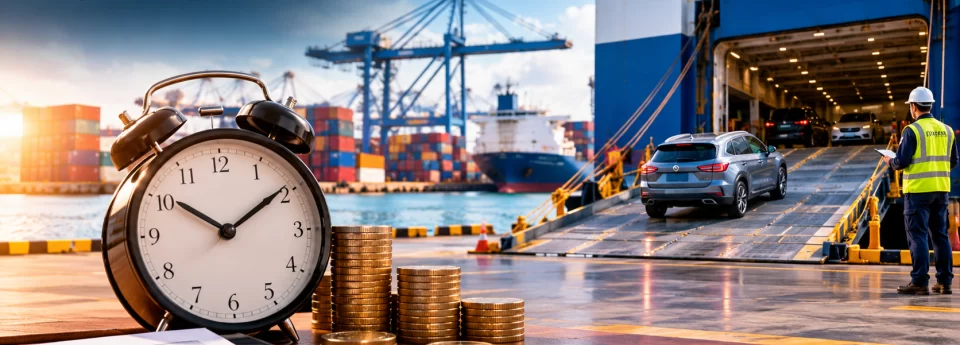
How to Avoid Demurrage Charges: A Complete Guide for Vehicle Shippers
Quick Answer: Demurrage is a daily fee charged by a port terminal when a vehicle or container is not collected within the allotted free time after a vessel arrives. Free time is typically 3–7 days and includes the time needed for customs clearance. Once free time expires, charges of £50–£200 per day accumulate — including weekends and public holidays — and must be paid in full before your vehicle is released. Demurrage is one of the most common hidden costs in international car shipping and is almost entirely avoidable with the right preparation.
What Is Demurrage in International Car Shipping?
Demurrage is a port storage fee applied when a vehicle or shipping container remains at a port terminal beyond the free time period granted after the vessel docks. It is charged by the port authority — not by your shipping company — and is the legal responsibility of the cargo owner.
Think of a port terminal as a highly secure, paid car park. They offer a limited period of free parking for you to collect your vehicle after arrival. Once that free period ends, the meter starts running — and it runs every day, including weekends and public holidays, until your vehicle leaves the terminal.
Key characteristics of demurrage:
- Accrues daily — charged for every calendar day the vehicle remains in port after free time expires, including weekends and public holidays
- Escalates over time — the daily rate often increases after the first 5–7 days, making prolonged delays extremely expensive
- Non-negotiable — once incurred, demurrage must be paid to the port authority before your vehicle is released; charges are legally enforceable
- Separate from shipping costs — demurrage is a port charge, not a shipping company charge; it is the cargo owner’s responsibility to avoid it
What Is the Difference Between Demurrage and Detention?
These two terms are often confused. Both are port-related fees, but they apply to different situations:
| Term | What It Means | When It Applies |
|---|---|---|
| Demurrage | Charges for a container or vehicle sitting inside the port terminal too long after the vessel arrives | The most common issue for car shipping — applies to both RoRo and container shipments |
| Detention | Charges for holding a shipping container outside the port for too long after it has been collected | Less common for RoRo vehicle shipments; more relevant for container users who take the container off-site |
For RoRo car shipping and container car shipping, demurrage — charges inside the port — is the primary risk. Detention is less common but can apply if you are using a container and delay returning it to the port empty.
How Much Do Demurrage Charges Cost?
Demurrage fees vary by port and country, but as a general guide:
- Typical daily rate: £50–£200 per day
- Free time before charges begin: 3–7 days (this window includes the time needed for customs clearance)
- Escalation: Daily rates often increase after the first 5–7 days of chargeable time
- Two-week example: Over two weeks of demurrage, costs can easily reach £1,500–£2,000 — on top of your original shipping quote
These figures make demurrage one of the largest potential unexpected costs in international vehicle shipping, particularly for destinations with complex customs procedures.
For context on what a standard shipment costs before demurrage is ever a factor, see our car shipping cost guide.
What Is “Free Time” at a Port and How Does It Work?
Free time is the number of days you are granted to collect your vehicle from the port after the vessel docks, without incurring demurrage charges. It is typically 3–7 days — but this window is not as generous as it sounds.
The critical point most shippers miss: free time begins the moment the ship docks — not when customs clearance is complete. The customs process itself must happen within this window. If clearance takes 4 days and your free time is 5 days, you have one day to physically collect or arrange collection of your vehicle before charges begin.
This is why proactive customs clearance — ideally started before the vessel arrives — is the single most effective way to protect your free time.
What Causes Demurrage Charges on Car Shipments?
Understanding the causes of demurrage is the first step to preventing it. Most cases fall into one of four categories.
How Does Customs Clearance Cause Demurrage?
Customs clearance delays are the single biggest cause of demurrage. Your vehicle cannot be released from the port until it has been formally cleared by customs — and the clock runs throughout the clearance period.
The most common customs-related triggers are:
- Incomplete or incorrect documentation — a missing Bill of Lading, incorrect Commercial Invoice, or errors on the Certificate of Title will cause customs to reject the application and halt clearance
- Inaccurate vehicle valuation — declaring an incorrect value triggers a customs investigation; the vehicle is held until the value is verified
- Missing import permits or approvals — certain countries require specific permits before a vehicle can be imported (e.g. Tanzania’s CRF certificate, Canada’s RIV compliance). Arriving without these causes an immediate hold
How Do Documentation Errors Cause Demurrage?
Even when the vehicle itself is problem-free, paperwork errors cause delays:
- Bill of Lading issues — the Bill of Lading is the legal title document for your shipment; if the original is not available at the destination port, or if there are any discrepancies in the details, the port will not release the vehicle
- Communication failures — a breakdown in coordination between origin agent, shipping line, and destination agent leads to missed deadlines and unsubmitted paperwork
Why Does Not Having a Destination Agent Cause Demurrage?
Attempting to manage the import process yourself from abroad — without a licensed local representative — is one of the highest-risk decisions in international car shipping. Without a local agent:
- No one is physically available to respond to customs queries
- Documents cannot be submitted promptly
- Minor issues escalate into multi-day delays as you navigate a foreign bureaucracy remotely
A licensed destination agent with local knowledge and existing customs relationships is the single most effective insurance against demurrage.
How Do Timing Mistakes Cause Demurrage?
- Ignoring weekends and public holidays — if your vessel arrives on a Thursday, free time may run out before the customs office reopens after a long weekend
- Underestimating clearance time — even a straightforward customs clearance takes time; assuming it is instant leads to reactive rather than proactive management
How Do You Avoid Demurrage Charges? (Complete Checklist)
Avoiding demurrage is almost entirely about proactive preparation. Follow this three-stage checklist from the moment you book.
What Should I Do Before My Vehicle Ships? (The Most Critical Phase)
1. Appoint a reputable destination agent before your vehicle sails This is your single most important action. A good agent in the destination country will manage the entire clearance process on your behalf. Arrange this before your vehicle is loaded — not after.
2. Secure and check every required document Work with your shipping agent to confirm you have every document required for the destination country. The standard checklist includes:
- Original Bill of Lading (or a verified Telex Release)
- Commercial Invoice — accurate purchase price
- Original Vehicle Title (V5C Logbook for UK vehicles)
- Copy of your passport
- Any destination-specific import permits (e.g. Canada RIV compliance, Tanzania CRF certificate, Australia biosecurity clearance)
3. Verify document accuracy across every form Check that the vehicle identification number (VIN), owner name, declared value, and all other details are identical across every document. A single inconsistency — even a name spelling difference — can cause a week-long hold while customs investigates.
4. Declare an accurate vehicle value Use a fair, verifiable market value on the Commercial Invoice. Be prepared to provide supporting evidence (purchase receipt, market valuation) if customs request it. Undervaluation is a customs red flag and one of the most common triggers for extended holds.
What Should I Do While My Vehicle Is in Transit? (The Preparation Phase)
5. Send documents to your destination agent in advance As soon as origin documents are available, send them to your destination agent. This allows pre-clearance — the process of beginning customs formalities before the vessel arrives. Pre-clearance is the most effective way to protect your free time window.
6. Confirm Power of Attorney Ensure your destination agent holds a signed Power of Attorney or Letter of Authority granting them the legal right to act on your behalf with customs and the port authority. Without this, they cannot submit paperwork or make decisions on your behalf.
7. Track your vessel and know the ETA Monitor your vessel’s progress. Knowing the Estimated Time of Arrival (ETA) allows you and your agent to time the pre-clearance process accurately. Free tools like MarineTraffic allow you to track vessels by name or IMO number.
What Should I Do When My Vehicle Arrives? (The Execution Phase)
8. Authorise your agent to act immediately The moment the vessel arrives, your destination agent should proceed with final customs clearance and duty payment without waiting for further instruction from you. Brief them in advance.
9. Respond to your agent immediately If your agent contacts you for additional information — a document clarification, a value query, a signature — respond immediately. Any delay on your part translates directly into demurrage charges.
10. Have a collection plan ready Before the vessel docks, know how the vehicle will be collected from the port the moment it is released. Your destination agent can typically arrange this — confirm it in advance.
Can I Dispute Demurrage Charges Once They Are Applied?
This is exceptionally difficult. Port authorities’ terms and conditions are clear, and charges are applied automatically by terminal management systems. Disputes are rarely successful unless you can prove the delay was 100% the fault of the port authority or shipping line — for example, if the port itself lost your documentation.
The one exception: if your vehicle was selected for a random customs inspection, the inspection itself is not your fault. However, the port will still charge demurrage for every day your vehicle is held for that inspection. Having an experienced destination agent minimises the time spent in inspection because they can prepare compliant documentation in advance and respond to inspector queries immediately.
Prevention is the only reliable strategy. Once demurrage begins accruing, the cost is yours to pay before the vehicle is released.
How Does Ship Cars Ltd Help You Avoid Demurrage?
At Ship Cars Ltd, demurrage prevention is built into our service from the point of booking — not addressed as an afterthought when a vessel arrives.
How Does Ship Cars Ltd Handle Documentation?
We review and verify all UK-origin documents before your vehicle is loaded. Bill of Lading details, Commercial Invoice figures, and title documents are cross-checked for accuracy and consistency before departure. If a document issue is identified, we resolve it in the UK — not at the destination port where it would cost you free time.
Does Ship Cars Ltd Work with Destination Agents?
Yes. We maintain a global network of vetted destination agents who are specialists in local customs law and port procedures at the ports we serve. These are established relationships, not ad-hoc arrangements — our agents know exactly what each port and customs authority requires and are positioned to begin pre-clearance the moment documents are available.
How Does Ship Cars Ltd Coordinate Between Origin and Destination?
We manage the document handover to your destination agent well in advance of the vessel’s arrival, enabling pre-clearance. We also keep you informed of vessel ETA, document status, and what is needed from you at each stage — so there are no last-minute surprises that eat into your free time.
For route-specific information on what documents and permits are required before your vehicle sails — which is the foundation of demurrage prevention — see our destination guides:
- Car shipping to Australia — biosecurity and customs requirements
- Car shipping to Canada — RIV programme and documentation
- Car shipping to Tanzania — CRF inspection and customs clearance
- Car shipping to China — CIQ inspection and import process
- Car shipping to USA — documentation and port procedures
Frequently Asked Questions — Demurrage in Car Shipping
What is demurrage in simple terms?
Demurrage is a daily port storage fee charged when your vehicle is not collected from the port terminal within the free time period after the vessel arrives. Free time is typically 3–7 days and includes the time needed for customs clearance. Once free time runs out, charges of £50–£200 per day accrue — including weekends and public holidays — until the vehicle leaves the terminal.
Who is responsible for paying demurrage charges?
The cargo owner — the person importing the vehicle — is responsible for demurrage charges. They are a port authority fee, separate from your shipping company’s charges. They must be paid in full before the port releases your vehicle.
How long is free time at a port?
Free time is typically 3–7 days from the date the vessel docks. It varies by port, country, and shipping line. Critically, this window includes the time needed for customs clearance — it does not begin only after customs is complete. This is why pre-clearance (starting customs formalities before the vessel arrives) is essential.
What happens if I don’t pay demurrage?
Your vehicle remains held at the port terminal. Charges continue to accrue daily. In some cases, if demurrage goes unpaid for an extended period, the port authority has the right to auction the vehicle to recover outstanding charges. Always address demurrage immediately — delay makes the problem more expensive, not less.
Can a destination agent reduce demurrage charges?
Not once they are applied — but a good destination agent prevents them from accruing in the first place by managing pre-clearance, submitting paperwork promptly, responding to customs queries immediately, and having collection transport arranged before the vehicle is released.
Is demurrage the same as a storage fee?
In practice, yes — demurrage is the port’s charge for storing your vehicle beyond the free time window. Some ports use “storage fee” and “demurrage” interchangeably. “Detention” refers to holding a shipping container outside the port after it has been collected, which is a separate charge.


