


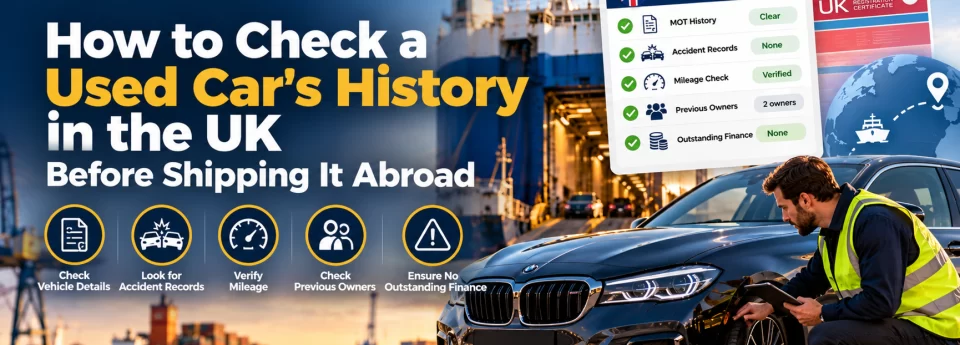
How to Check a Used Car's History in the UK Before Shipping It Abroad
If you are buying a used car in the UK to ship to another country, a vehicle history check is not optional — it is the foundation of a safe purchase. The checks themselves take less than 30 minutes and cost as little as £10–30 for a comprehensive report. Skipping them risks importing a car with outstanding finance (which the finance company can legally reclaim even from you as a new owner), a hidden write-off category, clocked mileage, or a stolen status.
Why Vehicle History Checks Matter for International Car Buyers
Buying a car in the UK and shipping it overseas is a significant financial commitment. By the time a vehicle arrives at its destination port, you have paid purchase price, shipping costs, import duties, and local compliance fees. If the car turns out to have undisclosed problems — outstanding finance, a hidden write-off, or clocked mileage — unwinding the deal from overseas is extremely difficult.
A thorough pre-purchase history check protects you from:
- Stolen vehicles: A car registered as stolen can be seized by police at any point — including at the destination country’s customs. You lose the vehicle and any money paid.
- Outstanding finance: If a vehicle has been purchased on finance in the UK, the finance company retains legal ownership until the debt is settled. If the seller has not cleared the finance, the lender can reclaim the vehicle — even from a legitimate buyer who paid in good faith.
- Undisclosed write-offs: A car written off by an insurer and repaired may be structurally compromised. Some destination countries refuse entry to previously written-off vehicles; others require declaration.
- Clocked mileage: Odometer fraud (artificially lowering the recorded mileage) is common in the used car market. MOT history records show mileage at each test — making discrepancies easy to spot.
- Misrepresented identity: A car may have had its VIN plate altered or its registration changed to conceal a stolen or written-off history.
- Previous usage: Former taxi, rental, or police fleet vehicles may have significantly higher wear than their mileage suggests, and some destination countries treat commercial-use histories differently at customs.
Ready to ship once you have found the right car? Get a free international car shipping quote →
Step 1 — Locate and Verify the VIN
The Vehicle Identification Number (VIN) is a 17-character alphanumeric code that is the unique identifier for every vehicle manufactured since the 1980s. All subsequent history checks are built around the VIN — and verifying it physically is the first step.
Where to find the VIN on the vehicle:
- Dashboard, visible through the windscreen on the driver’s side (stamped into the chassis)
- Driver’s doorjamb or door pillar (on a sticker or stamped plate)
- Engine bay (stamped or on a plate)
- V5C registration document (must match the vehicle)
- MOT certificate
- Insurance certificate
What to check:
- The VIN on the V5C must exactly match the VIN on the vehicle. Any discrepancy is a serious red flag.
- The VIN should not show signs of tampering — uneven stamping, fresh paint over the stamp, or a plate that looks re-applied.
- Run the VIN through a history check service (see Step 2) before paying a deposit.
Step 2 — Run a Comprehensive Vehicle History Check (HPI or Equivalent)
A paid vehicle history check is the most important single action you can take before purchasing a used car in the UK. These services query multiple databases — insurance write-off registers, the Police National Computer (stolen vehicles), finance registers, DVLA records, and mileage databases — and return a consolidated report.
What a comprehensive history check covers:
| Check | What it shows |
|---|---|
| Stolen status | Whether the vehicle is flagged as stolen on the Police National Computer |
| Outstanding finance | Whether the vehicle is subject to a finance agreement (HP, PCP, lease) |
| Write-off category | Whether the vehicle has been declared a total loss by an insurer |
| Mileage discrepancy | Whether recorded mileage is consistent across checks |
| VIN and plate changes | Previous number plate history and VIN verification |
| Import / export markers | Whether the vehicle has been previously imported or exported |
| Scrapped status | Whether the vehicle has been issued a Certificate of Destruction |
| Number of previous keepers | DVLA registered keeper count |
Main providers in the UK:
- HPI Check — the longest-established UK service; used by dealers and insurers
- Experian AutoCheck — runs similar database checks
- RAC Car Checks — includes additional dealer valuations
- Car Data Check — competitive pricing on standard checks
Cost: typically £10–30 for a full report. Given the value of most vehicles being imported, this is money that is never worth skipping.
⚠️ For imported vehicles being brought into the UK from abroad: The history check should be supplemented with records from the country of origin. Japanese domestic market (JDM) imports often come with Japanese auction sheets — cross-reference these against the VIN. European imports may have service histories in the vendor country’s language; ask for translation or use a specialist importer’s check.
Step 3 — Check the Free MOT History
The DVLA’s free MOT history service (gov.uk/check-mot-history) is one of the most valuable tools for any used car buyer. It shows the complete pass/fail record for every MOT test the vehicle has had since 2005, including:
- Pass or fail result at each test
- Mileage recorded at each test — essential for spotting clocked mileage
- Reason for failure at each failed test
- Advisory items noted at each test (things that were not failures but required monitoring)
- Expiry date of the current MOT
How to use it: Enter the vehicle’s registration number at gov.uk/check-mot-history. No payment required.
What to look for:
- Mileage progression: The mileage should increase consistently year on year. A sudden drop, a flat line, or a figure lower than a previous entry is a strong indicator of clocking.
- Repeated failures on the same item: Suggests a persistent mechanical problem that has been temporarily fixed rather than properly resolved.
- Gap in MOT records: A multi-year gap may mean the car was off the road, in storage, or being used abroad. Ask the seller to explain.
- Mileage vs. vehicle condition: If the MOT records show 120,000 miles but the seller claims 80,000, you have your answer.
MOT applies to vehicles three years and older. Vehicles under three years old will not have an MOT history.
Step 4 — Check the Vehicle Tax (VED) Status
The DVLA’s free vehicle enquiry service (vehicleenquiry.service.gov.uk) shows:
- Current tax status (taxed or untaxed)
- Tax expiry date
- Tax class (private light goods, taxi, disabled, historic, etc.)
- SORN status (whether the vehicle is declared off the road)
- MOT expiry date (cross-reference against the MOT history)
- Colour on DVLA record (cross-reference against the actual vehicle)
Why this matters for importers: The tax class can reveal prior commercial use — a vehicle taxed as a taxi or private hire vehicle has a very different usage profile from a private car, even if it has been re-registered as private by the time of sale.
Check at: vehicleenquiry.service.gov.uk — free, no registration required.
Step 5 — Understand UK Write-Off Categories
If a vehicle history check returns a write-off marker, you need to know what it means. UK insurers use four categories:
| Category | Meaning | Can it return to the road? |
|---|---|---|
| A | Scrap only — vehicle must be crushed | ❌ Never |
| B | Body shell must be crushed; some parts salvageable | ❌ Never (as a whole vehicle) |
| S | Structural damage — can be repaired and returned to the road if properly certified | ✅ Yes, with care |
| N | Non-structural damage — can be repaired and returned to the road | ✅ Yes |
Category A and B vehicles must never be exported. A vehicle with a Category A or B marker has been issued a Certificate of Destruction and should not exist as a driveable vehicle. If one is offered for sale, it is fraudulent.
Category S and N vehicles can be legitimately sold and, in principle, shipped — but:
- Many destination countries require declaration of write-off history at customs. Some may refuse entry.
- The repair quality of a Cat S vehicle should be assessed by an independent engineer before purchase.
- Marine cargo insurance for Cat S vehicles may be on different terms — ask your insurer.
Related: Shipping a damaged vehicle — RoRo and container options →
Step 6 — Check for Outstanding Finance
Finance is the most common hidden problem in the UK used car market. Under a Hire Purchase (HP) or PCP agreement, the finance company — not the registered keeper — is the legal owner of the vehicle until the final payment is made. The seller is not legally entitled to sell a vehicle they do not own.
If you buy a vehicle with outstanding finance and the seller defaults on the loan, the finance company can legally reclaim the vehicle from you — even if you paid the seller in full and in good faith. Your only recourse is against the seller, who may be untraceable.
How to check:
- A comprehensive history check (HPI, Experian AutoCheck) queries the finance register.
- Check the Finance & Leasing Association (FLA) consumer guidance at fla.org.uk for advice if you are in dispute.
If the vehicle has outstanding finance:
- Ask the seller to settle the finance before completion, with written confirmation from the lender.
- Or negotiate the purchase price net of the outstanding balance and pay the lender directly — but only with legal advice.
Step 7 — Verify Service History and Physical Condition
A vehicle history check covers database records. Physical condition and service history are the complementary checks that no database can provide.
Service history
Ask the seller for:
- Stamped service book or digital service records
- Invoices and receipts for servicing, repairs, and MOT-related work
- Recall completion records — check whether any manufacturer recalls have been carried out
Cross-reference the service history mileage against the MOT records. They should be consistent.
Physical inspection
For any vehicle you are purchasing to ship internationally, a pre-purchase inspection by an independent mechanic is strongly recommended — particularly if you are buying remotely without seeing the car yourself.
What to check physically:
- Bodywork: Look for paint colour mismatch between panels (sign of repair), uneven panel gaps, filler under a magnet, and rust around wheel arches, sills, and door bottoms.
- Interior wear vs. mileage: Heavy wear on the driver’s seat, steering wheel, and pedals that is inconsistent with the stated mileage.
- Engine bay: Fluid leaks (oil, coolant, brake fluid), corrosion on the battery terminals, evidence of steam cleaning to hide leaks.
- Tyres: Check tread depth on all four tyres and look for uneven wear, which suggests alignment or suspension problems.
- Electrics: Test all lights, windows, central locking, air conditioning, and the instrument cluster.
- Under the vehicle: Look for corrosion, impact damage, or evidence of repairs to the chassis or subframe.
A specialist pre-purchase inspection typically costs £100–250 and can save significantly more in avoided problems.
What These Checks Mean for International Car Importers
If you are buying a UK vehicle specifically to export — either as a personal vehicle for relocation, a collector’s car, or a commercial export — the same checks apply, with a few additional considerations:
- Previous import or export markers on the HPI report indicate the car has crossed a border before. This is not automatically a problem, but worth understanding — especially for JDM or US-import vehicles that have been re-registered in the UK.
- Write-off category must be checked against the destination country’s import rules before shipping. Some countries prohibit the import of any written-off vehicle regardless of category.
- Accurate V5C is essential for customs documentation. The V5C is the primary UK ownership document used in export declarations and bills of lading.
- Outstanding finance on a vehicle being exported is a serious complication — some shipping companies will not handle vehicles with unresolved finance disputes.
Ready to ship once your checks are complete? Get a free international car shipping quote →
Frequently Asked Questions
What is the most important check to run on a used car before shipping it from the UK?
A comprehensive paid history check (such as an HPI check) is the single most important check. It queries the stolen vehicle register, outstanding finance register, insurance write-off database, and DVLA records in one report. This typically costs £10–30 and takes minutes to obtain. Combine it with a free MOT history check (gov.uk/check-mot-history) for a complete mileage and condition record.
How do I check if a UK car has outstanding finance?
Run a paid vehicle history check through HPI, Experian AutoCheck, RAC Car Check, or a similar UK provider — these services query the finance register as part of a standard report. If finance is flagged, do not complete the purchase until the seller provides written confirmation from the lender that the debt has been discharged.
What do UK write-off categories A, B, S, and N mean?
Category A and B vehicles have been deemed unfit to return to the road and must be scrapped — never purchase or export these. Category S (structural damage, repaired) and Category N (non-structural damage, repaired) can legally return to the road and be shipped, but many destination countries require declaration of write-off status at customs, and some may refuse entry.
Is a free DVLA check enough, or do I need a paid history check?
The free DVLA vehicle enquiry service shows tax status, MOT expiry, and tax class — useful, but limited. The free MOT history service adds mileage and test records. Neither checks for stolen status, outstanding finance, or write-off history. For those, a paid history check is essential.
Can I check the history of a Japanese import or European import car in the UK?
Yes, but the UK databases only cover UK-registered history. For a JDM (Japanese domestic market) import, ask the seller for the original Japanese auction sheet and cross-reference with the VIN. For European imports, request service records from the country of origin. Once the car is UK-registered, UK history checks will show its post-import record.
What should I do if the VIN on the car doesn’t match the V5C?
Do not proceed with the purchase. A VIN mismatch is a serious red flag that suggests the vehicle may be stolen, cloned (using another vehicle’s identity), or have had its identity deliberately altered. Walk away and report the discrepancy to the police if you believe the vehicle is stolen.
How do I check whether a UK car has been previously written off?
Run a paid history check — HPI, Experian AutoCheck, and similar services query the insurance industry’s write-off database (managed by the Motor Insurers’ Bureau). The free DVLA and MOT services do not show write-off status. If the report returns a write-off marker, check the category (A, B, S, or N) and assess accordingly.
Why does it matter if a car was previously used as a taxi or rental vehicle?
Tax class on the DVLA record (visible through the free vehicle enquiry service) can reveal prior commercial use. Former taxis and rental vehicles typically accumulate significantly higher wear relative to their mileage, have had multiple drivers, and may have maintenance records that are less thorough than private ownership. Some destination countries treat commercial-use history differently at customs, and insurance or valuation may be affected.
Plan Your Shipping with ShipCars
Once your checks are complete and you have a clean vehicle, ShipCars handles the rest — UK collection, international sea freight by RoRo or container, marine cargo insurance, and destination support for countries worldwide.
Get a free international car shipping quote →
Related Guides
- How to ship a car from the UK to Australia →
- Shipping a damaged vehicle — RoRo and container options →
- How to photograph your car before shipping →
- RoRo car shipping explained →
- Container car shipping explained →
- Get a free shipping quote →


