


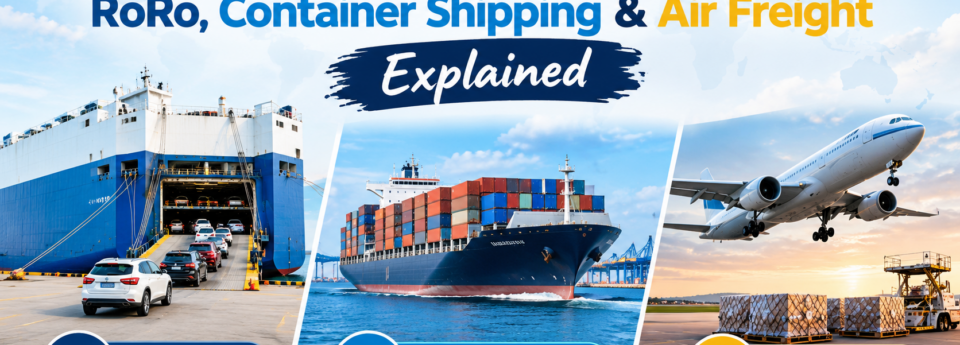
Car Shipping Methods: RoRo, Container Shipping & Air Freight Explained
ShipCars offers two main methods for international car shipping from the UK: RoRo (roll-on/roll-off) and container shipping. RoRo is the most cost-effective option for standard, driveable petrol and diesel vehicles — cars that are not electric and have no significant modifications. Container shipping is required for electric vehicles, non-running cars, high-value or classic vehicles, and any shipment where personal belongings are being included. Air freight is available for urgent shipments where speed outweighs cost.
Car Shipping Methods: RORO vs Container Shipping
Choosing the right method to ship your car is the most critical decision you will make in the process. The best option depends on your vehicle’s type, value, and destination, as well as your budget and timeline. For international moves, the choice primarily comes down to two main maritime shipping methods: Roll-on/Roll-off (RORO) and Container Shipping.
At Ship Cars Ltd, we provide clear, expert advice to help you select the perfect shipping solution. This guide breaks down the key international methods, their pros and cons, and which one is right for your vehicle Ro-Ro vehicle shipping.
Part 1: An Overview of International Car Shipping
International vehicle transport involves moving your car across borders, typically over sea. This is a complex process governed by logistics, customs regulations, and strict safety protocols shipped in a container.
The Two Main Sea Freight Methods:
- Roll-on/Roll-off (RORO): Your vehicle is driven onto a specialised vessel.
- Container Shipping: Your vehicle is loaded into a standard shipping container.
The choice between them hinges on a balance of cost, convenience, and protection.
Part 2: Roll-on/Roll-Off (RORO) Shipping
RORO is the most common method for shipping standard, driveable vehicles across the globe.
How RORO Shipping Works
The process is in the name. Your car is driven onto a large, multi-storey car carrier vessel at the departure port. It is securely parked and strapped down amongst hundreds of other vehicles. At the destination port, it is driven off the ship by port personnel.
Key Characteristics of RORO:
- Vehicle Condition: Must be fully driveable (a “runner”).
- Personal Belongings: Strictly prohibited. The vehicle must be empty.
- Protection: The vehicle is exposed to the marine environment (salt air, weather) inside the ship’s hold.
- Loading: Driven on and off by port stevedores.
Advantages of RORO Shipping
- Cost-Effective: It is almost always the most economical option for sea freight due to high-volume efficiency.
- Efficient: The loading and unloading process is fast, which can lead to quicker transit times.
- Widely Available: Frequent sailings on all major international shipping routes.
Disadvantages of RORO Shipping
- Limited Protection: The vehicle is not enclosed, leaving it susceptible to weather and incidental contact.
- Strict Restrictions:
- No non-runners: The car must be able to drive on and off the ship under its own power.
- No electric vehicles (EVs): Most RORO carriers prohibit EVs due to the fire risk from their lithium-ion batteries.
- No personal goods: Nothing can be left inside the car.
- Less Control: You have no control over what other vehicles are parked near yours.
Best For RORO Shipping:
- Standard, driveable petrol or diesel cars.
- Clients on a budget for whom cost is the primary concern.
- Vehicles without significant modifications.
Read More About RORO Car Shipping Method
Part 3: Container Shipping
Container shipping offers a secure, enclosed environment for your vehicle. It is the premium choice for international transport cheaper way of shipping your vehicle.
How Container Shipping Works
Your car is loaded into a standard 20ft or 40ft steel shipping container. This container is then lifted onto a cargo ship and stacked with thousands of other containers for the ocean crossing. There are two main configurations:
- Sole-Use Container: Your vehicle is the only cargo in the container. It can be either:
- Tied down using specialised straps fixed to the container floor.
- Crated in a custom-built wooden frame for absolute maximum protection (for high-value classics).
- Shared Container (LCL – Less than Container Load): Your vehicle shares a 40ft container with another vehicle or cargo to split the cost.
Key Characteristics of Container Shipping:
- Vehicle Condition: Can accommodate both runners and non-runners.
- Personal Belongings: A limited amount of personal effects can be shipped inside the vehicle (subject to customs rules and declaration).
- Protection: Fully enclosed from the elements, handling, and pilferage.
- Loading: Loaded using a ramp (for runners) or a crane/forklift (for non-runners).
Advantages of Container Shipping
- Maximum Security & Protection: The steel container shields your vehicle from saltwater, rain, sun, and wind.
- Versatility: It is the only option for non-running, damaged, or modified vehicles.
- Accommodates All Vehicle Types: The only safe way to ship electric vehicles (EVs) via sea freight.
- Allows Personal Effects: You can often ship a limited number of belongings inside the car.
Disadvantages of Container Shipping
- Higher Cost: Significantly more expensive than RORO shipping.
- Longer Process: The process of packing and securing the container can lead to slightly longer lead times.
- Less Frequent: Sailings can be less frequent than dedicated RORO services.
Best For Container Shipping:
- High-value, luxury, and classic cars.
- Electric Vehicles (EVs).
- Non-running or project cars.
- Heavily modified vehicles.
- Clients shipping personal belongings with their car.
Read More About Container Shipping Method
Part 4: RORO vs. Container Shipping: A Detailed Comparison

| Factor | Roll-on/Roll-Off (RORO) | Container Shipping |
|---|---|---|
| Cost | Economical | Premium |
| Protection Level | Standard (Exposed) | Maximum (Enclosed) |
| Vehicle Eligibility | Driveable, non-EV, runners only. | All vehicles, including EVs, non-runners, and damaged cars. |
| Personal Belongings | Strictly Prohibited | Allowed (subject to declaration). |
| Best For | Standard cars on a budget. | High-value, classic, electric, or non-running vehicles. |
| Loading Method | Driven onto the ship. | Loaded into a container via ramp or crane. |
Air Freight Car Shipping: When Speed Is the Priority
For buyers where time is more important than cost, ShipCars offers air freight car shipping from the UK. This is the fastest method available and reduces a 20 to 45 day ocean transit to a matter of days, depending on the destination.
Air freight is used for high-value vehicles where the owner cannot wait for the next RoRo sailing, for urgent corporate relocations with fixed start dates, and for classic or collector cars attending overseas events where a specific delivery deadline is non-negotiable.
The cost of air freight is significantly higher than sea freight and is calculated on a chargeable weight basis — a combination of the vehicle’s actual weight and its volumetric dimensions. For most standard passenger cars, air freight costs several times more than the equivalent container rate to the same destination.
For the full air freight guide and current rates: Air Freight Car Shipping from the UK
Part 5: The Step-by-Step International Shipping Process
Regardless of the method, the process follows a similar structure.
Step 1: Pre-Booking Preparation
- Determine your vehicle’s condition (runner/non-runner).
- Decide on your budget and timeline.
- Research import regulations for your destination country.
Step 2: Choosing Your Method and Getting a Quote
- Contact Ship Cars Ltd. We will advise on whether RORO or Container is best for you and provide a transparent quote.
Step 3: Vehicle Preparation
- For All Methods:
- Clean the vehicle thoroughly.
- Remove all personal belongings (mandatory for RORO, recommended for Container).
- Reduce fuel to 1/4 tank or less.
- Disable the alarm.
- Take comprehensive photos of the vehicle’s condition.
- For Container Shipping (if shipping belongings): Create a detailed packing list.
Step 4: Collection and Documentation
- We arrange collection from your address or a designated meeting point.
- You provide the necessary documents (Original V5C logbook, passport copy, etc.).
- A pre-shipment inspection is conducted, and a condition report is signed.
Step 5: Customs and Ocean Transit
- Your vehicle is transported to the port.
- It is loaded via the chosen method (RORO or Container).
- The shipping company handles the UK export customs declaration.
- Your vehicle begins its ocean voyage.
Step 6: Arrival and Delivery
- Upon arrival, the destination customs clearance is handled by your appointed agent.
- Once cleared, your vehicle is delivered to your specified address.
- You inspect the vehicle against the initial condition report and sign for its receipt.
Part 6: Which Shipping Method is Right For You?
Choose RORO Shipping if:
- Your vehicle is a standard, driveable car (not an EV).
- Your primary concern is finding the most cost-effective option.
- You do not need to ship any personal belongings inside the car.
- You are comfortable with your vehicle being transported in an open hold.
Choose Container Shipping if:
- Your vehicle is a high-value classic, luxury car, or EV.
- Your vehicle is non-running or significantly modified.
- Maximum protection from the elements is your top priority.
- You need to ship a limited number of personal effects with the vehicle.
FAQ — Car Shipping Methods
What is the difference between RoRo and container car shipping?
RoRo (roll-on/roll-off) means your vehicle is driven onto a specialist vessel and transported on the vehicle deck amongst hundreds of other cars — the most cost-effective option for standard, driveable vehicles. Container shipping means your vehicle is loaded into a sealed steel container and transported with cargo ships — more expensive but required for electric vehicles, non-running cars, classic and high-value vehicles, and any shipment including personal effects.
Can I ship an electric vehicle by RoRo?
No. Most RoRo shipping lines prohibit electric vehicles due to the fire risk associated with lithium-ion batteries in an enclosed vessel environment. Electric vehicles must be shipped by container. ShipCars uses dedicated container shipping for all EV exports and can advise on the appropriate container size and securing method for your specific vehicle.
Can I ship a non-running car by RoRo?
No. RoRo requires the vehicle to drive on and off the vessel under its own power. Non-running vehicles must use container shipping, where they can be winched or crane-loaded into the container at the UK port. Advise ShipCars that your vehicle is non-running at the point of enquiry so the correct handling can be arranged.
Is it safe to ship a classic or high-value car by RoRo?
RoRo is safe for the vast majority of vehicles including classics, but the vehicle is exposed to the marine environment inside the vessel’s hold — salt air, humidity, and incidental contact from port staff. For high-value or irreplaceable vehicles, sole-use container shipping provides a sealed, fully enclosed environment and eliminates these risks. Most classic car owners prefer container shipping for this reason, and it is ShipCars’ recommendation for any vehicle where cosmetic condition is critical.
How long does international car shipping take?
Transit times depend on the destination and shipping method. RoRo sailings to Spain take 2 to 13 days depending on the port. USA East Coast ports take 9 to 25 days. Australia takes 36 to 67 days. South Africa (Durban) takes 20 to 21 days. Container shipping transit times are broadly similar to RoRo on equivalent routes.
For the complete transit time guide covering over 60 destinations: How Long Does It Take to Ship a Car from the UK?
Can I include personal belongings when shipping my car?
Not with RoRo — personal items are strictly prohibited and vehicles are checked at loading. With container shipping, a limited amount of personal effects can be included inside the vehicle, subject to formal written approval from both the shipping line and the destination customs agent before packing. All personal effects must be fully declared.
For the complete guide: Can I Ship Personal Belongings With My Car?
Let Ship Cars Ltd Navigate Your International Move
Choosing between RORO and Container shipping is a significant decision. Our team at Ship Cars Ltd will provide the expert guidance you need by:
- Providing a Clear Recommendation on the optimal method for your specific vehicle and needs.
- Offering Transparent Pricing for both RORO and Container services.
- Managing the Entire Process from collection and documentation to port logistics.
- Ensuring Full Compliance with all international shipping and safety regulations.
Don’t leave your vehicle’s international journey to chance. Contact Ship Cars Ltd today for a professional consultation and a fixed-price, no-obligation quote. Contact us today for further information or visit our sailing schedule and get an instant quote to schedule your car shipping with us.


