


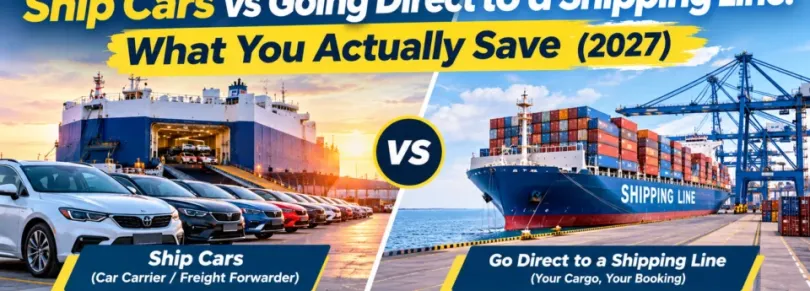
Ship Cars vs Going Direct to a Shipping Line: What You Actually Save (2027)
For most people shipping a car from the UK, going directly to a shipping line is not an option. The major RoRo carriers — including Wallenius Wilhelmsen, Höegh Autoliners, and Grimaldi — do not accept bookings from private individuals. Even where container lines take direct enquiries, you would still need to handle UK customs declarations, port liaison, and marine insurance yourself. A specialist like Ship Cars manages all of this as a single service.
Can You Book Directly With a Shipping Line for a Single Car?
The short answer: for most people, no
The major RoRo (roll-on/roll-off) shipping lines that carry vehicles from the UK to destinations worldwide do not accept bookings from private individuals. Wallenius Wilhelmsen, one of the world’s largest vehicle carriers, states this clearly on its own website: private individuals are required to contact a freight forwarding company, which then handles the full range of services including inland transportation, shipping documentation, and export paperwork on their behalf.
This is the standard model across the deep-sea RoRo sector. Carriers like Höegh Autoliners, Grimaldi, and EUKOR contract primarily with authorised freight forwarders, shipping agents, and NVOCCs (Non-Vessel Operating Common Carriers) — businesses that aggregate cargo and hold the commercial relationships the lines require.
For container lines such as MSC or Maersk, the picture is slightly different: some do allow direct bookings for businesses shipping at volume. But a single vehicle is a very small shipment, and even where a direct booking were technically possible, you would still need to manage everything else around the ocean leg yourself.
What about NVOCCs?
An NVOCC is a licensed intermediary that holds its own bill of lading authority and books space with carriers in bulk. Ship Cars, like other specialist car shipping companies, works within this framework — which is precisely why it can secure bookings and competitive rates that are not available to private individuals approaching a carrier directly.
What You Would Need to Handle If You Could Go Direct
Even setting aside whether a direct booking is possible, it is worth understanding what the ocean freight leg represents as a share of the total process. It is one part of a much longer chain — and not the most complicated part.
Here is what would remain your responsibility if you managed the ocean booking yourself:
1. HMRC Export Declaration via the Customs Declaration Service (CDS)
Since CHIEF — the legacy UK customs system — was retired in 2024, all UK export declarations are now filed through the Customs Declaration Service (CDS). To submit one, you need a valid EORI (Economic Operators Registration and Identification) number, which HMRC requires for all exporters. You are legally responsible for the accuracy of the declaration, regardless of whether a third party files it on your behalf.
For a one-off vehicle export, registering for an EORI, learning the CDS system, and filing correctly is achievable — but it takes time, and mistakes can cause the vehicle to be held at the port.
HMRC’s own guidance is frank on this point: for smaller exporters, it is often simpler to pay a freight forwarder or customs agent to handle the declaration, because getting it wrong has consequences.
2. Port liaison and terminal booking
UK export ports — Southampton, Tilbury, Liverpool, and Sheerness among them — do not operate as simple drop-off points. Each has its own booking window, documentation requirements, and procedures for accepting vehicles. These vary by port, by carrier, and by route. Getting a vehicle accepted at the terminal requires the correct paperwork to be in place, submitted in the right format, before the car arrives.
A specialist shipping agent handles port liaison as a matter of routine. Without one, you are navigating this directly.
3. Bill of lading
The bill of lading is the primary transport document for an international shipment by sea. It acts as a receipt for the cargo, a contract of carriage, and — in some cases — a document of title. You cannot collect a car at the destination port without the correct bill of lading. Preparing and issuing one requires a formal relationship with the carrier or an NVOCC.
4. Marine insurance
Standard motor insurance does not cover a vehicle in transit by sea. Marine (or transit) insurance is a separate product, and arranging it for a single vehicle as a private individual can be more complex and more expensive than through a specialist who places regular policies.
A reputable shipping agent will offer transit cover as part of the service or as a clearly priced add-on.
5. DVLA permanent export notification
If the vehicle is leaving the UK permanently, you must notify the DVLA using the permanent export section of the V5C logbook before the car leaves. This is straightforward in itself, but it must be done in the right sequence — before departure, not after.
6. Destination paperwork coordination
Documentation requirements vary significantly by destination country. Australia requires specific biosecurity declarations and vehicle cleaning compliance. The USA requires EPA and DOT compliance documentation for vehicles under 25 years old. Dubai and the UAE have their own customs entry requirements. Getting this wrong at the destination is expensive to fix.
A specialist agent familiar with the route knows what is required and coordinates with the destination agent accordingly.
What Using Ship Cars Actually Gets You
Using ShipCars is not simply paying someone to make a phone call to a shipping line on your behalf. It is a managed logistics service covering every stage of an international vehicle export.
A single point of contact and accountability
When you book through ShipCars, one team is responsible for the entire process from UK collection to vessel departure. If something needs resolving — a documentation query, a port delay, a change to the vessel schedule — there is a single point of contact, not a chain of separate parties each responsible for their own slice of the job.
Established carrier relationships and confirmed bookings
ShipCars books space with carriers regularly, as part of an ongoing commercial relationship. This matters because vessel space is not unlimited, particularly on high-demand routes. Established agents have confirmed allocations; private individuals approaching carriers — where they can — are generally placed on a waiting basis.
UK customs filing handled correctly
The CDS export declaration is handled as part of the service. ShipCars’ team is familiar with the requirements, the commodity codes, and the specific documentation needed for vehicle exports. This is not a process that benefits from learning on the job.
Marine insurance arranged as standard
Transit cover is included or offered as a named add-on, not an afterthought. The vehicle is covered from the point of UK collection to delivery at the destination port or address.
Route-specific documentation guidance
Whether you are shipping to Australia, Dubai, the USA, Canada, or elsewhere, the destination requirements are known in advance. ShipCars coordinates with agents at the receiving end, so the paperwork is in order before the vessel docks.
Transparent, all-in quoting
A ShipCars quote covers the full scope of what is included — collection, export handling, ocean freight, transit insurance, and destination costs where applicable — so there are no unexpected invoices when the car arrives.
What Does an Agent Actually Cost?
Agent fees are a real part of the total cost of shipping a vehicle. They cover the work of booking, documentation, customs filing, port liaison, and coordination — services that have genuine value.
Freight forwarder and customs agent charges are not standardised, and they vary by route, shipment complexity, and service scope. What is consistent across the industry is the structure: a service fee for coordination, pass-through costs for the ocean freight and port charges, and fees for specific services such as customs declarations.
What you should look for in a quote is transparency: each cost item clearly listed, so you can see what you are paying for the ocean freight, what covers the documentation, and what the agent’s coordination fee represents. A single unexplained total is a reason to ask questions.
ShipCars provides itemised quotes. If you would like to see what the full cost of your specific shipment looks like, get a free quote here.
The Situations Where Agents Add the Most Value
Agents earn their fee most clearly in three situations:
High-value or classic vehicles. When the car being shipped is worth a significant sum, the cost of a documentation error, an uninsured transit incident, or a customs delay is severe. Getting the process right the first time is worth considerably more than the agent’s fee.
Complex or less-travelled routes. Shipping to Australia involves biosecurity requirements that catch out first-time exporters. Shipping to West Africa involves specific port procedures and customs requirements. Specialist knowledge is not overhead — it is what prevents expensive mistakes.
Time-sensitive moves. If you are relocating and need the car to arrive within a specific window, confirmed vessel space and reliable documentation handling are not optional extras. They are the difference between the car arriving when planned and the car sitting at a port.
Frequently Asked Questions
Can a private individual book directly with Wallenius Wilhelmsen or Höegh Autoliners?
No. Both carriers state clearly that private individuals must book through a freight forwarding company. They do not accept direct bookings from individual vehicle owners.
Is it cheaper to go direct to a shipping line?
For private individuals, going direct is generally not possible for the reasons above. Even in cases where a container line might entertain a direct enquiry, the cost saving on the ocean freight alone would need to be weighed against the cost of arranging customs declarations, port liaison, marine insurance, and destination documentation independently. For most people shipping a single vehicle, this does not represent a saving.
What is an NVOCC and why does it matter?
An NVOCC (Non-Vessel Operating Common Carrier) is a licensed intermediary that holds its own bill of lading authority and books space with carriers. ShipCars operates within this framework. It is the structural reason why specialist agents can secure bookings and rates not available to private individuals.
Do I need my own EORI number to export a car from the UK?
Yes. Even if ShipCars files the export declaration on your behalf, you need a valid EORI number as the legal exporter. HMRC’s own guidance confirms this: the EORI number on the export declaration identifies you as the exporter, and you remain legally responsible for the accuracy of the declaration.
What happens if something goes wrong during transit?
When you book through ShipCars, there is a single point of contact for the entire journey. If the vessel schedule changes, documentation needs to be updated, or something needs resolving at the destination, ShipCars coordinates the fix. When you are managing multiple parties yourself, each is responsible only for their own part of the process.
What is included in a ShipCars quote?
ShipCars provides itemised quotes covering the agreed scope: collection, export handling and documentation, ocean freight, transit insurance, and destination costs where included. The quote sets out each cost so there are no unexpected charges on arrival.
How long does it take to ship a car from the UK?
Transit times vary by route and method. As a general guide, RoRo shipping to Australia takes approximately five to seven weeks; to the USA, three to five weeks; to Dubai, two to three weeks. These are voyage transit times — total door-to-port or door-to-door times depend on collection, port processing, and destination clearance. ShipCars will confirm the expected window for your specific route when you get a quote.
What documents do I need to export a car from the UK?
The core documents are your V5C logbook (with the permanent export section completed if the vehicle is leaving permanently), valid photo ID, proof of purchase if you bought the vehicle recently, and an EORI number. ShipCars handles the HMRC export declaration and the bill of lading as part of the service.
Internal Links
- Get a free car shipping quote
- How RoRo car shipping works
- Container car shipping
- How to export a car from the UK
- How to deregister a car for export in the UK
- Documents needed to ship a car abroad
