


Shipping a Caravan or Motorhome from the UK: IMDG Compliance Guide for Gas Systems and Lithium Batteries
Shipping a caravan or motorhome internationally is governed by the International Maritime Dangerous Goods (IMDG) Code. LPG gas cylinders must be completely emptied, disconnected from the gas system, and the entire system purged before a vessel will accept the vehicle. Lithium leisure battery banks must be installed and secured, with terminals insulated, and charged to between 30% and 50%. Loose or spare lithium batteries cannot be shipped inside the vehicle under any circumstances. Failure to comply results in refusal at the port.
The Process of Shipping Caravans Or Motorhomes
Shipping your caravan or motorhome opens up a world of adventure, allowing you to explore new countries with all the comforts of home. However, the very features that make these vehicles so self-sufficient—namely, their liquefied petroleum gas (LPG) systems and potential lithium battery banks—are classified as hazardous materials for international shipping. At ShipCars, we specialise in navigating these complex regulations to ensure your vehicle is shipped safely, legally, and without delay.
This definitive guide explains the strict rules governing flammable gas and lithium batteries, detailing exactly what is allowed and what is prohibited for a successful shipment.
Why Regulations Are So Strict For Shipping Caravans Or Motorhomes
International maritime law, governed by the International Maritime Dangerous Goods (IMDG) Code, is uncompromising when it comes to safety at sea. A cargo vessel is a confined environment where a fire or explosion can be catastrophic.
- Liquefied Petroleum Gas (LPG): Propane or butane is highly flammable. A leak in an enclosed hold can create an explosive atmosphere, which could be ignited by a single spark.
- Lithium Batteries: These batteries pose a dual risk of fire and thermal runaway. If damaged, short-circuited, or improperly manufactured, they can self-heat and ignite, producing intense heat that is extremely difficult to extinguish.
Due to these severe risks, shipping lines enforce a strict “zero tolerance” policy. Non-compliance will result in your vehicle being refused loading at the port, leading to significant financial loss and delays.
Part 1: Flammable Gas (LPG) Systems – Rules & Preparation
The regulations for gas systems are clear and non-negotiable. Failure to adhere to them is the most common reason for caravans and motorhomes being rejected for shipping.
What is NOT Allowed
- Gas Cylinders with Gas: You are absolutely prohibited from shipping a caravan or motorhome with any LPG gas cylinder that contains gas, whether it is connected to the system or stored separately.
- Connected Gas Cylinders: Even an empty gas cylinder must not be connected to the vehicle’s gas system at the time of shipping.
What IS Allowed & The Correct Procedure
The only way to ship a vehicle with a gas system is to demonstrate it is completely safe and de-pressurised.
- Gas Cylinders Must Be EMPTY: All LPG cylinders must be fully emptied of gas.
- Cylinders Must Be DISCONNECTED: All cylinders must be physically disconnected from the vehicle’s gas system.
- Cylinder Valves must be CLOSED: The valve on the empty, disconnected cylinder must be securely closed.
- The Entire System Must Be PURGED: It is not enough to just disconnect the cylinder. The entire gas system (pipes, hoses, and appliances) must be purged of any residual gas. The safest and most accepted way to do this is to run each gas appliance (cooker, heater, fridge) until the flame dies out, confirming no gas remains in the lines.
Your Pre-Shipment Gas System Checklist
- Use up or safely discharge all gas from every LPG cylinder.
- Physically disconnect all cylinders from the vehicle.
- Ensure all cylinder valves are tightly closed.
- Purge the entire gas system by running appliances until they are completely out of fuel.
- If possible, secure disconnected cylinders in their storage locker to prevent movement.
Proof of Compliance: While not always formally requested, it is highly advisable to take photographs and videos of the disconnected, empty cylinders and the purged system. This can serve as valuable evidence if any questions are raised at the port.
Part 2: Lithium Batteries – Rules & Preparation
The rules for lithium batteries depend entirely on their type, size, and how they are integrated into the vehicle.
What is NOT Allowed
- Loose/Spare Lithium Batteries: You are prohibited from shipping loose lithium-ion or lithium-metal batteries (e.g., spare e-bike batteries, power tool batteries, portable power stations) inside the caravan or motorhome.
- Damaged or Recalled Batteries: Any battery that is damaged, defective, or subject to recall is strictly forbidden.
- Non-Compliant Installations: Aftermarket lithium battery banks that are not professionally installed and securely fixed may be questioned and rejected.
What IS Allowed
The regulations distinguish between batteries that are installed in equipment and those that are not.
- Batteries INSTALLED in Equipment: This is the key distinction. A lithium battery that is permanently installed and powering a part of the vehicle is generally permitted, provided it is securely fitted to prevent movement and the terminals are insulated to prevent short circuits.
- Examples: A factory-fitted or professionally installed leisure battery bank, or the starter battery for a motorhome.
- Small Consumer Electronics: Small lithium batteries contained in personal devices (e.g., laptops, mobile phones, cameras, shavers) are typically allowed when carried inside the vehicle.
Your Pre-Shipment Lithium Battery Checklist
- Identify All Batteries: Locate every lithium battery in your vehicle, including those in leisure systems, e-bikes, scooters, or medical devices.
- Remove Loose Batteries: Take out all spare, uninstalled lithium batteries. These must be transported separately by air or not shipped at all.
- Secure Installed Batteries: Ensure all installed battery banks are physically secured in their housings and cannot shift during transit.
- Disconnect and Insulate: For the main leisure battery bank, it is a best practice to:
- Disconnect it at the main terminals.
- Insulate the terminals with electrical tape or proper terminal covers to prevent any chance of a short circuit.
- Charge Level: Lithium batteries should be shipped at a partial state of charge, ideally between 30% and 50%. Do not ship them fully charged or completely flat.
General Preparation: Beyond Gas and Batteries
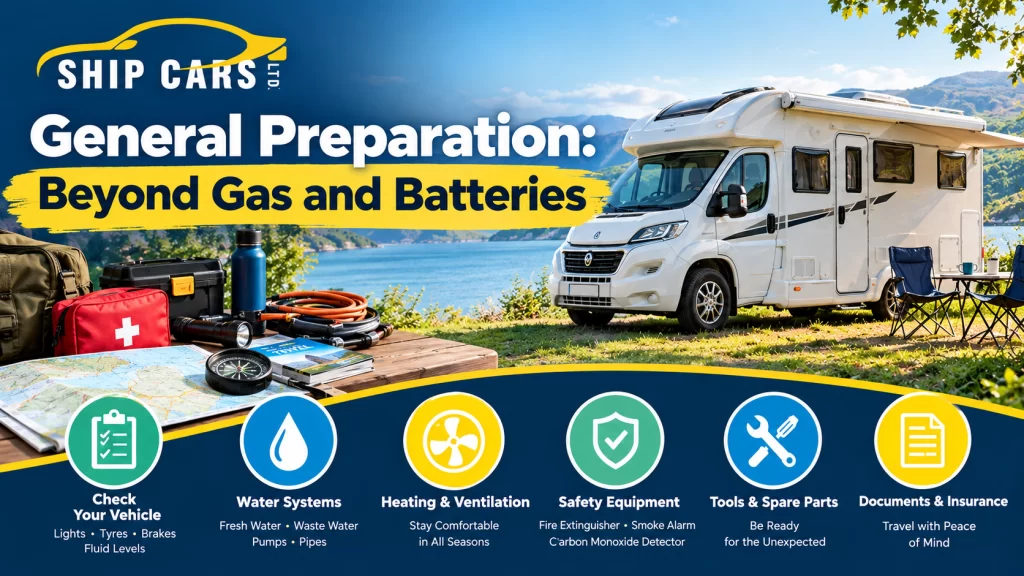
To ensure your vehicle is ready for its journey, a thorough general preparation is also required.
-
Deep Cleaning
- Interior: The living area must be clean, dry, and free from food crumbs, dirt, and debris. This is crucial for biosecurity inspections at the destination country (e.g., Australia, New Zealand, USA).
- Exterior & Undercarriage: A clean exterior and, most importantly, a spotlessly clean undercarriage are often mandatory. Mud and soil can harbour pests and seeds, leading to your vehicle being held, cleaned, and fumigated at your expense.
-
Remove Personal Belongings & Prohibited Items
- Personal Effects: For Roll-on/Roll-off (RORO) shipping, personal goods are generally not allowed inside the vehicle. For container shipping, they may be permitted but must be declared. Always confirm with us first.
- Other Hazardous Materials: Remove all other prohibited items, including:
- Fuel cans (petrol/diesel)
- Fireworks, flares, or ammunition
- Aerosols (unless essential and declared)
- Fresh foods, plants, and seeds
-
Mechanical Preparation
- Motorhomes: Must be in full working order for RORO shipping. The fuel tank should be no more than 1/4 full.
- Caravans: Ensure the braking system is functional and the tyres are correctly inflated.
Why Destination Biosecurity Requirements Vary Significantly
Australia and New Zealand have the world’s most stringent biosecurity inspection regimes. Every caravan or motorhome arriving at an Australian or New Zealand port is inspected. The vehicle must be completely free of soil, seeds, plant debris, and organic matter — including in wheel arches, chassis rails, habitation area vents, and all storage compartments. A professional biosecurity clean immediately before loading is mandatory and must be arranged in advance. ShipCars arranges biosecurity cleaning as part of the Australia and New Zealand shipping process.
Your Essential Pre-Shipment Action Plan
To guarantee a smooth shipping process for your caravan or motorhome, you must complete the following steps:
-
GAS SYSTEM:
- Completely empty all LPG cylinders.
- Disconnect all cylinders from the vehicle.
- Purge the entire gas system of residual fuel.
-
LITHIUM BATTERIES:
- Remove all loose or spare lithium batteries.
- Ensure installed batteries are securely fixed.
- Disconnect and insulate the terminals of main leisure battery banks.
-
GENERAL PREPARATION:
- Conduct a deep clean of the interior, exterior, and undercarriage.
- Remove all personal belongings and other prohibited items.
- Ensure the vehicle is mechanically sound.
How Much Does It Cost to Ship a Caravan or Motorhome from the UK?
Motorhomes and caravans are oversized vehicles that typically require dedicated container shipping due to their dimensions and the LPG and lithium battery requirements described in this guide. Most motorhomes exceed the height clearance for standard RoRo vessel decks, and the dangerous goods compliance requirements make container the appropriate method for almost all motorhome and caravan shipments.
Costs depend on the vehicle’s dimensions, weight, and destination. Container shipping for a motorhome or caravan is quoted individually based on exact measurements. Contact ShipCars with your vehicle’s make, model, and overall dimensions for an accurate quote.
Ready to Ship with ShipCars?
The rules are strict for a reason: your safety and the safety of the crew and vessel. By following this guide, you take full control of the process. The team at ShipCars is here to provide further clarification and manage the complex documentation on your behalf.
Contact us today for a definitive quote and let our experts guide you through a compliant and worry-free shipping experience for your caravan or motorhome.
Other Resources
- Container Car Shipping from the UK — for readers who want to understand the shipping method in more detail.
- Car Shipping to Australia — for readers shipping their motorhome to Australia.
- Car Shipping Documents Required — for readers who want the complete documentation checklist.
- How to Export a Car from the UK — for readers who want the complete UK export process guide.
FAQ — Shipping Caravan Or Motorhome
Can I ship a caravan or motorhome with gas in the cylinders?
No. All LPG cylinders must be completely emptied of gas before shipping. It is not sufficient to simply turn off the gas supply or disconnect the cylinder while it still contains gas. The cylinder must be fully empty, disconnected from the vehicle’s gas system, and the valve closed. The entire gas system including pipes, hoses, and appliances must then be purged of residual gas by running each appliance until it runs out of fuel. Failure to do this results in the vehicle being refused at the port.
Can lithium batteries be shipped inside a caravan or motorhome?
It depends on whether the battery is installed or loose. Lithium batteries permanently installed in the vehicle — such as a factory-fitted or professionally installed leisure battery bank — are permitted provided they are securely fixed and cannot move during transit, and the terminals are insulated to prevent short circuits. Loose or spare lithium batteries including spare e-bike batteries, portable power stations, and removable battery packs are prohibited and must be removed before shipping.
What charge level should lithium batteries be at for shipping?
Between 30% and 50% state of charge. Do not ship lithium batteries fully charged or fully discharged. Both extremes increase the risk of thermal instability during a long ocean transit. ShipCars advises discharging leisure battery banks to the 30-50% window in the days before collection and confirming the charge level at the vehicle condition report.
What happens if I ship a caravan with gas still in the cylinders?
The vehicle will be refused loading at the UK port. There are no exceptions and no appeals process at the point of loading. A refusal results in the vehicle being held at the port, incurring storage charges, until it is properly prepared. You will then need to rebook the shipment on the next available sailing. This is one of the most common and entirely avoidable reasons for shipping delays on caravan and motorhome shipments.
Do I need a dedicated container to ship a motorhome or caravan?
In most cases yes. Most motorhomes and caravans exceed the height clearance of standard RoRo vessel vehicle decks. Even where height permits RoRo loading, the dangerous goods compliance requirements for LPG systems and lithium batteries make container shipping the appropriate and in most cases only practical method. Container shipping provides the enclosed environment required for safe transport of vehicles with these systems.
What cleaning is required before shipping a caravan to Australia?
Australia has the world’s most stringent biosecurity inspection regime. The caravan must be completely free of soil, seeds, plant debris, insects, and organic matter — including in the undercarriage, wheel arches, chassis rails, habitation area vents, roof space, and all storage compartments. A professional biosecurity clean immediately before loading is mandatory. ShipCars arranges this clean as part of the Australia shipping process.


