


Taking Your UK Car to Europe Permanently: All You Need to Know
Permanently exporting your UK car to Europe requires four stages: notifying the DVLA using your V5C (marking it “PERMANENT EXPORT”), passing a local technical inspection in your destination country, obtaining a Certificate of Conformity from the manufacturer, and completing local vehicle registration. Most European countries allow 30–180 days to complete this process after arrival. Key modifications typically required: headlights adjusted to dip right, km/h speedometer display, and amber side-marker reflectors.
At Ship Cars Ltd, we specialise in the complexities of international vehicle relocation. This guide provides a complete overview of the essential steps you must take to legally and smoothly transition your UK car to your new life in Europe.
The Core Principle: From Temporary Visitor to Permanent Import
When you drive your UK-plated car to Europe for a holiday, you are a temporary visitor. When you move there permanently, your car must transition from a “visitor” to a legally imported asset. This involves changing its registration, complying with local technical standards, and formally exporting it from the UK.
Part 1: Pre-Export Preparation from the UK
Before you leave the UK, there are several critical tasks to complete.
-
Ensure You Have the Correct Documentation
You must have the following documents physically with you and in order:
- V5C Registration Certificate (Logbook): This is the most important document. Ensure the registered keeper details are correct.
- Valid UK Driving Licence: A photocard licence is essential.
- Proof of Ownership/Insurance: Have your insurance documents and any finance settlement paperwork ready.
- Passport: This will be your primary ID.
-
Notify Your Insurance Provider
You must inform your insurer of your move. Your UK policy will not cover you for permanent residence in another country. They will advise you on the next steps, which typically involve cancelling your UK policy and taking out a new one in your destination country. Do not drive in your new country without valid, local insurance.
-
Conduct a Final Vehicle Check
Ensure your car is in good mechanical condition. Check:
- Tyre tread and condition
- All lights and indicators
- Brakes
- Fluid levels A pre-export service is highly recommended to identify any issues that might cause it to fail its new country’s technical inspection.
Part 2: The Formal Export Process with the DVLA
This is a crucial and often misunderstood step. You must formally tell the DVLA that you are permanently exporting your vehicle.
Should You Keep a Right-Hand Drive Car in Europe?
UK cars are right-hand drive (RHD). Mainland European countries drive on the right, meaning your driver’s seat is on the opposite side to oncoming traffic. This is legal — there is no European law preventing an RHD car from being registered and driven in an EU country — but it creates practical challenges worth understanding before you commit.
Practical considerations:
- Overtaking — judging safe overtaking on right-hand roads is harder from an RHD car. Passengers need to signal when the road ahead is clear.
- Toll booths and drive-throughs — designed for left-hand drive. You will regularly need to exit the car or stretch across to pay.
- Petrol stations — the filler cap on most UK cars is on the driver’s side (left on UK roads), which becomes the wrong side on European forecourts. Not all pumps have hoses long enough to reach.
- Headlights — UK headlights dip left. On right-hand roads they dazzle oncoming drivers. Adjustment is mandatory for permanent use and is usually a simple beam-deflector sticker for temporary visits or a workshop adjustment for permanent residence.
Countries where RHD is more common: Cyprus, Ireland, Malta, and Gibraltar all drive on the left — making UK RHD cars a natural fit with no overtaking complications.
The honest answer: RHD in mainland Europe is legal and manageable, but adds minor daily inconvenience. Many UK expats keep and register their UK cars successfully for years. Others choose to sell and buy a locally-sourced LHD vehicle after settling in. If your car has high sentimental or financial value, the registration process is worth completing. If it is a standard used car, the practical case for selling and buying locally is worth considering.
How to Permanently Export Your Vehicle from the UK:
- Complete the V5C Logbook: On the V5C document, you need to fill out section 2 (” Selling, transferring or part-exchanging the vehicle”) but you do not fill in the new keeper’s details. Instead, you write “PERMANENT EXPORT” in the field for the new keeper’s name and address.
- Send it to the DVLA: Send the entire V5C document (not just the green slip) to the DVLA at the address listed on the form. Do not give it to the new keeper in your destination country.
- Receive a V5C/2B Export Slip: The DVLA will send you an acknowledgement letter (V5C/2B), which acts as proof that you have notified them of the permanent export. Keep this document safe.
- DVLA Deregistration: The DVLA will then deregister the vehicle from the UK database. Your UK road tax will be automatically refunded for any full remaining months.
What you cannot do: You cannot simply keep your UK plates and re-register the car abroad. The DVLA must be notified first to cancel the UK registration.
Part 3: The Import Process in Your EU Destination Country
Once you have arrived in your new country of residence, the import process begins. The exact requirements vary by country, but the general framework is consistent across the EU.
Step 1: Arrange Temporary Import and Customs
You will have a limited period (often 30 to 180 days) to complete the re-registration process using temporary import papers. You must declare the car to the local customs authority. For EU citizens moving within the EU, VAT is typically not an issue as the car is a personal possession. However, you must prove you have owned and used the car in the UK for a certain period (usually 6-12 months). Keep proof of purchase and old insurance documents.
Important: Most EU countries allow a grace period of 30–90 days during which you can drive with UK plates while completing the registration process. This varies by country — France typically allows 30 days, Germany up to 12 months for residents in certain circumstances, Spain 30 days. Exceeding your country’s grace period without completing registration can result in fines and in some cases the vehicle being seized. Check your destination country’s specific timeframe with a local lawyer or your registration office before arrival.
Step 2: Pass the Local Technical Inspection
Almost every European country requires an imported vehicle to pass a technical inspection equivalent to the UK’s MOT, but often more rigorous. This is known as:
- France: Contrôle Technique
- Germany: TÜV or DEKRA inspection
- Spain: Inspección Técnica de Vehículos (ITV)
- Italy: Revisione Auto
The inspection will verify that the vehicle complies with local standards. Modifications that may be required include:
- Adjusting headlights to dip to the right (for driving on the right-hand side of the road).
- Fitting rear-facing, amber side-marker reflectors (required in many countries like Germany and Italy).
- Ensuring speedometer displays km/h predominantly.
Step 3: Pay Any Applicable Taxes
While VAT is usually exempt for personal moves, some countries levy a one-off registration tax based on the car’s CO2 emissions, engine size, or value (e.g., in Denmark, Ireland, and the Netherlands). Research this for your specific destination as it can be a significant cost.
Step 4: Obtain Local Vehicle Insurance
You must take out a new insurance policy with a provider in your new country before you can complete the registration. You will need the insurance certificate to finalise the process.
Step 5: Register the Vehicle and Get New Plates
Visit the local vehicle registration office (e.g., the Préfecture in France, the Zulassungsstelle in Germany) with your complete dossier of documents. You will surrender your UK registration plates and be issued with new ones from your country of residence.
Essential Document Checklist for EU Registration
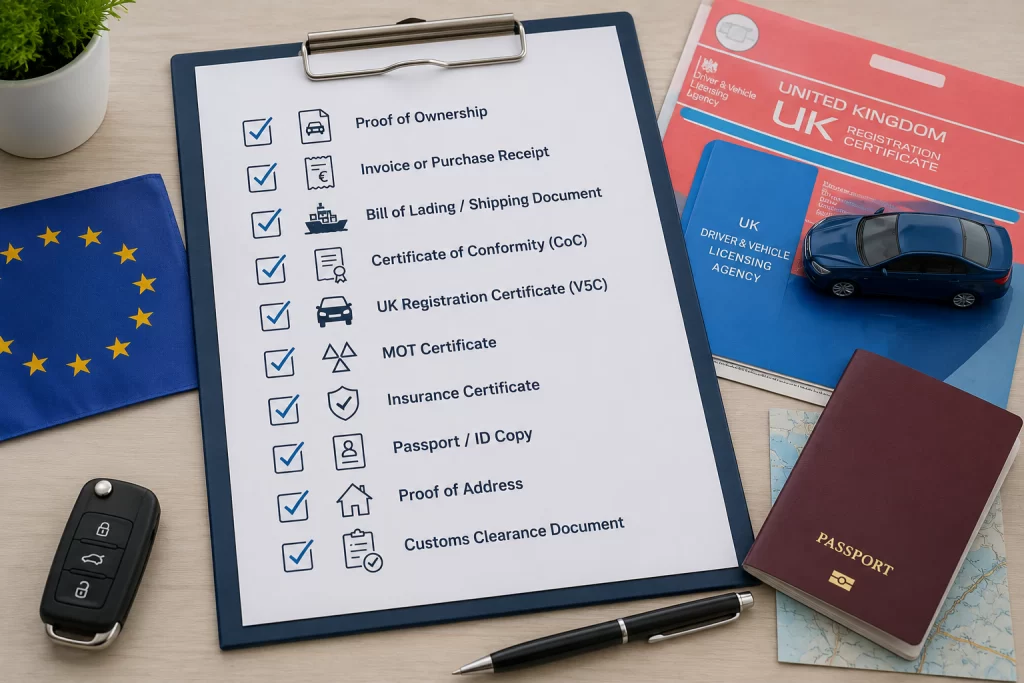
When you visit the registration office, you will typically need:
- Proof of Identity: Your passport.
- Proof of Residence: A utility bill, rental contract, or residency certificate from your new town hall.
- DVLA Export Slip (V5C/2B): Proof of export from the UK.
- Certificate of Conformity (CoC): This document, issued by the vehicle manufacturer, confirms your specific vehicle meets EU type-approval standards. It is required at most EU registration offices. To obtain one, contact your vehicle manufacturer’s national headquarters or their designated CoC department — each brand handles this differently. BMW, Mercedes, Volkswagen, Toyota, and most major manufacturers provide CoCs on request. Typical cost: £50–£150. Allow 2–4 weeks for processing. If a CoC cannot be obtained (common for older or specialist vehicles), the registration office will typically require a detailed technical assessment report from an approved inspection centre instead.
- Proof of Ownership: The old V5C, purchase invoice, or a customs declaration.
- Technical Inspection Certificate: The pass certificate from the local technical inspection (e.g., TÜV, Contrôle Technique).
- Proof of Local Insurance: The insurance certificate from your new provider.
- Receipt for Paid Taxes: Proof that any applicable registration taxes have been paid.
How Ship Cars Ltd Can Lead To Vehicle Shipping Service
While it is possible to manage this process yourself, it is administratively complex, time-consuming, and requires navigating foreign bureaucracy, often in a different language. This is where a professional service like Ship Cars Ltd provides immense value.
We handle the entire process for you, including:
- Collection and Secure Shipping: We collect your car and transport it via roll-on/roll-off (RoRo) or container shipping.
- Customs Documentation: We manage the complex customs declarations and paperwork for both export and import.
- Destination Support: We can arrange for the necessary technical inspections and liaise with local authorities to streamline the registration process.
- Peace of Mind: We ensure the process is compliant, reducing the risk of delays, fines, or legal issues.
Summary of Key Considerations
| Step | Key Action | Potential Pitfall |
|---|---|---|
| UK Export | Notify DVLA using V5C, marking it “PERMANENT EXPORT”. | Failing to do this makes EU registration impossible. |
| Technical Compliance | Research and make necessary modifications for your destination country. | Failing the local technical inspection due to non-compliant headlights or other features. |
| Documentation | Gather a complete dossier, including the CoC and proof of ownership. | Missing documents cause significant delays at the registration office. |
| Tax & Insurance | Research local taxes and secure local insurance immediately. | Facing an unexpected large tax bill or driving illegally without insurance. |
Permanently taking your UK car to Europe is a multi-stage process that demands careful attention to detail. From correctly notifying the DVLA to navigating the specific technical and administrative requirements of your new home country, each step is critical. By understanding and preparing for these requirements, or by engaging a specialist to manage the logistics, you can ensure a smooth transition for both you and your vehicle, allowing you to focus on starting your new European life.
Please do not hesitate to contact us if you need any assistance in car shipping services or check our RORO Sailing schedule for further details.
Other Resources:
Frequently Asked Questions
Do I need to notify the DVLA when I permanently take my car to Europe?
Yes — this is mandatory. You must complete section 2 of your V5C logbook, write “PERMANENT EXPORT” in the new keeper field, and send the entire V5C to the DVLA. You will receive a V5C/2B export acknowledgement slip as confirmation. Without this step, registering the car in an EU country is effectively impossible.
Can I keep my UK right-hand drive car registered in Europe?
Yes — RHD cars can be legally registered in all EU countries. There is no European law prohibiting it. You must adjust the headlights to dip right (not left) and in some countries fit amber side-marker reflectors. The practical inconvenience of RHD on right-hand roads is manageable but worth considering before committing to the registration process.
How long do I have to register my UK car after moving to Europe?
It varies by country. Most EU countries allow 30–90 days of grace period to complete registration using temporary import papers. France typically allows 30 days. Exceeding the grace period without completing registration risks fines and in some cases vehicle seizure. Check the specific timeframe for your destination country before you arrive.
What is a Certificate of Conformity and where do I get one?
A Certificate of Conformity (CoC) is a document issued by your vehicle manufacturer confirming the car meets EU type-approval standards. It is required at most EU registration offices. Contact your car manufacturer’s national headquarters to request one. Cost is typically £50–£150 and allow 2–4 weeks for processing. If unavailable, a detailed technical inspection report from an approved centre may be accepted instead.
Do I pay VAT when I permanently take my car to Europe?
For personal moves within the EU where you owned and used the car in the UK for at least 6–12 months, VAT is typically exempt. However, some countries — notably Denmark, Ireland, and the Netherlands — levy a one-off registration tax based on CO2, engine size, or value. Research the specific registration tax for your destination country as it can be a significant cost.
Can ShipCars transport my car to Europe rather than me driving it?
Yes — for high-value vehicles, vehicles that are not roadworthy, or simply to avoid the wear of a long drive, Ship Cars provides RoRo and container shipping to European ports. We also handle all customs documentation for both UK export and European import.


