


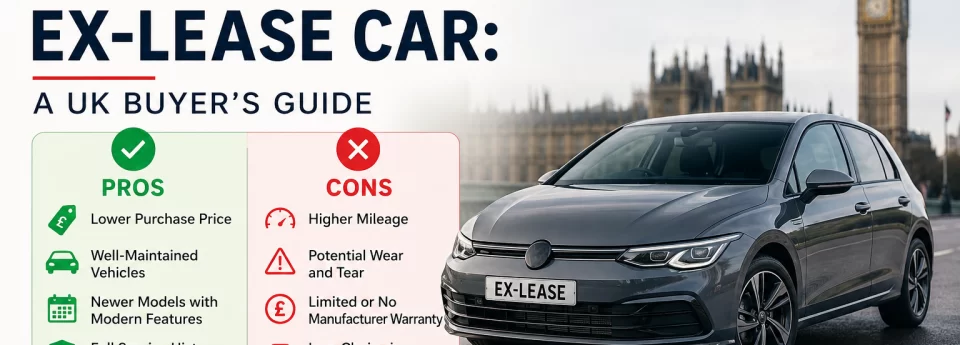
The Pros and Cons of Buying an Ex-Lease Car: A UK Buyer's Guide
An ex-lease car is a vehicle returned at the end of a 2–4 year contract hire agreement and sold on the used market. Key advantages include full main-dealer service histories, modern low-mileage specification, and competitive pricing. Key risks include long-life servicing intervals, cost-led repair work, and limited model choice. In 2026, a large wave of ex-fleet EVs is also entering the market — requiring specific battery health checks not covered by a standard used car inspection.
At Ship Cars Ltd, we see the entire lifecycle of vehicles, and understanding the origin of a used car is key to making a smart purchase. This guide will walk you through the distinct advantages and potential drawbacks of buying an ex-lease car, empowering you to make an informed decision.
What Exactly is an Ex-Lease Car?
An ex-lease car is a vehicle that was originally acquired through a business contract hire (BCH) or personal contract hire (PCH) agreement. The driver paid a fixed monthly fee to use the car for an agreed period — typically two to four years — and a pre-set annual mileage allowance. Crucially, they never owned it. At the end of the contract, the car is returned to the leasing funder — organisations like Lex Autolease, Alphabet, or a major bank — and sold on through auctions or dealers.
The UK vehicle leasing market is substantial. The British Vehicle Rental and Leasing Association (BVRLA) represents over 900 member companies operating a combined fleet of millions of vehicles, making ex-lease cars one of the most common types of used vehicle on the British market.
Understanding where an ex-lease car comes from helps you understand what to expect from it — and what to watch for.
The Pros: Why an Ex-Lease Car Can Be a Smart Buy
-
Often Well-Maintained with Full Service History
This is the single biggest advantage. Lease companies have strict, non-negotiable maintenance schedules written into their contracts. Failure to adhere to these can result in hefty penalties for the driver upon returning the car.
- Result: Ex-lease cars almost always come with a full, main-dealer service history, providing excellent peace of mind regarding engine and mechanical health.
-
Generally Low Mileage and Recent Models
Lease contracts are typically for two to four years, with a pre-agreed annual mileage cap (e.g., 10,000 or 15,000 miles per year).
- Result: You find a plentiful supply of modern, low-mileage cars that are only a few years old, often equipped with the latest safety and infotainment technology. International Container Shipping
-
Usually in Good Cosmetic Condition
While not guaranteed, lessees are financially incentivised to keep the car in good condition. The “fair wear and tear” guidelines provided by the BVRLA (British Vehicle Rental and Leasing Association) set a standard the car must meet to avoid charges for damage.
The BVRLA guidelines cover bodywork, paint, tyres, glass, lights, and interior condition. Damage beyond the standard results in financial charges for the driver on return — creating a real, enforceable incentive to keep the vehicle in good condition throughout the lease. Download the current guide at bvrla.co.uk.
- Result: Many ex-lease cars have been well-looked-after, with minor scratches and dents often being professionally repaired by the leasing company before sale to maximise value.
-
High and Desirable Specifications
Cars are often leased by companies for employees, meaning they are frequently mid-to-high spec models to provide comfort and project a certain image. It’s common to find ex-lease cars with desirable optional extras like leather upholstery, advanced safety packs, and larger alloy wheels that would be expensive to add to a base model.
-
Competitive Pricing
Lease companies operate on volume. Their primary goal is to offload large numbers of returned vehicles quickly and efficiently to fund new leases. This means they are often priced competitively to sell, making them cheaper on the forecourt than an equivalent privately-owned car.
The Cons: The Potential Pitfalls to Watch For
-
Potential for Motorway Mileage and “Company Car” Driving
A large proportion of ex-lease cars are former company vehicles, which can mean a life of long, monotonous motorway miles. While this is often better for a car than constant short, cold-start trips, it can lead to:
- Higher wear on the clutch, brakes, and tyres.
- Stone-chipped front ends and windscreens.
- A more worn driver’s seat and interior driver-side bolster.
-
Inflexible Service Histories
While a full service history is a pro, the type of servicing can be a con. Many lease cars are on long-life servicing schedules, where the car’s computer dictates the service intervals, sometimes stretching to 20,000 miles or two years.
On motorway-heavy fleet cars, variable long-life schedules can push oil changes to 20,000 miles or two years between services. For a buyer planning long-term ownership, annual servicing at around 10,000 miles provides better engine protection — particularly on turbocharged petrol engines. Always check which schedule was used and what the actual recorded intervals were in the service book.
- Consideration: Some buyers prefer the traditional, time-based (annual) servicing for older oil changes, believing it is better for long-term engine health.
-
“Just Good Enough” Maintenance
The maintenance is done to the manufacturer’s schedule, but rarely beyond it. Lessees have no incentive to perform preventative maintenance or use premium parts, as they will not own the car long-term. It was maintained to be reliable for the lease period, not for a 10-year lifespan.
-
Risk of Damage Repairs
While leasing companies repair damage, their goal is cost-effectiveness. This could mean a replacement part might be a cheaper, non-OEM (Original Equipment Manufacturer) part, or a repair might not be to the standard of a meticulous private owner.
-
Generic and Sometimes Dull Model Choices
The fleet market tends to favour common, reliable, and economical models. This means you will find an abundance of:
- Ford Focuses and Fiestas
- Volkswagen Golfs and Polos
- BMW 3 Series and Mercedes-Benz A-Classes
- Vauxhall Astras If you’re looking for a quirky, rare, or performance-oriented car, the ex-lease market is not the best place to look.
Ex-Lease EVs and Plug-in Hybrids in 2026
The 2020–2022 company EV lease wave — driven by 1–2% Benefit-in-Kind tax — is now returning. A record 86,943 used EVs changed hands in Q1 2026 alone, up 32% year-on-year. Supply is plentiful and prices have fallen sharply. A 2025 Carwow study of 8,000+ used EVs found the average battery State of Health was 95.15% — significantly better than many buyers expect.
Battery State of Health (SoH) — the check that matters most
Always insist on a measured SoH figure from a diagnostic tool — not a verbal assurance. Above 85% is acceptable. Below 80% is a hard stop unless a long battery warranty remains. Ask for a Battery Health Certificate from the dealer, or arrange an independent check via Aviloo or the AA (typically £50–£150).
Battery warranty transfer
Most UK EVs carry an 8-year / 100,000-mile battery warranty that transfers to subsequent owners. Confirm this in writing before purchase. Tesla and MG include it as standard. Nissan and Renault have specific transfer rules — verify before signing.
Battery lease trap
Pre-2021 Renault Zoe and pre-2018 Nissan Leaf models may have a separate battery lease. The buyer owns the car but not the battery — meaning an ongoing monthly payment. Always confirm battery ownership in writing on these models.
VED from April 2025
EVs registered from April 2025 now pay £10 in year one, then £200 annually. Factor this into running cost comparisons with petrol alternatives.
Summary Table: Weighing Up Your Decision
| Pros (The Advantages) | Cons (The Disadvantages) |
|---|---|
| Full Service History | Potentially Boring Drives & Motorway Mileage |
| Modern & Low Mileage | Long-Life Servicing Intervals |
| Good Cosmetic Condition | Minimum “Just Good Enough” Maintenance |
| High Specification Levels | Possible Cost-Effective (Not Premium) Repairs |
| Competitive Market Pricing | Generic, Common Model Choices |
Your Essential Pre-Purchase Checklist for an Ex-Lease Car
If you’ve decided an ex-lease car is for you, follow this checklist to ensure you get a good one:
- Scrutinise the Service Book: Confirm it’s a full main-dealer or approved specialist history. Check the service schedule type (time/distance vs. long-life).
- Conduct a Thorough Vehicle History Check: Use HPI or a similar service to rule out any hidden finance (the lease will have been settled), previous write-off status, or mileage discrepancies.
- Inspect the MOT History (if old enough): Use the free GOV.UK MOT history checker. Look for advisories on tyres and brakes, which can indicate a car that has been driven hard.
- Examine the Interior for Wear: Pay close attention to the driver’s seat bolster, steering wheel, and gear knob for excessive shine or wear that doesn’t match the low mileage.
- Inspect the Exterior for Damage: Look for paint mismatches on panels, which could indicate less-than-perfect repair work. Check the front bumper and bonnet for stone chips.
- Get a Pre-Purchase Inspection: For ultimate peace of mind, especially on a premium brand, pay for an independent inspection from the RAC or AA to assess the mechanical and structural condition.
For EVs and plug-in hybrids:
Request a Battery State of Health certificate. Confirm the battery warranty transfers to you in writing. For pre-2021 Renault Zoe or pre-2018 Nissan Leaf, confirm the battery is owned outright — not on a separate lease. Check the charging cable is present and undamaged.
On the service history:
Identify whether the car was on annual or variable long-life servicing. Check the actual mileage intervals recorded in the service book — consistently over 15,000 miles between services warrants further scrutiny.
Bought an Ex-Lease Car and Relocating Abroad?
Ex-lease cars are well-suited to international shipping. Their full service history satisfies destination customs requirements, their right-hand drive configuration matches left-hand-traffic countries (Australia, India, South Africa, New Zealand, Cyprus, and others), and their age typically fits within destination import rules.
One important check before you buy:
Several countries restrict personal vehicle imports by age. India, for example, generally requires the vehicle to be under three years old. If you buy a four-year-old ex-lease car for a market with a three-year rule, you cannot import it — and the purchase cannot be reversed.
Contact ShipCars before you buy if you are unsure. We ship via RoRo and container worldwide. 01495 320540 | info@shipcars.co.uk | Get a free quote
Ship Cars Ltd can assist you at best to ship your car from UK to overseas or import to UK efficiently. Please do not hesitate to contact us if you need any assistance in car shipping services or check our RORO Sailing schedule for further details.
Other Resources
- How to Prepare Your Car for Shipping
- Preparing Your Car for Export
- Avoiding Damage with International Shipping
- Top 10 Mistakes People Make During International Car Shipping
Frequently Asked Questions
Are ex-lease cars reliable?
Generally yes. Mandatory servicing requirements produce a verified full-service history — one of the strongest reliability indicators for any used car.
What mileage should I expect?
A typical three-year lease at 10,000 miles per year returns a vehicle with around 30,000 miles. High-mileage business leases can produce 50,000–60,000 miles over three years.
Should I pay for an independent inspection?
For any car over £12,000, yes. An RAC or AA pre-purchase inspection costs £150–£250 and covers mechanical condition beyond what a visual check reveals. A paint thickness check is worthwhile on any vehicle.
Can I ship an ex-lease car abroad?
Yes — and they are well-suited to it. Full service history, right-hand drive, and typically good condition make them practical export vehicles. Confirm the V5C is in your name and check destination age rules before purchasing.
Are ex-lease EVs worth buying in 2026?
In most cases, yes. Prices are competitive and battery durability is better than expected. Always insist on a measured State of Health figure above 85% and confirm battery warranty transfer in writing.


