


UK Vehicle Import: Customs Clearance, Duty and Tax Explained (2026)
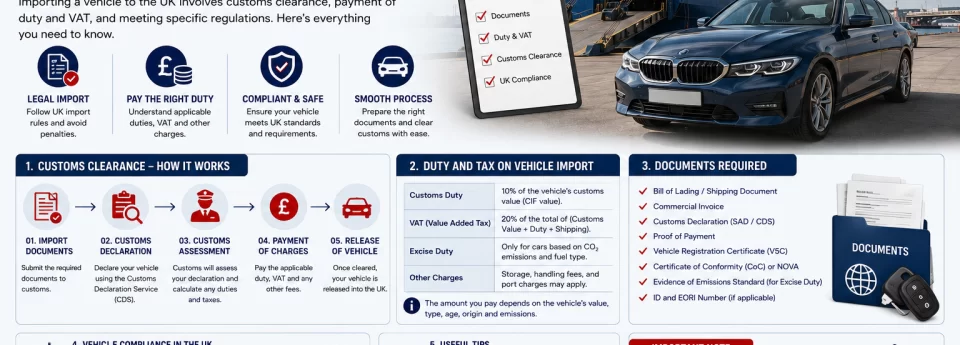
Importing a car to the UK requires customs clearance through HMRC, paying 10% import duty and 20% VAT on most vehicles from outside the EU, and meeting UK roadworthiness standards. The total tax on a £25,000 car is typically around £7,500. Qualifying returnees can eliminate duty and VAT under Transfer of Residence (ToR) relief. Customs clearance with correct documentation takes 2–5 working days. Vehicles over 30 years old qualify for 0% duty and 5% VAT as historic vehicles.
Understanding UK Customs Clearance for Vehicles
Customs clearance is the official process of meeting all regulations and completing all documentation required by HMRC (His Majesty’s Revenue and Customs) to allow your vehicle to enter the UK. This involves declaring the vehicle, paying applicable duties and taxes, and ensuring compliance with all import laws.
Key Stages of UK Customs Clearance:
- Pre-Arrival Notification: Lodging necessary declarations before the vehicle arrives in UK waters.
- Customs Declaration: Submitting detailed information about the vehicle, its value, and its origin.
- Duty and Tax Payment: Calculating and paying applicable Import Duty and VAT.
- Inspection (if required): Facilitating any physical inspections by customs officials.
- Vehicle Approval: Ensuring the vehicle meets UK roadworthiness and emissions standards (e.g., IVA test), which is separate from customs but often required before registration.
Required Paperwork for UK Customs Clearance
Accurate and complete documentation is paramount for a successful customs clearance. The specific documents required can vary depending on the vehicle’s origin, value, age, and the import circumstances (e.g., personal import, Transfer of Residence).
Essential Documents:
- Bill of Lading (BOL) / Air Waybill: The transport document issued by the shipping company, proving ownership and detailing the shipment.
-
Proof of Ownership:
- Vehicle Title / Certificate of Origin (from countries like USA, Japan, etc.)
- Original Purchase Invoice / Bill of Sale: Detailing the purchase price and terms.
-
HM Revenue & Customs (HMRC) Forms:
- Entry Summary Declaration (ENS): A pre-arrival declaration.
- Import Declaration (C88/SAD): The formal customs declaration form detailing the vehicle’s value, classification, origin, etc. This is crucial for calculating duties and taxes.
- ToR1 Form: If you are importing the vehicle under the Transfer of Residence (ToR) scheme. This must be approved by HMRC before arrival.
-
Technical Information:
- Vehicle Identification Number (VIN)
- Make, Model, Year of Manufacture
- Engine Capacity and type (petrol, diesel, hybrid, electric)
- CO2 Emissions data (for certain tax calculations).
- Proof of Value: Purchase invoice, valuation reports, or previous sale records.
- Passport / Photographic ID: For the importer.
- Proof of UK Address: To confirm residency.
Ship Cars Ltd. will assist you in gathering and preparing the necessary documentation, but it is essential for the importer to provide accurate details and specific proofs of ownership and value.
UK Customs Duty and Tax
When importing a vehicle into the UK, you will typically be liable for Import Duty and Import VAT.
-
Import Duty:
- Standard Rate: For most vehicles imported from outside the EU (e.g., USA, Japan), the standard rate of Customs Duty is 10% of the vehicle’s customs value.
- EU-manufactured vehicles: 0% duty possible but not automatic
Cars manufactured in the EU (BMW, Mercedes, Porsche, Volkswagen, Audi, Renault, etc.) can qualify for 0% customs duty under the UK-EU Trade and Cooperation Agreement — but the zero rate is not automatic. The seller or exporter must hold a valid exporter reference number and make a declaration of the vehicle’s EU origin. Private sellers rarely hold this — meaning most private purchase imports of EU cars pay full 10% duty. Commercial dealers who regularly export may be able to provide this declaration. Always confirm before purchase if the 0% rate is important to your budget.
Source: HMRC UK Global Tariff, July 2026. - Customs Value: This is calculated as the purchase price of the vehicle, plus the cost of shipping and insurance to bring it to the UK border (CIF value).
-
Import VAT:
- Standard Rate: The current rate of Import VAT is 20%.
- Calculation: VAT is charged on the total of the customs value plus the Import Duty.
- Formula: ( {Total Taxable Value} = {Customs Value} + {Import Duty}
- {Import VAT} = 20%{Total Taxable Value}
-
Transfer of Residence (ToR) Relief:
- Exemption: If you qualify for Transfer of Residence relief and have obtained prior approval from HMRC, you can be exempt from paying Import Duty and VAT on your personal vehicle when you move your residence to the UK.
- Conditions: Strict criteria apply, including owning and using the vehicle for at least 6 months prior to moving, and not disposing of it for 12 months after import.
-
Other Potential Charges:
-
Expensive Car Supplement (ECS) — UK “Luxury Car Tax”
The UK does not apply an import-specific luxury car tax. What exists is the Expensive Car Supplement (ECS) — an additional annual Vehicle Excise Duty (VED) charge on vehicles with a list price above £40,000 (or £50,000 for fully electric vehicles from April 2026).
The ECS is:
- A fixed annual surcharge of £440 (2026/27 rate), not a percentage of vehicle value
- Applied for years 2–6 of the vehicle’s life after first registration
- Charged on top of the standard VED rate (£200/year in 2026/27)
- Based on the original list price when new, not the price you paid as an importer
- Not an import duty — it applies when the vehicle is taxed/registered in the UK, not at the customs clearance stage
This means a £45,000 imported car pays £640/year in road tax (£200 standard + £440 ECS) for five years — not an additional import charge at customs.
Source: DVLA Vehicle Excise Duty rates, April 2026.
- Excise Duty: While less common for standard car imports, certain types of vehicles or fuel types might be subject to specific excise duties.
Historic Vehicles (over 30 years old)
Vehicles manufactured more than 30 years ago that are no longer in production qualify for a reduced rate under HMRC’s antique vehicle classification: 0% customs duty and 5% VAT (reduced rate) rather than 20%. The vehicle must be in original or substantially unaltered condition. This concession makes importing classic cars from the USA, Japan, or elsewhere significantly more cost-effective than importing equivalent modern vehicles.
Source: HMRC Tariff Commodity Code 9705 — Collector’s Pieces; verify current classification with a customs broker before importing.
How Long Does UK Customs Clearance Take?
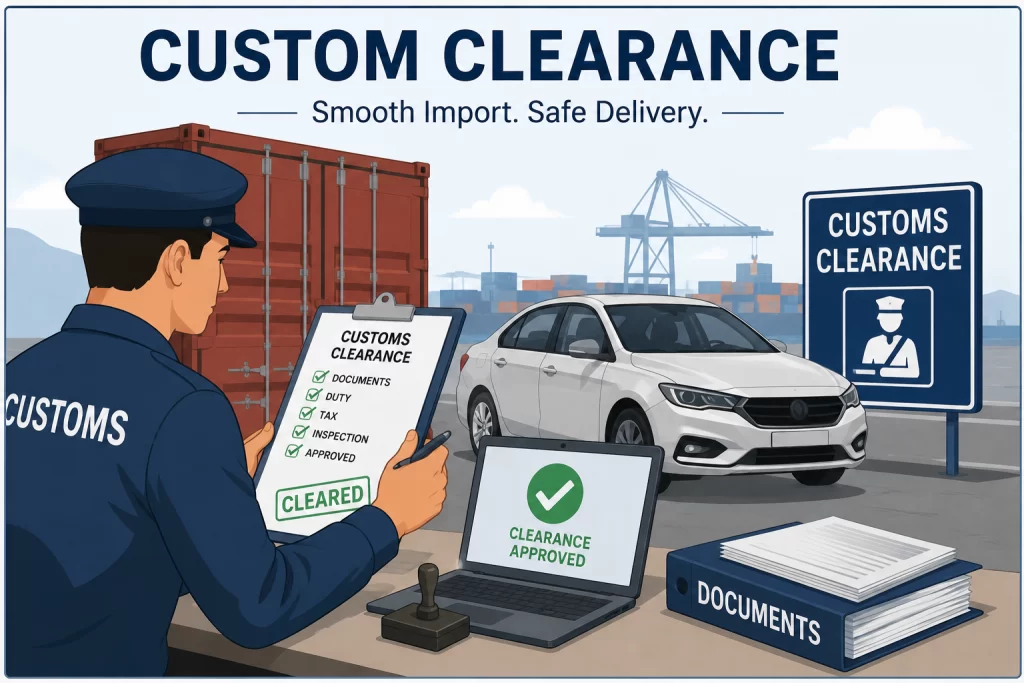
The timeframe for UK customs clearance can vary significantly based on several factors:
- Completeness of Documentation: Accurate and complete paperwork submitted promptly is crucial for swift processing. Missing or incorrect documents are the most common cause of delays.
- Vehicle Inspection: If HMRC decides to physically inspect the vehicle, this can add time, especially if the vehicle is at a busy port.
- Customs Workload: The general volume of imports being processed by HMRC at any given time.
- Complexity of Import: ToR applications or vehicles with unusual specifications may require more detailed scrutiny.
- Port Operations: Efficiency of the port authorities in handling documentation and releasing cargo.
Typical Timelines:
- Standard Clearance: With all documentation in order, clearance can often be achieved within 2-5 working days after the vehicle’s arrival and the submission of the import declaration.
- Delays: If issues arise with documentation, inspections, or compliance checks, clearance can take 1-2 weeks or longer.
Ship Cars Ltd works diligently to ensure all necessary pre-arrival information is submitted correctly to minimise delays. We maintain constant communication with customs brokers and port authorities to expedite the process.
What Can Go Wrong? Common Customs Clearance Issues
Despite best efforts, several issues can cause delays or complications during UK customs clearance:
- Incorrect Vehicle Valuation: Undervaluation of the vehicle can lead to penalties and delays as HMRC investigates. Providing accurate purchase invoices and supporting documentation is vital.
- Incomplete or Inaccurate Documentation: Missing forms, incorrect details (VIN, model year), or lack of proof of ownership are common reasons for rejection or holds.
- Failure to Meet UK Standards: If a vehicle does not meet UK emissions or safety standards (and isn’t being modified), it cannot be cleared for normal use on UK roads. This issue is addressed by the DVSA’s IVA test, which is separate from customs but often a prerequisite for final release and registration.
- ToR Application Issues: Submitting the ToR application late, not having it approved before arrival, or failing to meet the eligibility criteria will result in the full payment of duties and taxes.
- Prohibited or Restricted Goods: Attempting to import items that are banned or restricted in the UK, even if within the vehicle.
- Lack of Clear Evidence of Origin: Difficulty in proving the vehicle’s country of origin can impact duty rates.
- Shipping Personal Belongings (on RoRo): As RoRo explicitly forbids personal items, discovering them can lead to penalties, confiscation, or refusal of clearance.
What Is The Ship Cars Ltd.’s Role in Customs Clearance
Ship Cars Ltd. provides end-to-end support for your vehicle import, including navigating customs clearance:
- Shipping Method Expertise: We offer RORO, container shipping that includes; shared container, and dedicated container services, ensuring the right method for your vehicle.
- Documentation Assistance: We guide you on the required paperwork for both export from the origin country and import into the UK.
- Customs Liaison: We work with trusted customs brokers and directly with port authorities to facilitate the clearance process.
- Duty and Tax Guidance: We help you understand the potential tax and duty liabilities based on the vehicle’s origin and value.
- Pre-Clearance Procedures: We aim to submit necessary declarations ahead of the vehicle’s arrival to expedite the process.
Other Resources:
- Customs Clearance
- How to Prepare Your Car for Shipping
- Preparing Your Car for Export
- Top 10 Mistakes People Make During International Car Shipping
- How to Avoid Damage with International Shipping
- International Container Shipping
Entrust your UK to Ship Cars Ltd. Our expertise ensures your imported vehicle moves smoothly through the necessary procedures, allowing you to enjoy your car on UK roads sooner. Please do not hesitate to contact us to discuss your vehicle import and customs clearance needs. Please check our RORO Sailing schedule for further details.
FAQs – Customs Clearance
How much duty do I pay to import a car to the UK?
Most cars from outside the EU pay 10% import duty on the CIF value, plus 20% VAT on the duty-inclusive total. Vehicles over 30 years old pay 0% duty and 5% VAT.
How is UK car import duty calculated?
Duty is 10% of CIF value (car price + shipping + insurance). VAT is 20% of the CIF value plus the duty. On a £20,000 car with £1,700 shipping, total tax is approximately £6,900.
Can I avoid duty and VAT when importing a car to the UK?
Yes — under Transfer of Residence (ToR) relief if you are relocating to the UK after living abroad for at least 12 months and owned the vehicle for at least 6 months. HMRC ToR1 approval is required before the car arrives.
How long does UK customs clearance take for an imported car?
2–5 working days with correct documents submitted in advance. Documentation errors or physical inspections can extend this to 1–2 weeks.
Does an imported car need an IVA test?
Yes, if the vehicle has no UK or EU type approval — most Japanese domestic market cars and some US imports require an IVA test before UK registration.
What is the Expensive Car Supplement on imported cars?
A fixed £440/year VED surcharge applied for years 2–6 on cars with an original list price above £40,000 (£50,000 for EVs from April 2026). It is charged at registration, not at customs.
What documents are needed for UK customs clearance?
Original Bill of Lading, purchase invoice, vehicle title or certificate of origin, passport, and the import declaration (C88/SAD) filed by your customs broker. ToR applicants also need their HMRC-approved ToR1 reference number.


