


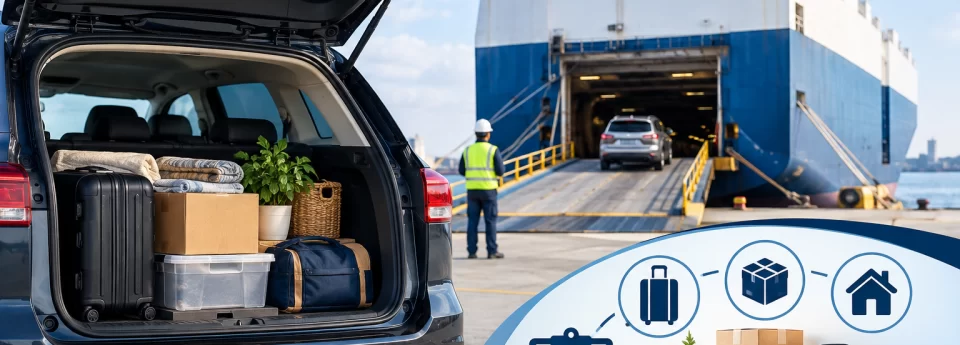
Can I Ship Personal Belongings With My Car When Shipping Internationally?
Quick answer: Whether you can ship personal belongings with your car depends entirely on your shipping method. If you are using RoRo (roll-on/roll-off) shipping, the answer is no — personal items are prohibited without exception. If you are using container shipping, limited personal effects may be permitted inside the vehicle, but only with prior written approval from both the shipping line and the destination customs agent. There is no single rule that applies to all shipments — it varies by method, destination country, and what you are shipping.
Shipping your car overseas is already a significant undertaking. The question of whether you can use that empty boot space to carry some of your belongings seems straightforward — and the answer is anything but. Get this wrong and you risk customs seizure, financial penalties, your shipment being delayed at the port, and potentially having your vehicle held until you pay to remove or dispose of the items. This guide gives you the actual rules, destination-specific considerations, and the process ShipCars follows for approved personal effects shipments.
Why This Question Matters More Than Most People Realize
Most customers asking this question are in the middle of an international relocation — moving to Australia, returning to Pakistan, starting a new role in Dubai, or emigrating to Canada. They are under pressure, time-constrained, and trying to consolidate costs. Packing a few boxes in the back of a car before it goes into a container feels like a natural solution.
It is not, however, a decision to make without understanding the full picture:
- Customs authorities in most countries treat the vehicle and its contents as two separate consignments. Even if the car is being shipped under a personal import scheme, additional goods inside it may attract separate duties and taxes.
- Shipping lines have their own rules that are entirely separate from customs regulations. Even if your destination country allows personal effects, your shipping line may not.
- Marine insurance does not cover personal effects packed inside a vehicle as standard. If items are stolen, damaged, or lost, you have no claim under your car’s transit policy.
- Prohibited items can invalidate your entire shipment — not just the items themselves.
Understanding this before you ship is considerably less painful than discovering it at Karachi Port three weeks after your car left Southampton.
The Most Important Rule: RoRo vs Container Shipping
The first question is always which shipping method you are using. This is not a minor distinction — it determines everything that follows.
RoRo Shipping — Absolute Prohibition on Personal Items
RoRo (roll-on/roll-off) shipping means your vehicle is driven onto a vessel, parked in an open or semi-open vehicle deck, and driven off at the destination port. It is the most common method for mainstream routes and is typically the lower-cost option — you can read more about RoRo car shipping and how it compares to container shipping on the ShipCars website.
On a RoRo vessel, there is an absolute prohibition on personal items inside the vehicle. This is not a ShipCars policy — it is a requirement of international maritime law. Under the International Maritime Dangerous Goods (IMDG) Code and the standard terms of all major shipping lines operating RoRo vessels, vehicles must be empty of all personal effects, loose items, and any cargo. The prohibition exists because vehicles are parked in enclosed, multi-deck spaces without regular inspection. A leaking container of shampoo is manageable in a household. On a vehicle deck carrying 2,000 vehicles, it is a fire and contamination risk.
Enforcement: Vehicles are inspected at UK port before loading. Items found inside will be removed. In some cases, the vehicle may be refused loading. The cost of removal, storage, and any delay is borne by the vehicle owner, not the shipping line.
If you are using RoRo shipping, you cannot ship personal belongings inside your car. That is the complete answer for this method.
Container Shipping — Permitted With Prior Approval
Container car shipping places your vehicle inside a standard 20ft or 40ft steel shipping container. The container is sealed at point of loading and not opened again until it reaches the destination port. This provides two things that RoRo does not: physical enclosure and separation from the rest of the vessel’s cargo.
In a container shipment, limited personal effects inside the vehicle may be permitted — but only with prior written approval from both the shipping line and the destination agent. ShipCars does not allow customers to simply declare items informally or pack without authorisation. The approval process (detailed in Step 3 below) must be completed before any packing takes place.
The key words are limited and prior. This is not a baggage-in-the-boot free-for-all. Quantity, item type, declared value, and destination all affect whether approval is granted — and approval can be withheld.
What You Can and Cannot Ship Inside a Container Vehicle
Items That Are Generally Permissible
The following categories of personal effects are typically permitted subject to approval, destination rules, and declaration:
- Clothing and soft textiles (boxed and sealed, not loose)
- Books and documents
- Small household items — crockery, ornaments, non-electrical items
- Children’s toys (non-battery, non-pressurised)
- Sports equipment not subject to country-specific restrictions
- Bedding and towels (sealed)
- Personal electronics — phones, tablets, laptops (declared with serial numbers; batteries must be within safe charge levels per IATA/IMDG guidelines)
These items must be:
- Declared in full on the inventory submitted to ShipCars
- Boxed, sealed, and labelled
- Loaded at the ShipCars depot under supervision
- Not exceed the agreed weight limit (varies by shipping line and destination)
Items That Are Strictly Prohibited
The following are never permitted inside a vehicle shipment under any circumstances, regardless of shipping method, destination, or approval status:
- Fuel exceeding a quarter of a tank (enforced for all shipments)
- Gas canisters, aerosol cans, or pressurised containers of any kind
- Loose batteries or battery packs (beyond what is factory-installed in declared electronics)
- Firearms, ammunition, or replica weapons
- Fireworks, flares, or pyrotechnics
- Alcohol, tobacco, or vaping products (in most destinations — high customs scrutiny)
- Food items of any kind — fresh, tinned, or packaged
- Plants, seeds, soil, or organic matter
- Prescription or over-the-counter medications beyond personal use quantities
- Currency or high-value negotiable instruments
- Anything listed as a controlled substance in the origin or destination country
- Any item not declared on the approved inventory
Consequence of undeclared items: If prohibited or undeclared items are found at the destination port, customs authorities may seize the entire container pending investigation. Financial penalties are levied on the importer, not ShipCars. In serious cases (weapons, controlled substances, large quantities of undeclared goods), criminal proceedings can follow. There is no grey area here.
The Ship Cars Approval Process for Shipping Personal Effects
ShipCars manages the approval process on your behalf, but the process must be followed in sequence. Do not pack anything until you have written approval from both parties.
Step 1 — Shipping Line Approval
ShipCars submits a detailed inventory of your proposed personal effects to the shipping line operating your specific sailing. Each shipping line has its own policies — some are more permissive than others, and policies can change. Approval from one shipping line does not mean approval from all of them.
What the shipping line assesses:
- Total weight of personal effects versus vehicle weight
- Item categories — particularly electronics, pressurised items, or anything that could be considered dangerous goods
- Volume — whether items can be safely loaded inside the vehicle without compromising the container load
- Destination country regulations that the shipping line must comply with as operator
Approval from the shipping line takes two to five working days and is confirmed in writing.
Step 2 — Destination Agent Confirmation
Parallel to shipping line approval, ShipCars contacts the destination customs clearing agent in your arrival country to confirm the personal effects will clear customs at that end. This is not the same as knowing the general rules — it is route-specific, importer-specific, and sometimes consignment-specific confirmation.
What the destination agent assesses:
- Import eligibility of your specific items in that country (some countries prohibit categories the UK does not)
- Duty liability — estimated customs duty and taxes on the personal effects value
- Documentation required at destination for clearance
- Whether any items require special import permits at destination
Both confirmations must be received before ShipCars gives the go-ahead to pack.
Step 3 — Packing Under Supervision at the Depot
Once written approval is received from both parties, personal effects must be packed and loaded at ShipCars’ secure depot under staff supervision immediately before the container is sealed. You cannot pre-pack items at home and bring them ready-loaded. This requirement exists because:
- It allows physical inspection of items against the approved inventory
- It ensures safe positioning inside the vehicle (items are secured, not loose)
- It provides a documented record of exactly what was loaded, which protects both parties at destination customs
Any item brought to the depot that was not on the approved inventory will not be loaded.
Destination-Specific Rules Worth Knowing
Personal effects rules vary significantly by destination. The following notes cover the countries most relevant to ShipCars’ customers — but always confirm the current position with ShipCars before shipping, as rules update without notice.
Australia
Australia operates some of the strictest biosecurity rules of any destination in the world. Personal effects inside a shipped vehicle are subject to scrutiny by the Australian Border Force and the Department of Agriculture, Fisheries and Forestry. All organic material — food, plant-based products, soil, wood, leather — faces inspection and potential destruction. Declared items that are found to harbour biosecurity risks are confiscated at the importer’s cost. For car shipping to Australia, the practical advice is: do not pack anything that has ever come into contact with soil, plants, or unprocessed food. The risk of biosecurity seizure far outweighs any shipping cost saving.
United States of America
CBP (US Customs and Border Protection) permits limited personal and household effects inside a vehicle shipment under specific circumstances, primarily when the importer is relocating to the US. Items must be declared on the CBP 3299 form. The CBP household effects exemption applies only to used personal effects for personal use — new, commercial quantities, or items for resale are not covered. CBP has wide powers to inspect and hold containers, and undeclared items carry civil and criminal penalties under US law.
United Arab Emirates (Dubai / Abu Dhabi)
The UAE has specific prohibitions on content that conflicts with Islamic law or UAE federal regulations — certain publications, media, foods, and other items may be confiscated regardless of their legality in the UK. For shipping a car from the UK to Dubai, Dubai Customs also requires a detailed packing list for any personal effects, and duty is charged on the declared CIF value of the goods. Pre-approval from the destination agent is non-negotiable on this route.
Pakistan
Pakistan Customs at Karachi treats vehicle contents as part of the overall import declaration. Vehicles imported under the Transfer of Residence (TR) scheme or Gift scheme must have personal effects declared separately, and duty applies to the declared value at destination customs rates. For car shipping from the UK to Pakistan, ShipCars strongly recommends liaising with a licensed Pakistani customs clearing agent before the vehicle departs the UK — given the complexity of Pakistan’s current import regulations under the Finance Bill 2026-27, anything undeclared or incorrectly classified creates significant clearance risk.
Insurance: What Your Marine Policy Does and Does Not Cover
This is the section most customers do not read until something goes wrong. Read it now.
Standard marine transit insurance taken out through ShipCars (or any reputable marine insurer) covers the vehicle itself against loss or damage during transit. The policy specifically excludes personal effects, cargo, and any items packed inside the vehicle.
What this means in practice:
If your vehicle is damaged in transit and you have marine insurance, your claim covers the vehicle. The clothing, electronics, or household items packed in the boot are excluded — you will receive nothing for them, regardless of their value, and the insurer will not be in breach of contract.
Your options for insuring personal effects:
- Separate contents/transit insurance: Arranged independently through a removal company or specialist marine cargo insurer. This is the appropriate product for personal effects in transit.
- Household goods removal insurance: If you are using a removal company for the rest of your belongings, extending that policy to cover the items in the vehicle may be possible — confirm with the insurer.
Read more about what is and is not covered under marine insurance for car shipping before finalising your decision.
The Recommended Alternative: Ship Your Vehicle Empty
ShipCars’ direct advice for most customers is this: ship the vehicle empty and use a dedicated international removal company for your belongings.
This is not a commercial position — it is the practical recommendation based on what actually goes wrong in shipments where personal effects are included:
- Approval process adds time to a booking that may already be tight
- Destination customs queries on personal effects add to port clearance time
- Items are physically inaccessible for the entire transit period (six to ten weeks on long-haul routes)
- Prohibited items discovered at destination create problems for the entire shipment, not just the items
- Insurance cover for the items does not exist under the vehicle policy
International removal companies that specialise in household goods are equipped, insured, and experienced for exactly this job. Their combined transit cost with your car shipping from ShipCars will, in most cases, deliver a better outcome with less risk than attempting to consolidate everything into one container vehicle.
If you do wish to proceed with personal effects in a container shipment, ShipCars will manage the process — but go into it with realistic expectations about the additional time, cost, and documentation involved.
Your Action Plan Before Shipping
If you are considering shipping personal effects with your car, follow this sequence:
- Confirm your shipping method. If it is RoRo — stop here. Personal effects are not possible on RoRo.
- Contact ShipCars at the earliest stage of your booking. Do not leave this until the week of collection — approval takes two to five working days and the booking timeline needs to accommodate it.
- Prepare a complete, itemised inventory. Every item, quantity, approximate age, and estimated value. No categories, no “miscellaneous box” — every individual item. Incomplete inventories delay approval.
- Check your destination’s specific rules using the destination-specific notes above and via the ShipCars team.
- Arrange separate insurance for personal effects — do not assume your vehicle policy covers them.
- Wait for written approval from both the shipping line and destination agent before packing anything.
- Bring items to the ShipCars depot on the agreed date for supervised packing.
Get Your Car Shipping Quote
Whether you are shipping your car empty or with approved personal effects, the first step is a quote.
Call: 01495 320540 Email: info@shipcars.co.uk Get a free online quote →
Our team will confirm which shipping method applies to your route, whether your destination permits personal effects, and what the approval timeline looks like for your departure date. Call us before you start packing.
Frequently Asked Questions
Can I ship personal belongings inside my car when using RoRo shipping?
No — without exception. RoRo shipping imposes an absolute prohibition on personal items inside any vehicle. This is an international maritime safety requirement, not a ShipCars policy. Vehicles are inspected at UK port before loading, and items found inside will be removed at the owner’s cost. The only shipping method that allows personal effects is container shipping, and only with prior written approval.
Can I ship personal belongings in a container car shipment?
Yes — but only with prior written approval from both the shipping line and the destination customs agent. ShipCars manages this process on your behalf, but you must request it at the point of booking. Approval takes two to five working days. No items should be packed until written confirmation from both parties is received.
What personal items are completely prohibited in a car shipment?
Items never permitted under any circumstances include: fuel beyond a quarter tank, gas canisters, aerosols, loose batteries, fireworks, ammunition, any food items, plants, seeds, soil, medications beyond personal use quantities, alcohol, tobacco, currency, and any item not declared on the approved inventory. Undeclared items discovered at destination can result in seizure of the entire container and financial or criminal penalties.
How long does the Ship Cars approval process take for shipping belongings with a car?
Two to five working days once ShipCars receives a complete, itemised inventory from you. Incomplete or vague inventories (categories rather than individual items, missing values) extend this timeline. For that reason, approach ShipCars as early in your booking process as possible — do not leave it until the week before collection.
Do I need to pay extra customs duty on personal effects shipped inside my car?
Almost certainly yes. Most destination countries treat personal effects packed inside a vehicle as a separate customs entry from the vehicle itself. Duty is assessed on the declared value of the items at the applicable rate in that country. The exact amount depends on destination, item categories, and your import status. Your destination agent will provide a duty estimate as part of the approval process.
Are personal belongings covered by my car’s marine insurance policy?
No. Standard marine transit insurance covers the vehicle itself and specifically excludes personal effects packed inside it. To insure personal effects in transit, you need a separate contents or cargo insurance policy — either through an international removal company or a specialist marine cargo insurer. Do not assume coverage exists for items in the vehicle under any standard vehicle transit policy.
What is the safest alternative to shipping personal effects with my car?
Ship your vehicle empty and use a dedicated international removal company for your household goods and personal effects. Removal companies are licensed, insured, and experienced for this purpose. Your belongings travel in a dedicated removal container with appropriate insurance, and the vehicle arrives in a clean, unencumbered state that simplifies customs clearance at destination. This approach reduces risk, adds no complexity to the vehicle shipment, and typically results in faster port clearance.
What happens if I pack items without declaring them to ShipCars?
Consequences range from confiscation of the items through to seizure of the entire container pending customs investigation, financial penalties levied on you as the importer, and in serious cases — particularly where prohibited goods such as medications, controlled substances, or undeclared currency are involved — criminal proceedings and vehicle forfeiture. The shipping line and ShipCars bear no liability. The cost and legal exposure fall entirely on the vehicle owner. Always declare everything, regardless of whether you think it is significant.
Related Guides
- Container Car Shipping: How It Works and What It Costs
- RoRo Car Shipping Explained
- Documents Required to Ship a Car from the UK
- Marine Insurance for Car Shipping: What’s Covered
- How to Ship a Car to Australia from the UK
- How to Ship a Car from the UK to Pakistan
Last updated: 15 October 2026 | Reviewed By: Director Navdeep Singh (1o years experience in international vehicle shipping)


