


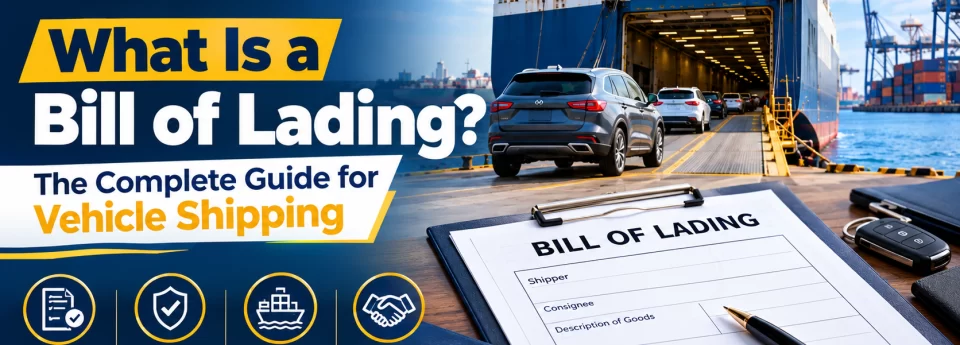
What Is a Bill of Lading? The Complete Guide for Vehicle Shipping
A Bill of Lading (BoL) is the most important document in any international vehicle shipment. It serves three functions simultaneously: a receipt confirming the shipping line has received your vehicle, a contract of carriage between the shipper and the carrier, and a document of title giving legal ownership of the vehicle to whoever holds the original. The destination port will not release your vehicle without the original Bill of Lading — or a Telex Release authorisation. ShipCars issues and manages the Bill of Lading for every vehicle we ship.
Bill of Lading: Your Vehicle’s Passport and Contract
In the intricate world of international shipping, few documents carry as much weight and importance as the Bill of Lading (B/L or BoL). For anyone shipping a vehicle overseas, understanding this document is not just beneficial—it is essential. It functions as a multi-purpose instrument that governs the entire transit of your car.
At ShipCars, we demystify this critical document for our clients. This guide explains exactly what a Bill of Lading is, its key functions, and the crucial difference between a traditional Paper Bill of Lading and the modern, efficient Telex Release.
What is a Bill of Lading?
A Bill of Lading is a legally binding document issued by a shipping line (the carrier) to the shipper (or their agent, like ShipCars) that details a shipment of merchandise. For your vehicle, it is the single most important piece of paper in the shipping process documentation.
It serves three fundamental and distinct roles:
-
A Receipt of Goods
The Bill of Lading acts as a formal receipt from the shipping line, confirming they have received your vehicle in an apparent good order and condition (unless damage is noted at the time of loading) for transport. It documents:
- The vehicle’s description (make, model, VIN).
- The date of receipt.
- The port of loading.
- The intended vessel and voyage.
-
A Contract of Carriage
It embodies the contract between the shipper and the carrier for the transportation of the goods. It outlines the terms, conditions, and obligations of both parties, including the route, the freight charges, and the liability clauses.
-
A Document of Title
This is the most powerful function of a Bill of Lading. It represents legal ownership of the vehicle itself. To take possession of the vehicle at the destination port, the original, negotiable Bill of Lading must be surrendered to the shipping line. This makes it a critical instrument in trade and finance.
The Two Key Types: Paper Bill of Lading vs. Telex Release
Historically, the only form of Bill of Lading was a physical, paper document. However, in today’s digital age, the Telex Release has become the standard for efficiency and security. The choice between them has significant implications for the speed and process of your shipment shipping your vehicle overseas.
The Traditional Paper Bill of Lading
A Paper Bill of Lading is a physical, original document set, often issued in three negotiable originals.
-
The Process:
- The shipping line issues the original paper documents at the port of loading.
- We, as your agent, receive these originals and courier them to you or directly to the destination agent.
- The recipient (consignee) in the destination country must present at least one original Bill of Lading to the shipping line’s office at the discharge port to obtain the “Delivery Order” needed to collect the vehicle.
-
Key Characteristics:
- Physical Transfer: Requires international courier services (e.g., DHL, FedEx).
- Inherent Delays: The shipping process can be paused for days or weeks while the paper documents are in transit.
- Security Risk: If the original documents are lost or stolen, it becomes extremely difficult and time-consuming to take possession of the vehicle, often requiring a bank guarantee.
The Modern Telex Release (e-Release)
A Telex Release (also known as a Surrender Bill of Lading or Electronic Release) is a digital process that eliminates the need for physical document transfer.
-
The Process:
- At the port of loading, the shipper (Ship Cars) instructs the shipping line to “surrender” the Bill of Lading.
- We provide the shipping line with a “Letter of Indemnity” and surrender all original Bills of Lading (if they were printed) to them.
- The shipping line then sends an electronic message (the “Telex Release”) to their office at the destination port, authorising the release of the cargo.
- The consignee at the destination can then collect the vehicle by simply presenting their photo ID and a copy of the Bill of Lading, without needing the original paper document.
-
Key Characteristics:
- Speed: It is instantaneous. The release authorisation is sent electronically, preventing any documentary delays.
- Security: There is no risk of losing physical documents in the post.
- Efficiency: It streamlines the entire collection process at the destination.
- Cost: There is usually a fee from the shipping line for this service, but it is often less than the cost and risk of international couriers.
Paper Bill of Lading vs. Telex Release: A Direct Comparison
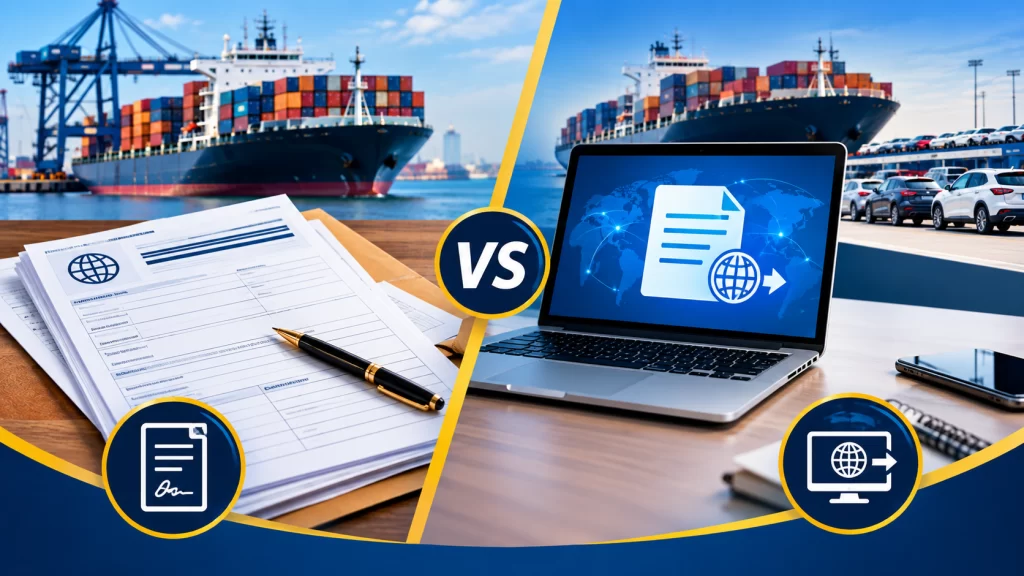
| Feature | Paper Bill of Lading | Telex Release (Electronic) |
|---|---|---|
| Document Form | Physical, original paper documents. | Electronic authorisation; no original papers needed at destination. |
| Transfer Method | International courier (slow). | Digital message/email (instant). |
| Impact on Speed | Can cause significant delays while documents are in transit. | Prevents documentary delays; vehicle can be collected as soon as it arrives. |
| Security | Risk of loss, theft, or damage to the originals. | Highly secure; no physical documents to lose. |
| Cost Implications | Couriers costs are high; risk of further costs if lost. | A service fee applies, but is typically more cost-effective overall. |
| Ideal For | Situations where original documents are legally required for bank transactions or letters of credit. | The vast majority of vehicle shipments, where speed and efficiency are priorities. |
What Happens at the Destination Port For BOL
When your vehicle arrives at the destination port, your appointed customs clearing agent will present either the original Bill of Lading or the Telex Release notification to the shipping line’s local office. This generates a Delivery Order — the terminal-specific document that authorises the port to physically release your vehicle from their custody.
Handling BOL To the Destination Agent
If you are using a Paper Bill of Lading, the original must be in the hands of your destination agent before the vessel arrives. If ShipCars is couriering the original to the destination, allow for courier transit time — typically three to five working days internationally. A vehicle sitting at a destination port waiting for paper documents accumulates daily storage charges from the day the free storage period ends.
If you are using a Telex Release, the electronic authorisation is sent the moment ShipCars surrenders the original documents at the UK port. Your destination agent can begin the clearance process as soon as the vessel arrives — there is no documentary wait.
What “Claused” Means and Why It Matters
The article mentions a claused BoL in the common issues section but does not fully explain it. Add this paragraph:
A clean Bill of Lading states the vehicle was received in apparent good order and condition. A claused Bill of Lading has a notation from the shipping line indicating visible damage or discrepancy observed at loading — for example “dented rear bumper” or “windscreen crack noted.” A claused BoL does not prevent the shipment but it creates a documented record that the damage existed before the voyage. This is relevant for insurance claims after arrival — if damage is claused on the BoL, the shipping line and their marine insurer will argue the damage pre-dated the voyage. ShipCars’ pre-shipment condition report and your own pre-collection photographs are your protection against disputing a claused notation.
Your Role and Responsibilities with the Bill of Lading
While we handle the issuance and management of the Bill of Lading, your input is crucial.
- Accuracy of Information: The details you provide us about the vehicle (VIN, make, model, year) and the consignee (recipient) must be 100% accurate. These details are printed on the Bill of Lading and are extremely difficult and expensive to amend later.
- Understanding the Type: We will advise you on whether a Telex Release or Paper Bill of Lading is most suitable for your shipment. For most private vehicle exports, a Telex Release is strongly recommended.
- Instructions for Paper B/L: If a Paper Bill of Lading is used, you must provide clear instructions on where to courier the original documents. You are then responsible for ensuring they reach the destination agent safely and promptly.
Common Bill of Lading Issues and How We Prevent Them
- Claused Bill of Lading: If the vehicle has visible damage upon loading, the shipping line may note this on the B/L, making it “claused.” This can complicate insurance claims. We conduct a pre-shipment inspection to ensure the vehicle is presented in the best possible condition.
- Amending a B/L: Amendments after issuance incur hefty fees from the shipping line. Our rigorous checking process before submission ensures all your details are correct the first time.
- Lost Original B/L: This is a severe problem. We mitigate this risk by strongly recommending the Telex Release process, which eliminates the hazard entirely.
How To Know The Bill of Lading in a Nutshell
- The Bill of Ladin is a Receipt, a Contract, and a Document of Title.
- It is the key that unlocks the release of your vehicle at the destination port.
- The Telex Release is the modern, fast, and secure standard for most vehicle shipments.
- The Paper Bill of Lading is a traditional method that can cause delays and carries security risks.
- The accuracy of the information on the Bill of Lading is paramount and relies on the details you provide.
Let Us Handle the Most Important Document
The Bill of Lading is the cornerstone of international shipping. With ShipCars, you don’t need to navigate its complexities alone. We manage its issuance, advise on the best type for your needs, and ensure the process is seamless, whether through a traditional paper document or a modern Telex Release.
Contact us today for a shipping quote, and trust us to manage the documentation that will see your vehicle safely to its new home.
Other Resources
FAQ — Bill Of Lading
What is a Bill of Lading in car shipping?
A Bill of Lading (BoL) is the most important document in international vehicle shipping. It simultaneously serves as a receipt confirming the shipping line has received your vehicle, a contract of carriage between the shipper and the carrier, and a document of title giving legal ownership of the vehicle to whoever holds the original. The destination port will not release your vehicle without either the original Bill of Lading or a Telex Release authorisation.
What is a Telex Release and how is it different from a Paper Bill of Lading?
A Telex Release (also called an electronic release or surrendered Bill of Lading) is a digital authorisation that eliminates the need to physically courier original documents to the destination. Once ShipCars surrenders the original documents to the shipping line at the UK port, an electronic authorisation is sent to the shipping line’s destination office, allowing the vehicle to be released without presenting paper originals. A Paper Bill of Lading requires the physical original to be couriered internationally and presented at the destination port — which can take days and creates the risk of loss or theft. For most vehicle shipments, Telex Release is the recommended method.
What happens if I lose my original Bill of Lading?
Losing an original Bill of Lading is a serious problem. The shipping line cannot release the vehicle without it and will typically require a Letter of Indemnity backed by a bank guarantee — a costly and time-consuming process that can delay vehicle collection by weeks. This is the primary reason ShipCars strongly recommends Telex Release for most vehicle shipments, as it eliminates the risk of losing physical documents entirely.
Can the details on a Bill of Lading be changed after it is issued?
Yes, but at significant cost and with delays. Any amendment to an issued Bill of Lading — correcting a VIN, changing the consignee name, or updating vehicle details — incurs an amendment fee from the shipping line, which can be substantial. The amendment must also be agreed by all parties. This is why accuracy in the booking form information you provide to ShipCars is critical — errors caught before the BoL is issued are corrected at no cost.
Why is the Bill of Lading called a document of title?
A document of title is a legal instrument that represents ownership of goods. Whoever holds the original, negotiable Bill of Lading is legally entitled to claim the vehicle at the destination port. This makes the original BoL as valuable as the vehicle itself during the period between shipping and collection. Keep it secure, courier it via a trackable international service if using a Paper BoL, and never allow unauthorised parties to take possession of it.
Does ShipCars manage the Bill of Lading process?
Yes — ShipCars issues and manages the Bill of Lading for every vehicle we ship. We advise on whether Telex Release or Paper BoL is most appropriate for your shipment, ensure all vehicle and consignee details are correct before issuance, and handle all documentation with the shipping line at the UK port. For most private vehicle exports, we recommend Telex Release for its speed and security advantages.


