Japan to UK Shipping
Shipping a car from Japan to the UK costs from £1,400 via RoRo or from £1,454 in a container shipping from Yokohama. Ocean transit takes around 55 days depending on route and method. Japan-manufactured vehicles now qualify for 0% import duty under the UK–Japan CEPA trade agreement, which took full effect in January 2026 — though 20% VAT on the CIF value still applies. RoRo sailings from Japan run every 15 days, which is why most buyers choose our shared container (LCL) service — more frequent departures, fixed schedules, and better protection for your vehicle. We can also collect your car anywhere in Japan and deliver it to Yokohama port on your behalf. That’s the core answer. Now here’s everything you need to make it happen correctly.
Why Japan?
Japanese domestic market vehicles — commonly known as JDM cars — are consistently better-maintained than comparable UK-sourced examples. The Japanese Ministry of Land, Infrastructure, Transport and Tourism (MLIT) runs a rigorous vehicle inspection system called Shaken, which requires full mechanical checks every two years. A car that has passed Shaken multiple times has a verifiable maintenance record. Combined with Japan’s lower annual mileage averages, generally drier inland climate, and strict roadworthiness culture, the result is a pool of used vehicles in significantly better condition than what’s typically available in the UK at the same price point.
Then there’s value. A clean-title 2004 Nissan Skyline V35, a 2008 Subaru Impreza WRX STI, or a 2001 Toyota Land Cruiser 100 Series can be sourced from a Japanese auction for a fraction of what the equivalent UK example — if you can even find one — would cost. Add the 2026 CEPA zero-duty rate and the arithmetic changes substantially in the buyer’s favour.
Popular categories for UK buyers include:
- JDM performance cars — Skyline, Supra, Evo, STI, RX-7
- Japanese classic and collectors’ vehicles — early NSX, AE86, Cressida, Celica
- Practical used imports — Land Cruiser, Hilux, Alphard, Hiace
- Kei trucks and vans — Subaru Sambar, Honda Acty, Daihatsu Hijet
Shipping Methods: RoRo vs Shared Container
Roll-on Roll-off (RoRo)
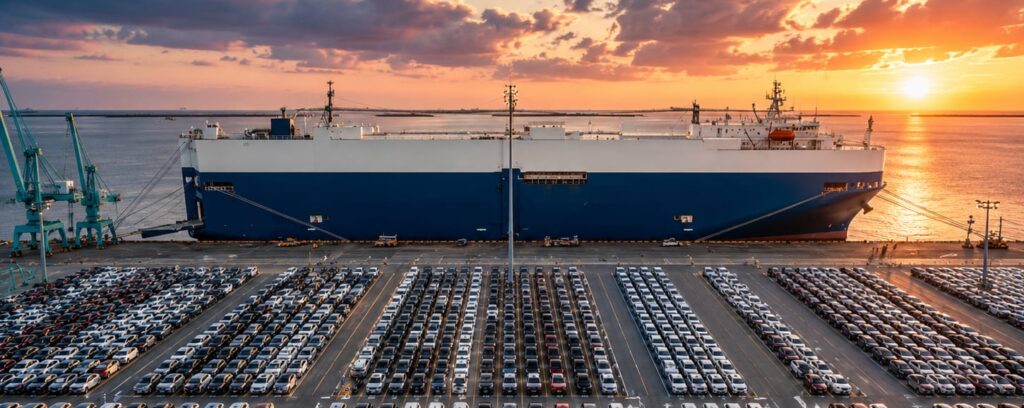
RoRo Shipping is the lowest-cost method for shipping a standard vehicle from Japan. Your car is driven onto a specialist RoRo vessel at the port of Yokohama or Nagoya, secured on the vehicle deck, and driven off again at the UK arrival port. It travels in the open air on the vessel’s enclosed decks — no container, no crating.
The catch with Japan RoRo: Sailings from UK to Japan are infrequent. Unlike the UK-USA route, which has weekly departures, RoRo vessels on the Japan-UK route are fully booked and takes months to book. If you miss a sailing window, you’re waiting another quarter. For many buyers, that waiting period simply doesn’t work.
| RoRo | Details |
|---|---|
| Cost (ocean freight) | £1,200–£1,800 |
| Departure port | Yokohama or Nagoya |
| UK arrival port | Southampton or Bristol |
| Ocean transit | 45–55 days (Suez route); 40–55 days (Cape route) |
| Sailing frequency | Every 15 days but fully booked for next few months |
| Best for | Standard vehicles, flexible timelines |
Shared Container (LCL) from Yokohama

Because RoRo sailings from Japan are so infrequent, Ship Cars Ltd offers a shared container (LCL — Less than Container Load) service departing from Yokohama. Your vehicle shares a 40ft container with other vehicles, splitting the container cost between shippers. Departures are significantly more regular than RoRo, and the enclosed container provides full weather and physical protection throughout the journey.
For high-value JDM vehicles, classic cars, or low-volume-bodied performance cars that you don’t want exposed on an open deck, the shared container is the right call regardless of cost.
| Shared Container (LCL) | Details |
|---|---|
| Cost (ocean freight) | From £1,454–£2,500 per vehicle |
| Departure port | Yokohama |
| UK arrival port | Felixstowe, Southampton, Bristol |
| Ocean transit | 45–50 days |
| Sailing frequency | More regular than RoRo — contact us for current schedules |
| Best for | Performance cars, classics, high-value vehicles, or anyone who can’t wait 3 months |
“Customer sourced a 2003 Nissan Skyline GT-R V-Spec from a Tokyo auction. Booked onto our shared container from Yokohama. Arrived Felixstowe 41 days later — zero damage, fully documented.”
- Collection Service: Trade Plate Driven, Open and Enclosed Transport
- Pre-Shipping Checklist for RoRo, LCL, and FCL Shipments
- Marine Insurance for Vehicle Shipping: Comprehensive Coverage Options and Pricing
Dedicated Container (FCL)
For buyers shipping two or more vehicles — dealers, collectors, or those also sending personal effects — a full 20ft or 40ft container offers maximum security and loading flexibility.
| Dedicated Container | Details |
|---|---|
| Cost | £2,800–£4,500 depending on size and route |
| Best for | Multiple vehicles, high-value single vehicles, personal effects alongside the car |
We Collect Your Car in Japan
One of the most common complications buyers face is getting a vehicle from an auction house or private seller to the port. Japan’s major auction hubs — USS Tokyo, TAA Yokohama, HAA Kobe, JU Aichi — are not always convenient to the nearest export terminal.
Ship Cars Ltd can arrange inland collection from any location in Japan — auction house, dealership, or private seller — and deliver the vehicle to Yokohama for container loading. This removes one of the biggest logistical headaches in the process and ensures your car arrives at the port correctly documented and ready for export.
If you’re buying from a Japanese domestic auction and need someone on the ground to handle the car between purchase and port, speak to us before you bid.
Japan Export Ports
| Port | Location | Notes |
|---|---|---|
| Yokohama | Kanagawa Prefecture | Primary export port for UK-bound vehicles; Ship Cars Ltd LCL container service departs from here |
| Nagoya | Aichi Prefecture | Alternative RoRo departure point; serves central Japan auction hubs |
| Osaka / Kobe | Kansai region | Useful for western Japan sourced vehicles |
| Tokyo / Hitachi | Greater Tokyo | Smaller export volumes; used for proximity to northeast auction houses |
Most buyers purchasing through Japanese auction platforms will find Yokohama the most practical and cost-effective departure port.
UK Arrival Ports
| UK Port | Type | Notes |
|---|---|---|
| Southampton | RoRo & Container | Primary RoRo arrival; regular Japan sailings |
| Felixstowe | Container | UK’s largest container port; common for LCL and FCL arrivals |
| Bristol (Portbury) | RoRo & Container | Alternative arrival for Midlands and South West buyers |
| Liverpool | RoRo & Container | Preferred for Northern England and Scotland deliveries |
After the vessel docks, customs clearance typically takes 5–10 working days. The NOVA declaration must be submitted within 14 days of the vehicle arriving in the UK or HMRC will issue a late notification penalty.
Read More Details About : How Much Does It Cost to Ship a Car to Japan? A Complete Guide
Import Taxes: The 2026 Picture
0% Import Duty — UK-Japan CEPA
This is the headline change that makes Japan-to-UK importing significantly more attractive in 2026. Under the UK–Japan Comprehensive Economic Partnership Agreement (CEPA), passenger cars manufactured in Japan now qualify for 0% import duty. This rate took full effect in January 2026 and is a permanent change — not a temporary scheme.
Before 2026: A car purchased for £6,000 with £1,400 shipping attracted roughly £740 in customs duty before HMRC would release it. From 2026: That same car pays £0 duty — provided the paperwork is correct.
Who Qualifies for 0% Duty?

Four conditions must be met — miss any one of them and HMRC defaults to the full 10% rate:
- The car must be manufactured in Japan — Toyota, Honda, Nissan, Mazda, Subaru, Suzuki, and Mitsubishi models built in Japan qualify. A BMW or Audi sold in Japan but built in Germany does not.
- A valid statement of origin must be provided — issued by the Japanese exporter; your shipping agent attaches this to the customs declaration.
- The car must ship directly from Japan to the UK — no re-clearing customs in a third country.
- The CEPA preference must be actively claimed — your customs agent must tick the preference box on the C88 form and enter the correct CEPA trade agreement code. If left blank, HMRC charges 10% automatically.
VAT — 20%
VAT at 20% applies to the CIF (Cost + Insurance + Freight) value regardless of duty outcome. It is separate from import duty and unaffected by CEPA.
Example calculation — qualifying CEPA vehicle:
| Item | Amount |
|---|---|
| Vehicle purchase price | £8,000 |
| Ocean freight (shared container) | £1,800 |
| Insurance | £100 |
| CIF value | £9,900 |
| Import duty (0% CEPA) | £0 |
| VAT (20% of £9,900) | £1,980 |
Compare that to a non-qualifying vehicle at the 10% MFN rate — the same £9,900 CIF value would attract £990 in duty plus VAT on top of that at 20% = £2,178 in tax, versus £1,980 under CEPA. The saving on a £9,900 CIF value is £1,188. On a more expensive car the saving grows proportionally.
Historic Vehicle Rate
Cars manufactured 30+ years ago in substantially original condition qualify for a separate duty classification under HMRC heading 9705 (collectors’ items of historical interest). These vehicles attract 0% import duty and — crucially — VAT is calculated on only 25% of the CIF value, producing an effective VAT rate of just 5% of the vehicle’s value.
For classic JDM imports — early Honda NSX, Nissan Skyline R32, Toyota Supra A70, Mazda RX-7 FC — this is a significant financial consideration and worth confirming with your customs broker before the car ships.
Vehicle Age Restrictions and IVA
The UK does not impose a blanket age restriction on vehicle imports. However, the approval requirement depends on the vehicle’s age:
- Vehicles under 10 years old: Require an Individual Vehicle Approval (IVA) test conducted by the DVSA. The test checks that the vehicle meets UK safety and environmental standards.
- Vehicles 10 years old or over: Exempt from IVA under the vehicle approval exemption for passenger cars more than 10 years old. They typically go through a standard MOT instead.
- Vehicles 30+ years old: May qualify as historic vehicles (heading 9705) for reduced tax treatment as above.
Common IVA Modifications for JDM Vehicles
Japanese domestic market cars are right-hand drive — which removes the conversion hurdle many US imports face. However, JDM vehicles still often require:
- Headlight beam adjustment — Japanese spec dips to the left; UK roads require dipping to the left too (same side), but alignment confirmation is often checked
- Speedometer — Japanese cars display km/h; UK IVA requires mph display or conversion
- Rear fog light — Many JDM vehicles don’t have one; a UK-spec rear fog must be added
- Side repeater indicators — Amber repeaters in the correct position if not already fitted
- Seatbelt compliance — Checked but rarely a modification requirement on standard JDM cars
IVA test and modification costs typically run £450–£1,200 depending on what needs changing.
“A collector in Edinburgh imported a 1997 Mazda RX-7 FD from an Osaka dealer. It qualified as a historic vehicle — VAT on 25% of CIF only. IVA modifications came to £550 at a Southampton specialist. Now registered and on the road.”
The Customs Process Step by Step
- Vehicle sourced in Japan — At auction, from a dealer, or privately.
- Ship Cars Ltd arranges inland collection — We collect from the seller or auction site and transport to Yokohama.
- Export documentation prepared — Japanese export certificate, deregistration from MLIT, statement of origin for CEPA, commercial invoice.
- Container loaded at Yokohama — Your vehicle is loaded into the shared or dedicated container; Bill of Lading issued.
- Ocean transit begins — 35–55 days depending on route (Suez or Cape of Good Hope).
- NOVA notification filed — Within 14 days of UK arrival, your customs agent files with HMRC through the NOVA system.
- Import declaration submitted — C88 filed by your UK customs broker, CEPA preference claimed, VAT assessed and paid.
- Vehicle released from port — Usually 5–10 working days after arrival once documentation is clean and VAT paid.
- IVA test (if under 10 years) — Booked at DVSA test centre; modifications done at a nearby specialist workshop first.
- DVLA registration — V55/4 (new) or V55/5 (used), plus original Japanese export certificate, NOVA confirmation, and IVA certificate. Registration fee: £55.
- V5C issued — Allow up to 6 weeks by post after application.
Required Documents
Getting the documents right — particularly the CEPA origin statement — before the car leaves Japan is the single most important thing you can do to protect your duty position. Core documents include:
- Original Japanese Export Certificate (Yushutsu Shomeisho) — Issued by MLIT. Proves the vehicle has been permanently deregistered from Japanese roads.
- Statement of Origin — CEPA-specific declaration provided by the Japanese exporter confirming the vehicle was manufactured in Japan. Without this, you pay 10% duty.
- Commercial Invoice — Purchase price, seller and buyer details, shipping cost breakdown.
- Bill of Lading — Issued by the shipping line; confirms direct shipment from Japan to UK.
- Packing List (for container shipments) — Describes the container contents and vehicle details.
- IVA Test Certificate (if applicable) — Required before DVLA will register vehicles under 10 years old.
- NOVA Confirmation Letter from HMRC — Required before DVLA will process the registration application.
- Proof of Vehicle Approval — IVA certificate or exemption confirmation.
- V55/5 Application Form — Used to register an imported used vehicle with DVLA.
You May Like to Read : Documents Required for Exporting a Vehicle from the UK
Transit Times: Japan to UK
| Route | Method | Ocean Transit | Total (incl. port & customs) |
|---|---|---|---|
| Yokohama → Southampton | RoRo (Suez) | 40–55 days | 8–10 weeks |
| Yokohama → Southampton | RoRo (Cape) | 40–55 days | 12–14 weeks |
| Yokohama → Felixstowe | Shared Container (LCL) | 45–58 days | 10–13 weeks |
| Yokohama → Bristol | Shared Container (LCL) | 48–50 days | 11–14 weeks |
| Yokohama → Liverpool | Container | 40–55 days | 12–15 weeks |
These are port-to-port ocean times. Allow additional time for:
- Inland collection in Japan to Yokohama: 1–5 days depending on location
- UK customs clearance: 5–10 working days after vessel arrival
- IVA test and modifications: 3–10 days if required
- DVLA processing and V5C by post: Up to 6 weeks
A realistic total timeline from purchase in Japan to driving on UK roads is 12–20 weeks. Planning ahead is essential.
Local Shipping Costs: Full Breakdown
The following illustrates an estimated cost for importing a 2006 Subaru Impreza WRX STI from a Tokyo auction to the UK via shared container from Yokohama:
| Item | Estimated Cost |
|---|---|
| Vehicle purchase price at auction | £9,500 |
| Japanese auction buyer’s premium (approx. 5%) | £475 |
| Inland Japan collection (auction to Yokohama) | £200–£400 |
| Shared container ocean freight (Yokohama → Felixstowe) | £1,600–£2,200 |
| UK port handling & terminal fees | £350–£500 |
| UK customs broker fees | £300–£500 |
| Import duty (0% CEPA — Japan-manufactured vehicle) | £0 |
| VAT (20% of CIF ~£11,800) | £2,360 |
| IVA test and modifications (vehicle is 20 years old — exempt from IVA) | £0 (MOT: £55) |
| DVLA registration fee | £55 |
| Estimated total (excl. vehicle purchase) | £4,920–£6,065 |
The same vehicle at the 10% non-CEPA rate (e.g., no origin statement supplied) would have attracted an additional £1,180 in duty plus VAT on that duty amount — demonstrating exactly why the paperwork matters.
You Can Also Read This : Price Breakdown For Shipping RoRo, LCL, and FCL
How Ship Cars Ltd Can Help
Shipping a car from Japan is not the same as shipping one from Europe. The auction system, Japanese export documentation, Shaken history verification, CEPA origin statement requirements, and the long transit windows all create complications that catch first-time importers out — sometimes expensively.
At Ship Cars Ltd, we handle Japan-to-UK shipments end to end:
- Vehicle collection anywhere in Japan — we coordinate inland transport from auction houses or private sellers to Yokohama port
- Shared container (LCL) service from Yokohama — regular departures, no 3-month RoRo wait, full weather protection for your vehicle
- CEPA origin documentation — we ensure the statement of origin is correctly prepared and attached to the customs declaration so you pay 0% duty, not 10%
- UK customs broker coordination — import declaration, NOVA filing, VAT payment, and port release managed on your behalf
- IVA guidance — for vehicles under 10 years old, we point you to experienced modification specialists near the UK arrival port
- End-to-end tracking — you’ll know where your car is from Yokohama to your door
We’ve shipped JDM performance cars, classic Japanese collectors’ pieces, Land Cruisers, commercial vans, and kei trucks. The route is familiar to us. The paperwork is not a mystery.
FAQs: Japan to UK Car Shipping
Q: Do I pay import duty on a Japanese car shipped to the UK in 2026?
A: No — if the car was manufactured in Japan and the correct CEPA origin statement is included with the shipping documents, import duty is 0% under the UK–Japan CEPA. If the origin statement is missing, HMRC defaults to 10%. VAT at 20% on the CIF value applies regardless.
Q: Why don’t you recommend RoRo from Japan?
A: We offer it, but RoRo sailings from Japan to the UK depart roughly every 3 to 4 months. Most buyers don’t want to wait that long after purchasing. Our shared container (LCL) service from Yokohama operates on a more regular schedule and provides better physical protection for the vehicle.
Q: Can you collect my car from a Japanese auction house?
A: Yes. We arrange inland collection from auction sites and dealerships across Japan — including USS Tokyo, TAA Yokohama, JU Aichi, and HAA Kobe — and deliver them to Yokohama for container loading.
Q: Does a JDM car need an IVA test?
A: Only if it’s under 10 years old. Vehicles 10 years old or older are exempt from IVA and go through a standard MOT instead. Japanese domestic market cars are right-hand drive, which removes the steering conversion issue, but JDM vehicles often still need a speedometer conversion, rear fog light, and IVA check on other compliance points.
Q: What is a Shaken certificate and do I need it?
A: Shaken is Japan’s compulsory vehicle inspection system, similar to an MOT but more comprehensive. It’s not required by UK customs, but it provides valuable evidence of the vehicle’s maintenance history and roadworthiness. A recently-passed Shaken certificate is a strong indicator of vehicle condition and can support your IVA preparation.
Q: Can I import a Nissan Skyline R34 from Japan?
A: Yes — from a UK customs and import regulation perspective, there is no specific age-based restriction preventing it. However, JDM R34 GTRs were never officially homologated for UK roads, so the IVA test requirements and any modification work should be discussed with a specialist before you commit to purchasing. The car itself can be legally shipped; the compliance route needs planning.
Q: What happens if my car is stuck at the Japanese port before loading?
A: Port congestion and berth changes can delay container loading. This is why we maintain regular communication with Yokohama-side agents. If a delay occurs, we notify you immediately and confirm the next available departure window.
Q: Is the shared container service safe for my car?
A: Yes. In a shared (LCL) container, each vehicle is individually secured and the container is sealed for the duration of the ocean transit. Your car is not accessible during shipping, which actually provides a higher level of protection and security than RoRo.
Country-Specific Case Studies
“A buyer in Manchester sourced a 2001 Toyota Land Cruiser 100 Series VX from an Osaka dealer. Collected by Ship Cars Ltd and loaded into a shared container at Yokohama. Arrived Liverpool 44 days later. CEPA origin statement confirmed 0% duty. Total import costs including VAT and customs broker: £3,800.”
“A classic car collector in Bristol imported a 1992 Honda NSX Type R — manufactured in Japan, 30+ years old, original specification. Classified under HMRC heading 9705 as a historic vehicle. Effective VAT rate: 5% of CIF value. 0% import duty. Shipped in a dedicated 20ft container from Yokohama to Portbury.”
“A dealer in London shipped four JDM vehicles in a single 40ft container — a Mazda RX-7 FD, two Subaru Imprezas, and a Nissan Stagea. CEPA preference was claimed on all four. Combined duty saving versus the 10% MFN rate: approximately £3,200 across the consignment.”
All costs, duty rates, and transit times are current as of July 2026. HMRC applies its own monthly GBP exchange rate — not the spot rate on the day of purchase — when assessing VAT. Contact Ship Cars Ltd for an up-to-date quote specific to your vehicle, its origin location, and your preferred UK arrival port.
Explore further resources:
-
For secure and versatile transport: International Container Shipping
-
Learn essential preparation steps: How to Prepare Your Car for Shipping and Preparing Your Car for Export
-
Understand common mistakes: Top 10 Mistakes People Make During International Car Shipping
-
Ensure safe transit: How to Avoid Damage with International Shipping
Contact Ship Cars Ltd. today to get a personalised quote and discuss your car shipping needs from Japan to the UK. We are dedicated to making your import experience smooth and successful.
We also provide fast and secure import services for car shipping from Yokohama to UK to the UK without any stress or delay. Contact us today for further information or visit our sailing schedule and get an instant quote to schedule your car shipping with us.
You may also want to read:
The Hidden Cost of Cheap Shipping
Car Shipping Costs Within The UK