


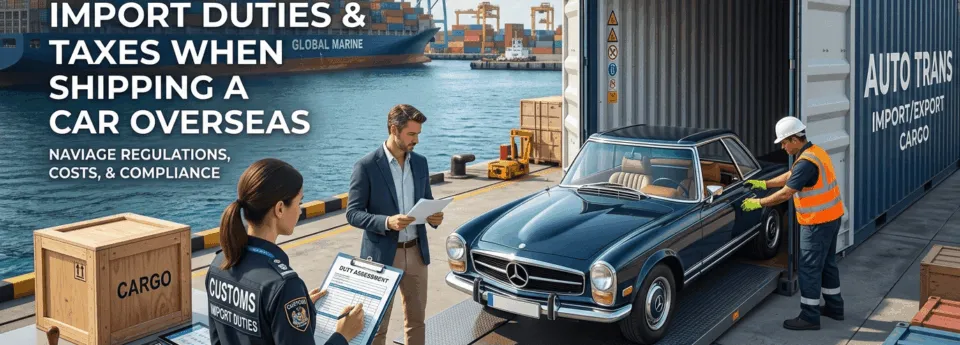
Complete Guide to Import Duties & Taxes When Shipping a Car Overseas
Shipping a car overseas is an exciting step — whether you’re relocating, selling a vehicle to a buyer abroad, or bringing a dream car home. But before your vehicle rolls onto the dock, there’s one thing every owner needs to get right: import duties and taxes.
At Ship Cars Ltd we’ve helped hundreds of customers navigate the paperwork, the costs, and the curveballs that come with international vehicle shipping. And if there’s one thing we’ve learned, it’s that knowing your tax obligations upfront can save you thousands — and a whole lot of stress.
Let’s walk through everything you need to know, from how duties are calculated to real-world examples from routes like the UK to Turkey, the USA, and Australia.
What Are Import Duties and Taxes For Vehicle Shipping?
When you ship a car from one country to another, the destination country’s customs authority will almost always charge a fee for allowing that vehicle into its market. This fee comes in two main forms:
- Import Duty – a percentage of the vehicle’s value, based on the destination country’s tariff rules.
- Import Taxes (VAT/GST) – a consumption tax applied on top of the duty and the vehicle’s value.
Together, these can range from as little as 2.5% to well over 50%, depending on where you’re shipping to.
Ship Cars Ltd Tip:
Always factor in these costs before you commit to a sale or relocation budget. We’ve seen customers get caught off guard by a £5,000 tax bill on a vehicle they thought would cost £800 to ship. Don’t be that person.
How Are Import Duties Calculated?
Customs authorities generally calculate duty based on three things:
- The vehicle’s CIF Value – Cost, Insurance, and Freight. This is the total value of the car plus the cost of shipping and insurance to get it to the destination port.
- The Harmonized System (HS) Code – Every vehicle has a specific tariff code. Most passenger cars fall under HS Code 8703.
- The Country of Origin – Where the vehicle was manufactured (not where it’s being shipped from).
Once these are determined, the duty rate is applied, and then VAT or GST is added on top.
Real Example:
Mark from Manchester shipped his 2019 BMW 3 Series to Sydney, Australia. The car’s value was £22,000, and shipping (RORO) cost £1,200. Australia applied a 5% import duty on the CIF value and then 10% GST on top of that total. His final tax bill came to around £3,500. “I’d budgeted for the shipping, but the taxes caught me out. Shipcars.co.uk walked me through every line item — I’d have been lost without it.”
Import Duties by Popular Destination
Let’s break down the real numbers for the three most common routes our customers ship.
Shipping from the UK to the USA
The USA is one of the most affordable destinations for import taxes:
| Charge | Rate |
|---|---|
| Import Duty (passenger cars) | 2.5% of CIF value |
| Customs processing fee | ~$85–$200 (fixed) |
| MPF (Merchandise Processing Fee) | ~0.3464% of value |
| State-level sales tax | Varies (applied at registration, not customs) |
Note: If the car is not US-spec (e.g., different speedometer, emissions), you may need modifications or a Show & Display exemption for rare models.
Real Example:
Sarah from Edinburgh shipped her classic 1974 MG MGB Roadster to Miami — a car she’d restored herself. The CIF value was £18,500. At 2.5% import duty, she paid only £462 in duty. Her total customs bill, including processing fees, was under £700. “I was dreading the customs part, but Shipcars.co.uk made it sound easy — and it was. The car cleared Miami port in two days.”
Car Shipping from the UK to Australia

Australia has a strict but manageable system:
| Charge | Rate |
|---|---|
| Import Duty (used cars) | 5% of CIF value |
| GST (Goods & Services Tax) | 10% on (CIF + duty + shipping + insurance) |
| Luxury Car Tax (LCT) | 33% on value above ~AUD $89,332 |
| Compliance & quarantine fees | AUD $500–$1,500 |
Key Point: Australia also requires a Vehicle Import Approval (VIA) before the car ships. This can take 4–6 weeks to process.
Ship Cars Customer Story:
James, a UK expat moving to Brisbane, shipped his 2021 Land Rover Discovery Sport (value £42,000). Using our container shipping service, his total landed cost including duties, GST, and quarantine was around £9,200. “The paperwork alone would’ve taken me weeks. Shipcars.co.uk handled the customs agent introductions and made sure my VIA was approved before the container even left Southampton.”
RORO vs Container Shipping: Which Is Better for Tax Purposes?
One question we get a lot: Does my shipping method affect how much tax I pay?
The short answer: Yes, indirectly.
RORO (Roll-on, Roll-off)
- Your car is driven onto a vessel and secured on deck.
- Cheaper — typically £800–£1,500 for most routes.
- Lower freight cost = lower CIF value = slightly lower duty.
- Best for: standard cars, older vehicles, budget-conscious shipping.
Container Shipping (FCL or Shared)
- Your car is loaded into a sealed container (often with household goods).
- More expensive — £1,800–£3,500 depending on route.
- Higher freight cost = higher CIF = higher duty, but…
- Better protection for valuable or classic cars.
- You can pack belongings around the car (subject to customs rules).
Car Shipping Via Container Shipping Method
Ship Cars Ltd Advice:
If you’re shipping a high-value car (over £30,000), use a container. The extra shipping cost is marginal compared to the protection and peace of mind. And don’t try to undervalue your car on customs forms — it’s illegal and almost always flagged.
- You can also read RoRo vs Container Shipping
How to Reduce Your Import Duty (Legally)
There are a few legitimate ways to reduce your tax bill:
- Personal Import Exemptions – Many countries (including Australia, Canada, and parts of the EU) offer reduced or zero duty if you’re relocating and have owned the vehicle for 6–12+ months.
- Temporary Import Permits (TIR / Carnet) – If you’re touring or staying less than 12 months, you may not need to pay duty at all.
- Classic / Vintage Car Status – Some countries (e.g., USA, UK) offer lower rates or exemptions for vehicles over 25–30 years old.
- Vehicle Value Declaration – Keep your purchase invoice, receipts for modifications, and proof of depreciation. Customs officers accept genuine market-based valuations.
Important: Customs fraud is a serious offence. Always declare accurately and keep documentation. At Ship cars ltd, we connect you with experienced customs brokers who handle every form correctly — so you never have to guess.
Step-by-Step: What Happens at Customs
Here’s what a typical customs clearance looks like:
- Your vehicle arrives at the destination port.
- Customs inspects the documentation — Bill of Lading, commercial invoice, proof of ownership, and your import permit.
- Duty and tax are calculated based on CIF value and HS code.
- You (or your broker) pay the charges — usually online or via bank transfer.
- The vehicle is released for pickup or delivery.
- Registration — You register the car locally, pay any state or provincial taxes, and get your plates.
With Ship cars ltd , we don’t just drop your car at the dock. We provide end-to-end support, including customs broker introductions, documentation checklists, and arrival notifications. Our customers tell us it’s the difference between a headache and a handshake.
Final Checklist Before You Ship Your Car
Before you book, run through this checklist:
- Know your destination country’s import duty rate.
- Calculate the CIF value (vehicle + shipping + insurance).
- Check for personal import exemptions (are you relocating?).
- Determine if RORO or container makes more financial sense.
- Apply for any pre-approvals (e.g., Australia’s VIA).
- Get your customs broker lined up — we can help with this.
- Keep all receipts and ownership documents accessible.
Ready to Ship Your Car With Ship Cars Ltd?
Every vehicle and every route is different. Whether you’re shipping a classic car to California, a family SUV to Sydney, or a sports car to Istanbul, the team at Ship cars ltd is here to guide you from quote to delivery.
Contact us today for further information or visit our sailing schedule and get an instant quote to schedule your car shipping with us.


