


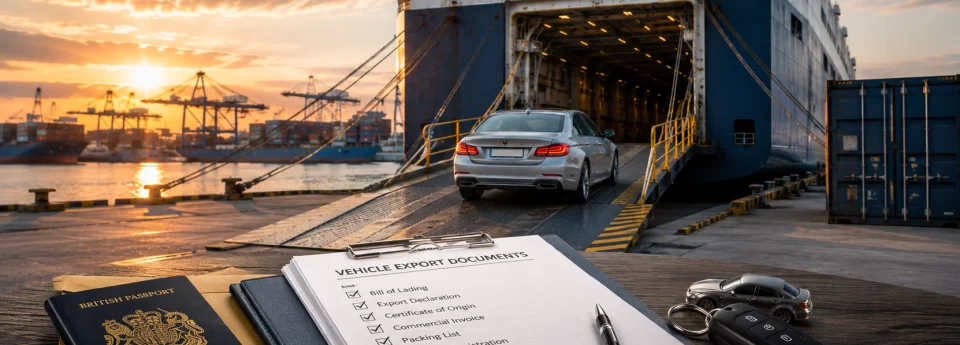
Vehicle Shipping Documentation
Vehicle Shipping Documentation: A Complete Guide for UK Export
Exporting a car from the UK requires six core documents: the original V5C logbook (notified to DVLA), a Bill of Sale, a Bill of Lading, a Commercial Invoice, a marine insurance certificate, and your passport copy. Additional documents Certificate of Conformity, fumigation certificate, or US title — are required depending on your destination. Missing a single document can delay your vehicle at port for weeks and trigger daily storage charges.
At Ship Cars Ltd, we guide you through every step of the documentation process. This definitive guide details the essential documents required for exporting a vehicle from the UK, providing clear explanations and links to official sources to ensure your shipment proceeds without complication.
The Absolute Essentials: Core Documents for Every Shipment
Regardless of the vehicle’s destination, age, or value, the following documents are mandatory for all exports.
-
Proof of Ownership (The V5C Logbook)
The V5C, or Vehicle Registration Certificate, is the primary document that links a vehicle to its registered keeper in the UK.
-
What it is: It contains the vehicle’s details (make, model, VIN, engine number) and the keeper’s name and address.
-
Crucial Export Rule: It is vital to understand that the V5C is not a proof of ownership; it is a proof of registration. However, for shipping purposes, it is the accepted document to demonstrate your right to export the vehicle.
-
What happens to it: When a vehicle is permanently exported from the UK, you must not send the V5C with the vehicle. You are legally required to DVLA permanent export notification by filling in section 4 (permanent export) of the V5C and sending it to the DVLA. Your shipping agent will typically manage this process on your behalf. The new keeper will receive documentation from their own country.
-
Bill of Sale / Purchase Invoice
This document proves the commercial transaction and is essential for customs valuation in the destination country.
What it must include:
-
Seller’s full name and address.
-
Buyer’s full name and address.
-
Vehicle details (make, model, VIN, registration number).
-
Date of sale.
-
Final sale price.
-
Signatures of both the buyer and seller.
Why it’s important: Customs authorities in the importing country use this to assess and charge any applicable import duties and taxes. An undervalued invoice can lead to significant fines and delays.
-
Bill of Lading (BoL)
The Bill of Lading is a legally binding contract between the shipper and the shipping carrier.
What it is: It acts as a receipt for the goods, a document of title, and a contract for carriage.
Types:
Original Bill of Lading: A negotiable document. The person who holds the original BoL is entitled to take possession of the goods. It is usually issued in sets of three.
Sea Waybill: A non-negotiable document used when the shipper does not need to control who collects the goods. It is faster and more straightforward for door-to-door shipments.
Your Role: Your shipping agent will create this document based on the information you provide. You must check it meticulously for accuracy before it is issued.
-
Commercial Invoice
While the Bill of Sale proves the transaction, the Commercial Invoice is a standardised document used globally for customs declarations.
-
What it includes: All the details from the Bill of Sale, plus a full description of the goods, the country of origin (UK), and the Harmonised System (HS) code for the vehicle.
-
Purpose: It is the primary document used by customs officials to clear the goods.
Destination-Specific & Vehicle-Specific Documents
Depending on where the vehicle is going and its type, additional documentation will be required.
Certificate of Conformity (CoC)
This is often required for vehicles being imported into countries with strict emissions and safety standards, such as those in the European Union, Australia, or New Zealand.
-
What it is: A document from the vehicle manufacturer certifying that the vehicle conforms to all relevant regulatory standards of the destination country at the time of its production.
-
How to get it: You typically apply for it directly from the vehicle manufacturer or their authorised agent, for a fee.
Fumigation Certificate
This is a mandatory requirement for countries with strict biosecurity laws, most notably Australia and New Zealand.
-
What it is: A certificate from a licensed pest control company proving that the vehicle has been professionally steam-cleaned (especially the undercarriage and wheel arches) and treated to remove all soil, seeds, and organic matter.
-
Timing: This must be done just prior to the vehicle being loaded into the container.
Authority Link (Australia): Australian Department of Agriculture, Fisheries and Forestry – Importing vehicles
Title Certificate (for US-Bound Vehicles)
When shipping to the United States, some states require the original title document, especially for newer vehicles.
-
UK Equivalent: The UK does not have a “title” system like the US. The combination of the V5C Logbook and the Bill of Sale is typically sufficient, but you must check the specific requirements of the US state you are importing to.
Insurance Documents
While not a customs document, you must have valid marine insurance in place for the journey.
-
What it covers: Protects against loss or damage during transit (e.g., from rough seas, accidents, fire, or theft).
-
Agreed Value: For classic or high-value cars, we strongly recommend an “agreed value” policy to ensure you are fully covered.
The UK Export Notification Process
This is a critical administrative step that must be completed when a vehicle leaves the UK permanently.
Notifying the DVLA
As the exporter, you have a legal responsibility to inform the DVLA that the vehicle is being permanently exported.
-
The Process: You complete the “permanent export” section (section 4) of the V5C logbook and send it to the DVLA.
-
Consequences of Not Doing So: If you fail to do this, you will remain liable for vehicle tax and could be fined. Furthermore, any parking or congestion charge penalties incurred by the new keeper abroad could still be sent to you.
-
How We Help: As part of our service, Ship Cars Ltd will handle the entire DVLA notification process for you, providing peace of mind and ensuring legal compliance.
Authority Link: GOV.UK – Taking your vehicle out of the UK
Document Checklist for a Smooth Shipping Process
Use this checklist to ensure you have gathered everything required.
Pre-Booking (Provide to Your Shipper)
-
Copy of the V5C Logbook
-
Copy of the Bill of Sale / Purchase Invoice
-
Your full contact details and delivery address
Pre-Shipment (Origin)
-
Original V5C Logbook (for DVLA notification)
-
Original Bill of Sale (for customs)
-
Certificate of Conformity (if required by destination)
-
Fumigation Certificate (if required by destination)
-
Marine Insurance Certificate
Post-Shipment (Destination)
-
Original Bill of Lading (or copy of Sea Waybill)
-
Original Commercial Invoice
-
Any other destination-specific documents
Documents Required by Destination
| Document | UK (export) | Australia | USA | UAE (Dubai) | Pakistan | EU countries |
|---|---|---|---|---|---|---|
| Original V5C (DVLA notified) | ✅ Required | ✅ Required | ✅ Required | ✅ Required | ✅ Required | ✅ Required |
| Bill of Sale / Purchase Invoice | ✅ Required | ✅ Required | ✅ Required | ✅ Required | ✅ Required | ✅ Required |
| Bill of Lading | ✅ Required | ✅ Required | ✅ Required | ✅ Required | ✅ Required | ✅ Required |
| Commercial Invoice | ✅ Required | ✅ Required | ✅ Required | ✅ Required | ✅ Required | ✅ Required |
| Marine Insurance Certificate | ✅ Recommended | ✅ Recommended | ✅ Recommended | ✅ Recommended | ✅ Recommended | ✅ Recommended |
| Certificate of Conformity (CoC) | ❌ Not needed | ✅ Required | ⚠️ State-dependent | ✅ Required | ⚠️ May be required | ✅ Required |
| Fumigation Certificate | ❌ Not needed | ✅ Mandatory | ❌ Not needed | ❌ Not needed | ❌ Not needed | ❌ Not needed |
| ROVER Import Approval | ❌ Not needed | ✅ Mandatory | ❌ Not needed | ❌ Not needed | ❌ Not needed | ❌ Not needed |
| US Title (state-dependent) | ❌ Not needed | ❌ Not needed | ⚠️ Some states | ❌ Not needed | ❌ Not needed | ❌ Not needed |
| ITAC Permit | ❌ Not needed | ❌ Not needed | ❌ Not needed | ❌ Not needed | ❌ Not needed | ❌ Not needed |
| ToR1 Reference (if claiming relief) | ⚠️ If importing to UK | ❌ Not needed | ❌ Not needed | ❌ Not needed | ❌ Not needed | ⚠️ Country-specific |
| UAE Emirates ID (for Dubai) | ❌ Not needed | ❌ Not needed | ❌ Not needed | ✅ Required | ❌ Not needed | ❌ Not needed |
| Pakistan CNIC | ❌ Not needed | ❌ Not needed | ❌ Not needed | ❌ Not needed | ✅ Required | ❌ Not needed |
What Happens If a Document Is Wrong or Missing?
Documentation errors are the most common cause of port delays — and the consequences are real and costly.
Common errors and what triggers them:
- Name mismatch — your name spelled differently across the V5C, passport, and invoice. Example: “Jonathan Smith” on the V5C and “Jon Smith” on the invoice. Customs computers flag the discrepancy automatically.
- VIN discrepancy — one transposed digit in the chassis number across documents. The vehicle will not be released until the error is resolved with supporting evidence.
- Undervalued invoice — declaring a lower price than the vehicle’s market value. Dubai Customs, SARS, and most customs authorities cross-reference declared values against official pricing databases. Discrepancies trigger reassessment and delays.
- Missing original — sending a copy of the V5C or Bill of Lading instead of the original. Most destination ports will not release the vehicle without the original documents.
What happens when an error is found:
- The destination customs authority places a hold on the vehicle
- Your clearing agent contacts ShipCars, who contacts you
- You must provide corrected or supplementary documentation — sometimes requiring a formal Statutory Declaration or notarised correction
- The vehicle remains in port storage accumulating daily storage charges until the error is resolved
- In serious cases (undervalued invoice, suspected fraud) the vehicle may be subject to formal investigation
How to avoid this entirely:
- Check every document against every other document before the car leaves the UK — every name, every number must match exactly
- ShipCars performs a pre-shipment document check on every booking — our team will flag discrepancies before the car ships, not after it arrives
Summary: The Importance of Getting it Right
Incorrect documentation is the leading cause of delays and additional costs in vehicle shipping. A simple error on a form can lead to your vehicle being held at the port for weeks, accruing daily storage demurrage charges.
-
Accuracy is Paramount: Double-check all names, addresses, VIN numbers, and values. They must match exactly across all documents.
-
Start Early: Begin gathering your documents as soon as you decide to ship. Some, like the Certificate of Conformity, can take several weeks to obtain.
-
Use a Professional: A reputable shipping agent like Ship Cars Ltd will manage the complex documentation process for you, ensuring everything is completed correctly and submitted on time.
Frequently Asked Questions
What documents do I need to ship a car from the UK?
The six core documents for every UK vehicle export are: the original V5C logbook (with DVLA permanent export notification completed), a Bill of Sale or purchase invoice, a Bill of Lading (issued by the shipping line), a Commercial Invoice, a marine insurance certificate, and a copy of your passport. Additional documents — Certificate of Conformity, fumigation certificate, or destination-specific permits — are required depending on where the car is going.
What is a Bill of Lading and why do I need the original?
A Bill of Lading is a legally binding document between the shipper and carrier that acts as a receipt for the vehicle, a contract for carriage, and a document of title. The person who holds the original Bill of Lading is legally entitled to take possession of the goods. Most destination ports will not release a vehicle without the original — a copy or photocopy is not accepted. Your shipping agent issues the Bill of Lading based on the information you provide.
Do I need to send my V5C with the car?
No — the opposite. When permanently exporting a car from the UK, you must NOT send the V5C with the vehicle. You complete section 4 (permanent export) of the V5C and send it to the DVLA. Failure to notify the DVLA means you remain legally responsible for vehicle tax and any penalties the vehicle incurs abroad. ShipCars handles the DVLA notification as part of every export booking.
What is a Certificate of Conformity and how do I get one?
A Certificate of Conformity (CoC) is a document from your vehicle’s manufacturer confirming it meets the regulatory standards of the destination country. It is required for most European, Australian, and UAE imports. Contact your manufacturer’s national headquarters or their designated CoC department — most major brands (BMW, Mercedes, Toyota, Ford, etc.) issue them on request. Allow 2–4 weeks and budget £50–£150.
What is a fumigation certificate and when do I need it?
A fumigation certificate is required by Australia and New Zealand to meet their strict biosecurity requirements. A licensed pest control company steam-cleans and treats the vehicle — particularly the undercarriage, wheel arches, and interior — to remove all soil, seeds, insects, and organic matter. This must be done immediately before the vehicle is loaded into its container. ShipCars arranges fumigation as part of the Australia and New Zealand export process.
What happens if my documents have an error?
Your vehicle will be held at the destination port while the error is resolved. Port storage charges accumulate daily from the moment the free storage period ends — typically 3–5 days for RoRo and 5–7 days for containers. Resolving documentation errors remotely can take days or weeks, depending on the nature of the error and the destination country’s customs process. ShipCars performs a pre-shipment document check on every booking to catch errors before the car ships.
Let Ship Cars Ltd Handle Your Documentation
We have the expertise to navigate the intricate documentation requirements for over 50 countries worldwide. From notifying the DVLA to preparing the correct customs forms for your destination, we ensure your vehicle’s paperwork is flawless full collection cost.
Contact us today for a shipping quote and let our expertise provide you with a seamless, stress-free export experience.


