


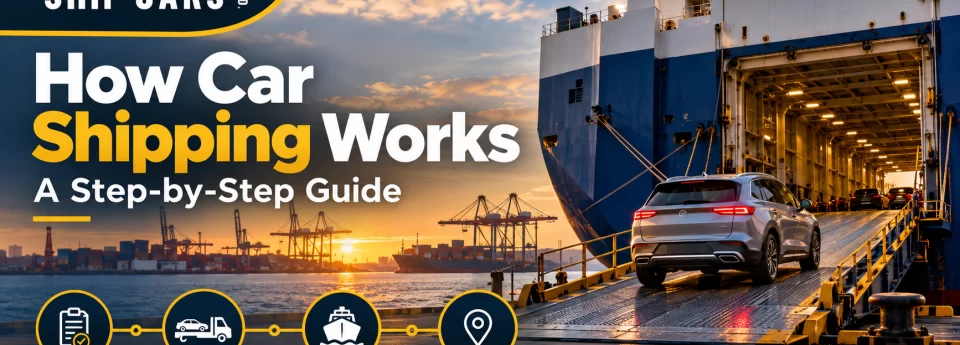
How the Car Shipping Process Works: A Step-by-Step Guide
Quick answer: The car shipping process from the UK has six core stages — get a quote and choose your shipping method; book and provide your vehicle details and documents; have your car collected or dropped off at a UK port; your car loads onto a vessel or aircraft and transits to the destination country; it clears customs there with your appointed agent; and you collect it from the destination port. ShipCars handles UK export documentation, booking, loading, and guidance at every stage. The full process takes between 5 and 70 days depending on method and destination.
Shipping a car overseas is not as complicated as it might appear — but knowing what happens at each stage, in the right order, removes the anxiety and makes for a much smoother experience. This guide walks you through every step of the ShipCars process, from your first enquiry to driving away at the other end.
Stage 1: Get a Quote and Choose Your Shipping Method
The first step is a quote. To give you an accurate price, ShipCars needs a small amount of information:
- Your departure location (UK address, or the UK port you can deliver to)
- Your destination country and city, or the nearest major port
- Your vehicle’s make, model, year, and whether it is running
- Your preferred shipping method (or guidance on which is best for your situation)
- Your target departure or arrival date
- Whether you wish to include personal effects in the shipment (container only — see the guide to shipping belongings with your car)
- Whether you require marine transit insurance
With those details, ShipCars returns a fixed, itemised quote — no hidden charges are added after booking.
Which Shipping Method Is Right for You?
There are three methods available from the UK. Your route, vehicle type, and timeline determine which applies.
RoRo (Roll-on/Roll-off) Your vehicle is driven onto a specialist vehicle carrier vessel and secured for transit. It is the most cost-effective option for standard running vehicles on mainstream routes. RoRo requires the vehicle to be in full running condition — it must be driveable on and off the vessel. Personal effects are not permitted inside the vehicle on a RoRo sailing. Electric vehicles cannot travel by RoRo due to battery safety regulations.
Read more about RoRo car shipping — how it works, departure ports, and routes available.
Container Shipping Your vehicle is loaded into a 20ft or 40ft steel shipping container — either as the sole vehicle (FCL, Full Container Load) or alongside other cars in a shared container (LCL, Less than Container Load). Container shipping is available for running and non-running vehicles, electric vehicles, classic and high-value cars, and shipments where personal effects are included. It offers a greater degree of physical protection than RoRo and is required for routes where RoRo is not available.
Read more about container car shipping — container sizes, pricing, and routes.
Air Freight The fastest option — typically 3 to 10 business days to most destinations. Air freight is used for motorcycles, scooters, compact specialist vehicles, high-value parts, and urgent shipments. Cost is significantly higher than sea freight and is calculated on actual or volumetric weight, whichever is greater.
Read more about air freight car shipping and whether your vehicle qualifies.
Stage 2: Book and Confirm Your Details
Once you accept the quote, ShipCars confirms the booking and issues a booking confirmation with your departure and estimated arrival dates, chosen sailing or flight, and the documents required from you.
At this stage you provide:
- Vehicle registration number and VIN (chassis number)
- Copy of your V5C logbook
- Copy of your passport (photo page)
- Bill of sale or purchase invoice if the vehicle was recently acquired
- Any destination-specific documents required (Certificate of Conformity, fumigation certificate for Australia, and so on — ShipCars advises which documents apply to your route)
Important: Start gathering documents at this stage — do not wait until the week before collection. A Certificate of Conformity from the vehicle manufacturer, for example, can take 2 to 4 weeks to obtain and costs £50 to £150. For a detailed checklist of documents required for your specific destination, see the car shipping documentation guide.
Stage 3: Collection or Drop-Off in the UK
ShipCars offers UK-wide collection by professional vehicle transporter or trade plate driver. Alternatively, you can deliver the vehicle yourself directly to the ShipCars depot or to your nominated UK departure port.
What happens at collection or drop-off:
- A ShipCars agent completes a vehicle condition report — a written and photographic record of the car’s condition before shipment. This is the baseline for any insurance claim, so it must be thorough. The condition report is provided free of charge if ShipCars collects the vehicle; a £35 fee applies if you deliver it to the depot.
- The fuel level is checked and reduced to a quarter of a tank or less — a mandatory requirement for both RoRo and container shipments for fire safety reasons.
- Alarm and immobiliser systems are disabled.
- Any loose personal items in the car are removed unless they are on an approved personal effects inventory for a container shipment.
- Spare keys are handed over — two sets where available.
- The vehicle is inspected for any pre-existing damage, tyre condition, and general roadworthiness for the port transit.
Your collection receipt confirms the vehicle handover. From this point, ShipCars takes custody of the vehicle.
Stage 4: UK Port Handling, Export Documentation, and Loading
ShipCars handles all UK export paperwork. You do not need to arrange this yourself.
DVLA permanent export notification: The V5C logbook must be submitted to the DVLA to notify them of the permanent export. Failure to do so can leave you liable for ongoing vehicle excise duty and potential penalties. ShipCars manages this step on your behalf as part of the standard service.
UK export customs declaration: An export declaration is filed through HMRC’s Customs Declaration Service for the vehicle consignment. ShipCars prepares and submits this as part of the booking.
Bill of Lading: Once the vehicle is loaded, the shipping line issues the Bill of Lading — the primary shipping document. This is your legal receipt for the consignment and is required by destination customs for clearance. ShipCars sends this to you as soon as it is issued — typically within a few days of vessel departure.
Loading:
- RoRo: Port staff drive the vehicle onto the vessel and secure it in the vehicle deck.
- Container: ShipCars’ team loads and professionally secures the vehicle inside the container at the UK loading facility using industry-standard restraints. The container is sealed and numbered before departure.
- Air freight: The vehicle or cargo is palletised, crated to IATA standards, and loaded as airside cargo.
UK departure ports used by ShipCars include Southampton, Tilbury (London), Felixstowe, Bristol (Portbury), Grimsby/Immingham, and Grangemouth (Scotland), depending on route and sailing schedule. Specific port allocation is confirmed at booking.
Stage 5: Transit to Destination
Once loaded and departed, your vehicle is in transit. Indicative transit times by method and destination:
(RoRo — indicative):
| Destination | Approximate transit |
|---|---|
| Spain / Portugal | 5–10 days |
| Turkey | 10–14 days |
| UAE / Middle East | 18–25 days |
| West Africa | 18 days |
| USA / Canada | 14–21 days |
| East / Southern Africa | 30 days |
| Australia | 25–35 days |
(container — indicative from London Gateway):
| Destination | Approximate transit |
|---|---|
| Karachi | 24 days |
| Jebel Ali (Dubai) | 28 days |
| Jeddah | 16 days |
| Hong Kong | 40 days |
| Australia (Melbourne, Sydney, Brisbane, Fremantle) | 47–66 days |
| New Zealand | 65 days |
By air: 3 to 10 business days depending on destination and routing.
All transit times are approximate and subject to vessel schedules, weather, port congestion, and routing. ShipCars provides tracking updates and will notify you of any material delays. You can track your container using the container number or Bill of Lading reference provided at departure.
During transit: no access to the vehicle is possible. Do not ship anything inside the car that you will need during the transit period.
Stage 6: Arrival, Customs Clearance, and Collection
Arrival at the destination port triggers the customs clearance process. This is managed by you — or your appointed local customs clearing agent — using the documents provided by ShipCars.
What you will need at the destination:
- Original Bill of Lading (sent to you by ShipCars after vessel departure)
- Commercial invoice showing the vehicle’s declared value
- Passport copy
- Any destination-specific documents (CoC, fumigation certificate, proof of import scheme eligibility, etc.)
- Proof of any applicable import scheme or residency status (e.g. Transfer of Residence for Pakistan, ToR1 for UK imports)
Customs duty and taxes are assessed by the destination country’s customs authority based on the declared value of the vehicle and your import status. These are separate from your ShipCars quote and are paid at destination. Rates vary significantly by country and engine size — always confirm the current duty position for your specific destination through a licensed local customs broker before shipping.
Free storage period: Once a container or RoRo vessel arrives at port, most ports offer a free storage period before daily storage charges begin — typically 3 to 5 days for RoRo and 5 to 7 days for container shipments. Having your documents prepared and your clearing agent briefed before the vehicle departs the UK is the single most effective way to avoid storage fees.
After customs clearance: the vehicle is released from the port facility and can be collected, or arrangements made for local delivery to your address.
ShipCars recommends appointing your local clearing agent before the vehicle departs the UK, not after it arrives. Early briefing significantly reduces clearance time and port storage costs.
Stage 7: Registration in the Destination Country
Once customs-cleared, you will typically need to register the vehicle in your destination country before driving it on public roads. Requirements vary by country but generally include:
- Customs clearance certificate
- Original shipping and import documents
- Proof of identity and local address
- Proof of duty payment
- Vehicle inspection (where required for roadworthiness or emissions compliance)
ShipCars advises on the general requirements for your destination as part of the service. For country-specific registration steps, consult the relevant transport authority or a local agent.
How Long Does the Whole Process Take?
From your first enquiry to collecting your car at the destination, allow:
- Quote and booking: 1 to 3 days
- Document preparation: 1 to 6 weeks depending on destination requirements (Certificate of Conformity can take 2 to 4 weeks)
- Collection to vessel departure: 3 to 14 days depending on sailing schedule
- Sea transit: 5 to 70 days depending on route (see table above)
- Port clearance at destination: 1 to 3 weeks depending on documentation readiness, port volumes, and customs authority
- Registration: varies by country
Total end-to-end, realistically:
- European destinations by RoRo: 3 to 5 weeks
- Middle East container: 8 to 12 weeks
- Australia / New Zealand container: 12 to 20 weeks
- Air freight: 2 to 4 weeks including clearance
Start the process earlier than you think you need to. The most common source of delays is incomplete documentation — start collecting documents at the same time you book.
Marine Insurance: Protecting Your Vehicle in Transit
Marine transit insurance is not included in the standard shipping cost. ShipCars strongly recommends taking out cover for the full insured value of the vehicle.
Two levels of cover are available:
- Total Loss Cover: 1% of vehicle value plus shipping cost. Covers you if the vehicle is lost, destroyed, or rendered a total loss during transit.
- Comprehensive Cover: 1.5% of vehicle value plus shipping cost. Covers loss, damage, and theft during transit. Available for vehicles up to 10 years old.
A condition report is the baseline for any insurance claim — which is why it is completed before the vehicle leaves the UK. Read more about marine insurance for car shipping and what is and is not covered.
Get Your Car Shipping Quote
Ready to start the process? ShipCars handles everything from your first question to the destination port.
Call: 01495 320540 Email: info@shipcars.co.uk Get a free online quote →
Tell us your vehicle, your destination, and your timeline — and we will give you a fixed, itemised quote with no hidden charges. Our team is available to walk you through the process and confirm which shipping method and departure port work best for your specific situation.
Frequently Asked Questions
How long does it take to ship a car from the UK overseas?
It depends on the destination and shipping method. European routes by RoRo typically take 3 to 5 weeks end-to-end including collection, transit, and customs clearance. Middle Eastern destinations by container take 8 to 12 weeks. Australia and New Zealand take 12 to 20 weeks by container. Air freight takes 2 to 4 weeks including clearance. Sea transit times are approximate and subject to vessel schedules.
What information do I need to get a car shipping quote?
You need: your UK departure location; destination country, city, or port; vehicle make, model, year, and running condition; preferred shipping method or guidance on which suits your route; target departure or arrival date; and whether you want to include personal effects or marine insurance. ShipCars can advise on method if you are unsure.
Do I need to be present when my car is collected?
Not necessarily — but someone who can authorise the condition report and hand over the keys must be present at collection. That can be you or a named person acting on your behalf. If you deliver the vehicle yourself to the depot, you sign the condition report at drop-off.
What documents do I need to ship a car from the UK?
The core documents for most shipments are: original V5C logbook, bill of sale or purchase invoice, passport copy, and the Bill of Lading (issued by ShipCars after loading). Destination-specific documents — such as a Certificate of Conformity for Australia and the UAE, or a fumigation certificate for Australia — are confirmed by ShipCars at booking. See the full car shipping documentation guide for a destination-by-destination checklist.
Can I ship a non-running car from the UK?
Yes — but not by RoRo. Non-running vehicles must travel by container shipping, where they are loaded using a forklift or winch rather than driven. Electric vehicles are also container-only. ShipCars manages non-running vehicle loading as part of the standard container service. For more on this, see the non-running car shipping guide.
What happens if my car is damaged during transit?
If you have marine transit insurance in place and the damage occurs during transit, you make a claim against the marine insurance policy using the pre-shipment condition report as the baseline. The condition report is completed by ShipCars before departure and establishes the vehicle’s pre-shipment state. Without insurance, you have limited recourse — shipping lines cap their liability at a very low level (approximately SDR 2 per gross kilogram of cargo). ShipCars strongly recommends insuring for the full value of the vehicle.
Do I pay customs duty before or after the car arrives?
After arrival. Customs duty and import taxes are assessed by the destination country’s customs authority when the vehicle arrives at the destination port. They are calculated on the declared value of the vehicle and paid by you or your appointed clearing agent before the vehicle is released. The amounts are separate from — and usually significantly more than — your ShipCars shipping quote. Always confirm the duty position for your specific vehicle and destination with a licensed local customs broker before shipping.
Can ShipCars ship my car to any country in the world?
ShipCars ships to destinations worldwide. The most common routes include Australia, New Zealand, the USA, Canada, the UAE, South Africa, Pakistan, Nigeria, Kenya, Spain, and many others. Some destinations are served by RoRo only, some by container only, and some by both. Air freight is available to over 150 destinations for qualifying vehicles. Contact ShipCars to confirm the specific route, available methods, and current sailing schedule for your destination.
Related Guides
- RoRo Car Shipping from the UK — How It Works
- Container Car Shipping — Sole and Shared Containers
- Air Freight Car Shipping — Is It Right for You?
- Documents Needed to Ship a Car from the UK
- Can I Ship Personal Belongings With My Car?
- Marine Insurance for Car Shipping — What’s Covered
- How Much Does It Cost to Ship a Car Overseas?
Last updated: 15 October 2026 | Reviewed By: Director Navdeep Singh (1o years experience in international vehicle shipping)


