


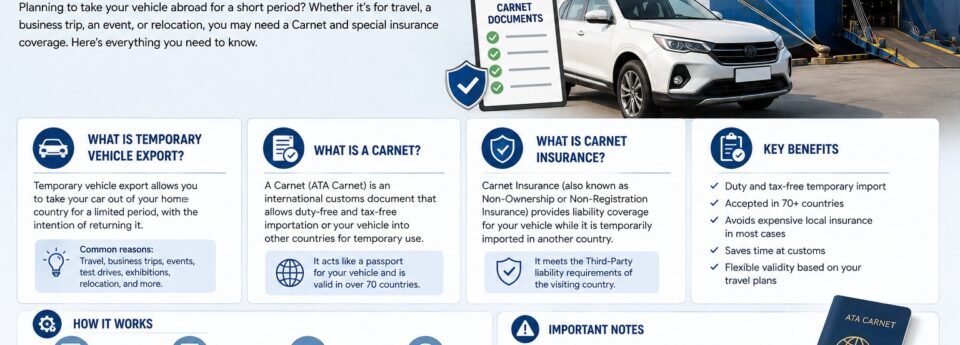
Temporary Vehicle Export & Carnet Insurance: A Complete Guide
A Carnet de Passages en Douane (CPD) is a customs document that acts as a temporary passport for your vehicle, allowing it to cross international borders without paying import duty — on the condition it returns to the UK. UK drivers need a carnet for most destinations outside the EU including India, Pakistan, Australia, Egypt, and most African and Middle Eastern countries. A carnet is valid for 12 months and requires financial security of 150–200% of the vehicle’s value with the issuing authority (RAC or AA in the UK).
What Does Mean By a Temporary Vehicle Export?
A temporary export is when you take your UK-registered vehicle to another country for a non-permanent, defined period. The core principle is that the vehicle will be returned to the UK and is not being permanently imported or sold abroad.
-
Common Reasons for Temporary Export:
- Overland touring and extended holidays (e.g., driving through Europe to Morocco).
- Participating in international motorsport events (e.g., rallies, track days).
- Attending classic car shows or exhibitions.
- Short-term work assignments or film production shoots.
The Carnet de Passages en Douane (CPD)
A Carnet de Passages en Douane (CPD) is a customs document that acts as a temporary passport for your vehicle. It guarantees to the customs authorities of the countries you visit that any potential import duties and taxes will be paid if you do not re-export the vehicle.
How a Carnet Works
The carnet is a multi-page, bound document issued by a motoring association (like the RAC or AA in the UK). It serves as a security bond, eliminating the need to pay a cash deposit for your vehicle at each border.
- The Guarantee: The issuing club provides a guarantee to the customs authorities of the countries you will visit.
- The Security: You provide the club with financial security (e.g., a bank guarantee or cash deposit), typically for 150% – 200% of the vehicle’s value in the highest-tax country on your itinerary.
- The Process: At each border, customs officials will stamp the carnet upon entry and exit, providing a clear, auditable trail.
Key Countries Requiring a Carnet
While not needed for short trips within the EU, a carnet is essential for many popular overland destinations, including:
- Middle East: Iran, Saudi Arabia, Qatar, UAE (for some vehicle types).
- Asia: India, Pakistan, Thailand, Malaysia, Singapore.
- Africa: Egypt, South Africa, Kenya, Nigeria, most other African nations.
- Oceania: Australia, New Zealand.
The carnet requirements above reflect common practice however requirements change and vary by vehicle type and purpose. Always verify directly with the RAC or AA carnet desk and the embassy of each destination country before applying.
How Much Does a Carnet de Passages Cost?
The cost of a carnet has two components:
1. The application fee
The RAC charges a carnet application fee based on the number of countries on the itinerary. As a guide, fees typically start from around £225–£300 for a basic carnet. Check current RAC carnet fees at therac.co.uk or the AA equivalent before applying — fees are subject to change.
2. The financial security (guarantee)
This is the larger commitment. The issuing club requires you to provide security equivalent to 150–200% of the vehicle’s market value in the highest-duty country on your itinerary — to guarantee that if you fail to re-export the vehicle, the import duties can be paid. You provide this security in one of three ways:
- Cash deposit held by the RAC or AA for the duration of the carnet
- Bank guarantee from your bank for the equivalent amount
- Carnet insurance — a specialist policy that replaces the cash deposit with an insurance premium, typically much cheaper than the equivalent cash deposit
For a £30,000 vehicle travelling to India (which applies high import duties), the required security could be £45,000–£60,000 as a cash deposit. A carnet insurance premium for the same vehicle and journey would typically cost a fraction of that — making insurance the practical choice for most travellers.
Carnet Insurance: Cover That Follows You Abroad
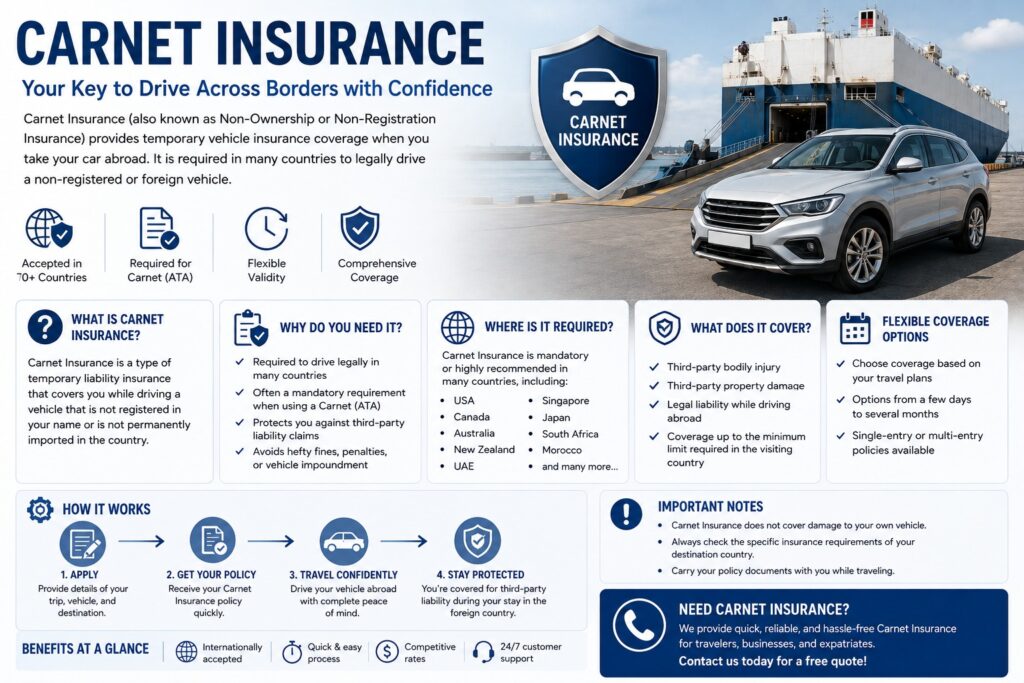
Standard UK car insurance is not sufficient for international travel, especially under a carnet. You require specialised international motoring insurance.
What is Carnet Insurance?
Carnet Insurance is a specialised policy designed to meet the legal and financial requirements of travelling with a carnet. It provides two key functions:
- It acts as the financial security for the carnet itself, replacing the need for a large cash deposit or bank guarantee.
- It provides comprehensive vehicle insurance cover for the territories you are visiting.
What Does This Insurance Typically Cover?
A robust carnet insurance policy should provide:
- Third-Party Liability: This is the legal minimum required by most countries. It covers injury to other people and damage to their property.
- Comprehensive Cover (Recommended): This extends to cover damage to or theft of your own vehicle. Given the remote locations and challenging roads often involved in carnet travel, this is highly advisable.
- Cover for the Carnet’s Guarantee: The policy will cover the potential liability to customs authorities if the carnet is not discharged correctly (e.g., if the vehicle is stolen or written off and cannot be re-exported).
- Territorial Coverage: The policy will be valid for all the specific countries listed on your itinerary and carnet.
- Breakdown and Recovery Assistance: Many policies include international breakdown cover, which is invaluable when far from home.
What Might Not Be Covered (Standard Exclusions)
Always read the policy wording carefully. Common exclusions can include:
- Wear and tear, mechanical or electrical breakdown.
- Damage from off-road driving unless specified.
- Driving under the influence of alcohol or drugs.
- Travelling in areas against Foreign Office advice.
The Step-by-Step Process for Temporary Export
Step 1: Pre-Trip Planning & Research
- Finalise Your Itinerary: List every country you plan to enter and confirm their specific carnet and insurance requirements.
- Check Vehicle Eligibility: Ensure your vehicle is legally registered in the UK and you have the V5C logbook.
- Apply for Your Carnet: Contact an authorised club (RAC, AA) and begin the application process. This can take several weeks.
Step 2: Arranging Your Carnet & Insurance
- Carnet Application: You will need to provide:
- Completed application form.
- Vehicle V5C logbook.
- Your passport details.
- Detailed travel itinerary.
- Proof of insurance for the carnet guarantee.
- Secure Carnet Insurance: Obtain a policy that covers both the carnet guarantee and your vehicle in the destination countries. Ship Cars Ltd can assist in finding suitable providers.
Step 3: At the Border (Entry & Exit)
- Present Your Documents: At each border crossing, present your Passport, Driving Licence, Vehicle V5C, Carnet, and Insurance Certificate (Green Card if in Europe).
- Get the Carnet Stamped: Ensure the customs officer stamps the correct vouchers in the carnet for both entry (importation) and exit (exportation). Do not leave the border until this is done correctly.
What Actually Happens at the Border: A Practical Walkthrough
Understanding the physical carnet process reduces border anxiety significantly. Here is what to expect at a typical carnet border crossing:
On entry to a new country:
- Pull into the customs lane (not the regular passport control lane) — look for signs for vehicles or goods declarations
- Present your passport, V5C, driving licence, and carnet document to the customs officer
- The officer will verify the vehicle details against the carnet (chassis number, make, model, registration)
- They will tear out the entry counterfoil (the left-hand page of the carnet voucher) and stamp the entry stub that remains in your carnet book
- Keep the stamped carnet book safely — you need it at every subsequent border
On exit from that country:
- Stop at the customs exit post before leaving the country
- Present the carnet again
- The exit counterfoil is torn out and the exit stub is stamped
- This “closes” that country’s entry in the carnet
Critical rule: Never leave a country without getting the exit stamp. If you cross a border without an exit stamp — even accidentally — you may be held liable for that country’s full import duties, as customs have no record of the vehicle leaving.
Returning to the UK
- Final Carnet Stamp: Get the carnet stamped by UK customs upon your return.
- Discharge the Carnet: Return the fully stamped carnet to the issuing club. This proves you have re-exported the vehicle from all countries and releases the financial guarantee.
What Is The Essential Pre-Departure Checklist
Documentation:
- Valid, full UK driving licence and International Driving Permit (if required).
- Passport with at least 6 months’ validity.
- Original Vehicle Registration Document (V5C).
- Valid Carnet de Passages en Douane (CPD).
- International Motor Insurance Certificate and Green Card.
- Vehicle insurance policy documents.
Vehicle Preparation:
- “UK” identifier sticker is displayed (even if you have new-style number plates).
- Headlight beam converters are fitted for driving on the right.
- A first-aid kit, warning triangle, and high-visibility vests are packed (legal requirements in many countries).
- The vehicle is mechanically sound and serviced.
Carnet & Insurance:
- I have verified that every country on my itinerary requires a carnet.
- My insurance policy provides comprehensive cover and acts as the security for my carnet.
- I understand the procedure for getting my carnet stamped at every border.
Frequently Asked Questions
Do I need a carnet for driving in Europe?
No. You do not need a carnet for temporary trips within EU countries. Since 2 August 2021, UK drivers also no longer need a Green Card for EU travel — your UK motor insurance provides the minimum legal third-party cover automatically. You must, however, carry your V5C logbook, proof of insurance, and display a “UK” sticker on your vehicle. Note that a Green Card may still be required for some non-EU European countries including Turkey, Albania, Belarus, and Ukraine — check with your insurer before travelling to these destinations.
Source: GOV.UK — Driving abroad; European Commission announcement, August 2021.
What happens if my car is stolen or written off while abroad with a carnet?
This is a serious situation. You must:
- Report the incident to the local police immediately and get a report.
- Notify your insurance company and the carnet issuing club.
- The insurance will handle the claim for the vehicle and, crucially, will cover the customs liabilities under the carnet guarantee, preventing you from having to pay the import taxes.
Can I sell my car abroad while under a carnet?
No. A carnet is strictly for temporary export. Selling the vehicle would be a breach of the carnet’s conditions. The full import duties and taxes of that country would become payable, and your financial security (or insurance) would be claimed.
How long is a carnet valid for?
A carnet is typically valid for one year from the date of issue. You must ensure your vehicle is back in the UK and the carnet is fully discharged before it expires.
Let Ship Cars Ltd Guide Your Temporary Export
Navigating the complexities of carnets and international insurance can be daunting. Ship Cars Ltd provides expert support for your temporary vehicle export by:
- Providing Clear Guidance on the documentation required for your specific itinerary.
- Connecting You with Providers for carnets and specialised international insurance.
- Offering Pre-Trip Consultation to ensure you understand the border procedures and your responsibilities.
Ensure your international motoring adventure is smooth and compliant. Contact Ship Cars Ltd today for expert advice on temporary vehicle export, carnets, and the insurance that will cover you in other countries.


