


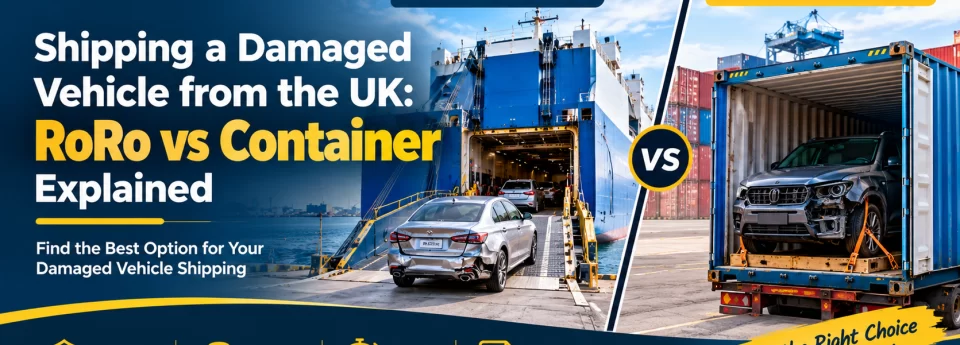
Shipping a Damaged Vehicle from the UK: RoRo vs Container Explained
Quick Answer
Damaged vehicles can be shipped internationally from the UK — but the method depends on the vehicle’s condition. RoRo (roll-on/roll-off) is available only for vehicles that can be driven, steered, and braked without fluid leaks. Vehicles that cannot move under their own power, have structural damage, or are leaking fluids must travel in a container. ShipCars handles both methods and assesses each vehicle individually at the quote stage.
Get a Free Quote for Your Damaged Vehicle →
Can a Damaged Vehicle Be Shipped Internationally?
Yes — damaged, non-running, salvage, and written-off vehicles are shipped from the UK to international destinations regularly. They move for several legitimate reasons: insurance salvage export, private sale to overseas buyers, repatriation after an accident abroad, or export to markets where the vehicle can be repaired and registered.
The key question is not whether your vehicle can be shipped — it almost certainly can. The question is which method is appropriate, and whether the destination country will accept it.
Both answers depend on the specific condition of your vehicle and where it is going.
Step One: Assess Your Vehicle’s Condition
Before choosing a shipping method, you need to be honest about your vehicle’s actual condition. ShipCars will ask the following questions at the quote stage — having the answers ready speeds up the process.
Can the vehicle move under its own power?
A vehicle that starts, drives, steers, and brakes — even with cosmetic damage, body damage, or a damaged interior — is considered “running” for shipping purposes. Running vehicles have access to both RoRo and container options.
A vehicle that cannot move under its own power requires container shipping. It will be loaded using a forklift or a skate system (small wheeled platform placed under each tyre) — specialist loading equipment that RoRo terminals do not provide.
Is the vehicle leaking fluids?
Even a running vehicle is disqualified from RoRo if it is leaking fuel, oil, coolant, or brake fluid. Leaking vehicles are a fire and contamination risk on a RoRo vessel, where cars are parked together in enclosed vehicle decks for weeks. Any vehicle with active fluid leaks must travel in a container, where it is isolated in a sealed steel box.
Before shipping, fluid leaks should be addressed where possible — even a temporary fix can open up the lower-cost RoRo option.
What is the damage type and extent?
| Vehicle condition | RoRo | Container |
|---|---|---|
| Cosmetic damage only (dents, scratches, broken glass) — running | ✅ Yes | ✅ Yes |
| Mechanical damage — can still drive, steer, brake — no leaks | ✅ Yes | ✅ Yes |
| Structural damage (Cat S / Cat N) — running, no leaks | ✅ Yes (some carriers) | ✅ Yes |
| Non-running — cannot drive | ❌ No | ✅ Yes |
| Leaking fluids — fuel, oil, coolant | ❌ No | ✅ Yes (after capping) |
| Stripped interior only — engine intact, running | ✅ Yes | ✅ Yes |
| Missing engine or major drivetrain components | ❌ No | ✅ Yes |
| Flood-damaged — running | Case by case | ✅ Yes |
| Fire-damaged | ❌ No | ✅ Yes (case by case) |
RoRo Shipping for Damaged Vehicles
What is RoRo?
Roll-on/roll-off shipping means your vehicle is driven onto the vessel at the UK departure port and driven off at the destination port. The vehicle is secured on the vessel’s vehicle decks alongside hundreds of other cars and commercial vehicles.
When is RoRo available for a damaged vehicle?
RoRo is available for damaged vehicles that meet all three of these conditions:
- The vehicle can be driven onto the vessel — it starts, moves forward and reverse, and can be manoeuvred by a port driver
- The vehicle can be steered and braked — to safely position it in the vehicle deck
- The vehicle has no active fluid leaks — fuel, oil, coolant, or brake fluid
Cosmetic damage, body panel damage, broken glass, and internal damage do not disqualify a vehicle from RoRo, provided the above three conditions are met.
Advantages of RoRo for damaged vehicles
- Lower cost — RoRo is significantly cheaper than container shipping on most routes. The cost saving compared to a sole-use container can be £500–£1,500 depending on the route.
- Frequent sailings — RoRo vessels operate on regular weekly schedules from UK ports, particularly Southampton and Tilbury.
- Suitable for vehicles with cosmetic or minor mechanical damage — if the vehicle runs and doesn’t leak, RoRo is the straightforward choice.
Limitations of RoRo for damaged vehicles
- Non-runners are categorically excluded — RoRo terminals have no forklift or skate-loading equipment
- Leaking vehicles are excluded — fire and contamination risk in enclosed vehicle decks
- The vehicle is exposed to the vessel environment (salt air, temperature variation) throughout the voyage — not enclosed in a container
- Some RoRo carriers apply restrictions to vehicles with structural damage (Cat S) — confirm at the quote stage
Learn more about RoRo car shipping →
Container Shipping for Damaged Vehicles
When is container shipping required?
Container shipping is required for any damaged vehicle that cannot meet the three RoRo conditions above: non-runners, vehicles with fluid leaks, fire-damaged vehicles, and any vehicle with missing major components.
It is also the strongly preferred option for high-value damaged vehicles — classic cars, luxury cars, or any vehicle where additional physical protection during transit matters.
How is a non-running vehicle loaded into a container?
Non-running vehicles are loaded using either a forklift (lifting the vehicle body directly) or skates — small wheeled platforms placed under each tyre that allow the vehicle to be rolled into the container without the engine running. The appropriate method depends on the vehicle’s structural integrity and the loading equipment available at the port.
ShipCars coordinates specialist loading for non-runners as part of the container shipping process — you do not need to arrange this separately.
Sole-use container vs shared container
| Sole-use container | Shared container (groupage) | |
|---|---|---|
| What it is | Your vehicle has the entire 20ft or 40ft container | Your vehicle shares container space with other vehicles |
| Protection | Maximum — no other cargo | Standard — other vehicles in the same container |
| Cost | Higher | Lower |
| Best for | High-value damaged vehicles, classic cars, fire/flood damage | Running damaged vehicles, standard salvage |
| Loading control | Full control of how the vehicle is positioned and braced | Shared loading — position determined by the loading team |
For heavily damaged, structurally compromised, or disassembled vehicles, a sole-use container is strongly recommended — the vehicle can be braced and secured in a position that accounts for its specific damage profile.
Learn more about container car shipping →
RoRo vs Container: Side-by-Side Comparison
| Factor | RoRo | Container |
|---|---|---|
| Vehicle must run | Yes | No — forklift/skate loading available |
| Fluid leaks allowed | No | Yes (after capping where possible) |
| Cost | Lower | Higher |
| Physical protection | Standard — exposed to vessel environment | High — sealed steel container |
| Voyage duration difference | Same sea transit time | Same sea transit time |
| Available on all routes | Most major routes | All routes |
| Best for | Running damaged vehicles, cosmetic damage | Non-runners, leaking vehicles, high-value salvage |
| Sole-use option | No | Yes |
| Disassembled vehicles | No | Yes |
Preparing a Damaged Vehicle for Shipping
Whether your vehicle travels by RoRo or container, preparation steps are required before it can be accepted at port.
For RoRo
- Drain or stabilise fluid leaks — cap any leak points so the vehicle qualifies for RoRo loading
- Charge the battery — the vehicle must start and move under its own power
- Disable any immobiliser or alarm — these create problems during port manoeuvring
- Remove loose parts — any body panels, trim, or glass that could detach during the voyage must be removed or secured
- Fuel level — tank should be no more than one-quarter full (port safety requirement)
- Document the damage — photograph the vehicle thoroughly before collection; ShipCars produces a pre-shipment condition report
For container shipping
- Fluid containment — fuel should be drained to near-empty; other fluid leaks capped where possible
- Battery disconnected — for non-runners and vehicles not expected to be started at the destination
- Secure or remove detached parts — loose panels, glass, or components should be secured inside the container alongside the vehicle (clearly labelled as belonging to it)
- Keys — provide all available keys; note which functions work and which do not
- Condition report — a pre-shipment condition report is produced by ShipCars at loading, establishing the vehicle’s documented condition before the voyage
Insurance for Damaged Vehicles
Marine cargo insurance for a damaged vehicle works differently from standard vehicle insurance. The key considerations:
Agreed value, not market value. Marine insurance for a damaged vehicle is typically written on an agreed value basis — you and the insurer agree the vehicle’s value at the time of shipment. This is particularly important for salvage vehicles, which have a market value very different from their pre-damage value.
Pre-existing damage is documented, not covered. The pre-shipment condition report records the vehicle’s condition before loading. Any damage that pre-exists the voyage is not a transit claim. Marine insurance covers new damage that occurs during the transit — not damage the vehicle arrived with.
Total loss coverage. For heavily damaged vehicles where the agreed value is lower, total-loss cover may be more appropriate than comprehensive cover. ShipCars can advise on the appropriate policy at the quote stage.
Destination country insurance. Marine insurance covers the transit. Once the vehicle clears the destination port, local insurance requirements apply. In most countries, a damaged or salvage-title vehicle requires specialist local insurance before it can be used on the road.
Marine insurance for car shipping — full guide →
Will the Destination Country Accept a Damaged Vehicle?
This is the question most guides on this topic skip — and it is critical.
UK write-off categories and export
UK insurance write-off categories (Cat S, Cat N, Cat A, Cat B) are a UK-domestic classification system. They do not automatically prevent export, but they affect how the vehicle is received at the destination:
- Cat S and Cat N vehicles can be exported from the UK. The DVLA must be notified of permanent export via the V5C process. The vehicle’s write-off status is recorded in the UK and may show up in checks run by overseas buyers.
- Cat A and Cat B vehicles must be destroyed in the UK — they cannot be exported. Attempting to export a Cat A or Cat B vehicle is illegal.
Destination-country considerations
| Country | Key rules for damaged/salvage imports |
|---|---|
| Australia | No ban on importing damaged vehicles, but strict biosecurity inspection applies; structural damage does not block import, but asbestos-containing vehicles (pre-1987) face additional restrictions |
| USA | Salvage-title vehicles can be imported; customs requires disclosure of title status; some states will not re-title a foreign salvage vehicle for road use |
| UAE | Heavily damaged vehicles may be refused GCC type approval; check with destination agent before shipping |
| Canada | Damaged vehicles must meet RIV (Registrar of Imported Vehicles) standards for registration; salvage vehicles face additional provincial requirements |
| South Africa | Damaged and salvage vehicles can be imported; NRCS approval required for registration; check ITAC import permit requirements |
| Nigeria / Kenya | Age restrictions apply to all imports; check current regulations with ShipCars before booking |
Verify before you book. Rules change. ShipCars checks destination eligibility at the quote stage for damaged vehicles — do not book a shipment without confirming the destination will accept your specific vehicle.
Frequently Asked Questions
Can I ship a non-running car internationally from the UK?
Yes. Non-running vehicles are shipped regularly from the UK using container shipping. A forklift or skate system loads the vehicle into the container without requiring the engine to run. Provide accurate information about the vehicle’s condition when requesting a quote — whether it rolls freely, whether it has been stripped, and whether fluids have been drained.
Can I ship a written-off (Cat S or Cat N) car from the UK?
Yes — Cat S and Cat N vehicles can be exported from the UK. You must notify the DVLA of the permanent export via the V5C process before shipment. Cat A and Cat B vehicles cannot be exported — they are legally required to be destroyed in the UK.
Is RoRo or container better for a damaged vehicle?
It depends on the vehicle’s condition. If the vehicle runs, steers, brakes, and has no fluid leaks, RoRo is the lower-cost option. If the vehicle is non-running, leaking, structurally compromised, or high-value, a container is required or strongly recommended. ShipCars assesses each vehicle individually at the quote stage.
How much does it cost to ship a damaged vehicle?
RoRo shipping for a damaged running vehicle follows standard RoRo pricing — indicatively £900–£2,200+ depending on destination. Container shipping for a non-runner costs more due to the specialist loading requirement and the container itself — indicatively £1,200–£3,500+ for a sole-use container depending on the destination. Get a specific quote for your vehicle and route from ShipCars, as cost varies significantly by condition and destination.
Will destination customs ask about the damage?
Yes, in many cases. The customs declaration at the destination includes the vehicle’s value and condition. For salvage or heavily damaged vehicles, a lower declared value (reflecting the salvage value, not the pre-accident value) affects the import duty calculation. Accuracy in customs declarations is non-negotiable — incorrect declarations can result in fines, holds, or seizure.
Can I ship car parts or stripped components alongside the vehicle in the container?
Yes — loose parts that belong to the vehicle (panels, doors, engine components, trim) can travel in the same container as the vehicle, clearly identified and secured. They are subject to the same customs declaration as the vehicle. Personal belongings cannot travel in the container.
Does the vehicle need to be insured during shipping?
Marine cargo insurance is strongly recommended for all shipments and is particularly important for damaged vehicles. Agree the vehicle’s current salvage value with the insurer at the time of booking. The pre-shipment condition report documents the vehicle’s pre-voyage state — transit insurance covers new damage that occurs during the voyage, not pre-existing damage.
What documents do I need to ship a damaged vehicle from the UK?
The standard set applies: V5C logbook (or V5C/3 tear-off section for permanent export notification), proof of ownership (purchase receipt or insurance settlement letter for write-offs), a valid ID or passport, and any import permit required by the destination country. For salvage vehicles, the insurance total-loss settlement letter is useful for customs valuation at the destination.
Ready to Ship Your Damaged Vehicle?
ShipCars handles damaged, non-running, salvage, and written-off vehicle shipments from the UK to destinations worldwide. Every vehicle is assessed individually — we confirm the right method, check destination eligibility, and provide a clear all-in quote.
Get a Free Qute for Your Damaged Vehicle →
Questions about your specific vehicle or destination? Contact the ShipCars team →


