


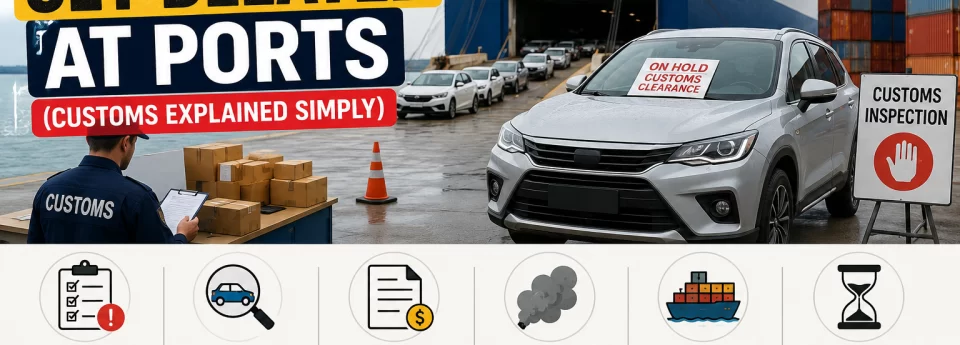
Why Some Cars Get Delayed at Ports (Customs Explained Simply)
Cars are most commonly delayed at port due to one of five causes: incorrect or missing documents (the most frequent), unpaid or miscalculated import duties, undeclared items left inside the vehicle, VIN checks against stolen vehicle databases, or random customs inspections. Most delays are entirely avoidable with correct paperwork and a pre-shipment checklist. Storage charges typically start accumulating after 3–5 days at the port — making early resolution essential.
Customs Clearance: What Actually Happens at the Port
When your vehicle arrives at a port — whether that’s Southampton, Felixstowe, Houston, Sydney, or Mersin in Turkey — it doesn’t just roll off the ship and onto the road. Every vehicle must pass through a customs clearance process. Customs authorities check that the car matches the paperwork, that import duties have been correctly assessed, and that there are no legal reasons to hold or refuse entry to the vehicle.
In the vast majority of cases, this process runs smoothly. But when it doesn’t, a short delay can quickly turn into days or even weeks. Here’s what causes it.
Common Reasons a Car Gets Held at Port During Car Shipping
1. Paperwork Errors or Missing Documents
This is by far the most frequent cause of customs delays globally — and it’s the one that frustrates customers the most, because it’s almost always preventable.
Customs authorities need to see a consistent, accurate set of documents. For most international car shipments from the UK, that typically includes the vehicle’s V5C logbook, a bill of sale, a valid export declaration, the Bill of Lading, and identification documents. If a name is spelled differently across two documents, if a VIN number contains a typo, or if the declared value on the invoice doesn’t match the sale price — customs will pause the clearance and ask questions.
Real Customer Example:
A customer shipping a Land Rover Defender from the UK to Australia found their vehicle held at Fremantle port for four days because the name on their V5C didn’t exactly match the name on their passport. One document used a middle name; the other didn’t. A small thing — but enough to trigger a query that needed resolving before release.
At Ship Cars Ltd, we pre-screen all documentation before your vehicle is loaded. We check for these inconsistencies before they become your problem at the destination port.
2. Unpaid or Unconfirmed Import Duties
Every country has its own import duty structure for vehicles. In the USA, it’s typically 2.5% for passenger cars. Australia has its own calculation based on vehicle age and value. Turkey applies customs duties that vary depending on engine size and country of origin. When those duties haven’t been calculated correctly, or when the payment hasn’t been confirmed before the vessel docks, the car simply won’t be released.
This is a particular issue for private buyers who arrange shipping independently without fully understanding the destination country’s import requirements. Using a specialist like Ship cars ltd means we guide you through duty calculations as part of the process — not as an afterthought.
3. Items Left Inside the Vehicle
Most customs agencies have strict rules about personal belongings inside a shipped vehicle. If a car arrives with undeclared items inside — tools, electronics, extra parts, or even a sat-nav that wasn’t listed — customs officers have the right to hold the vehicle for further inspection.
This catches a surprising number of people out. Someone puts a gym bag in the boot and forgets about it. A spare set of tyres is left in the car because it seemed convenient. These things matter at the border.
Customer Case Study:
One of our clients shipping a classic Mercedes from the UK to the USA had their vehicle flagged at Baltimore port because of a toolbox left in the boot. It hadn’t been declared on the documentation. The hold lasted five days and incurred storage charges. We now include a clear pre-loading checklist with every booking — because the best time to fix this is before the car goes on the ship, not after it arrives.
4. Vehicle Identity Checks and Anti-Theft Screening
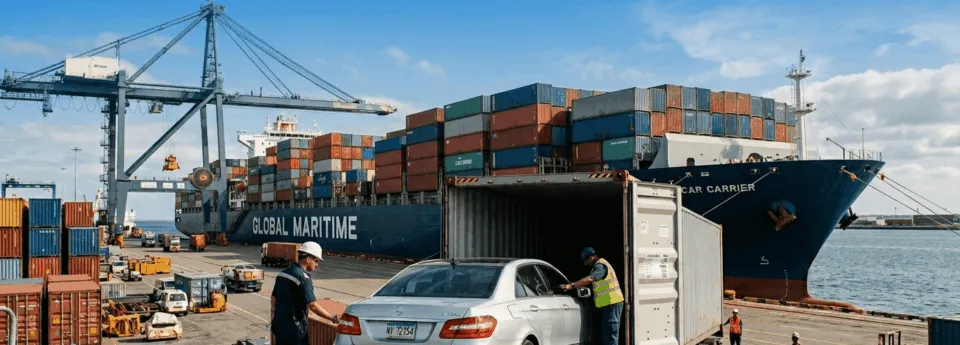
Some ports, particularly in the USA and Australia, run checks on VIN numbers against international stolen vehicle databases. If your vehicle appears on any watchlist — even incorrectly, due to a previous keeper’s history — it can be held pending investigation.
This is why we always advise customers to run a full vehicle check before shipping. Buying a car at auction with an incomplete history and shipping it overseas carries real risk. If any red flags surface once the car reaches port, resolving it from thousands of miles away is far more complex and costly than dealing with it before departure.
5. Random Port Inspections and External Disruptions
Not every delay is caused by an error. Customs authorities worldwide carry out random physical inspections as part of their normal operations — your car might be selected simply by chance. These inspections typically add two to five days to clearance times.
Beyond inspections, ports themselves can be disrupted. Congestion at major automotive gateways like Rotterdam, Hamburg, and Antwerp caused significant knock-on delays throughout late 2025 and into 2026. Industrial action, severe weather, and global shipping alliance restructuring have all contributed to vehicles sitting in port yards longer than expected — despite everything being in order.
My Car Is Already Held at Port — What Do I Do Now?
If you receive notification that your vehicle has been held at customs, act immediately. Every day of inaction is a storage charge.
Step 1: Contact your shipping agent within the same day.
If you booked through ShipCars, call us directly on 01495 320540. If you used another agent, call them. Do not wait for them to contact you — chase the status actively.
Step 2: Find out the specific reason for the hold.
“Customs query” is not a reason. Get the specific issue in writing — is it a document discrepancy, unpaid duty, a physical inspection request, or a VIN query? Each has a different resolution path.
Step 3: Gather your documents.
Have your Bill of Lading, original V5C, bill of sale, and passport copy ready to send digitally within the hour. Delays in providing documentation extend the hold and increase storage charges.
Step 4: Do not attempt to resolve it yourself with foreign customs directly.
Unless you speak the local language and understand the customs system, attempting to contact the destination customs authority yourself often makes things worse. Your shipping agent’s destination partner handles this relationship professionally — let them.
Step 5: Confirm the free storage period remaining.
Ask your agent exactly how many free storage days remain and when daily charges begin. This sets the urgency level and helps you prioritise.
How Ship Cars Ltd Reduces Your Risk of Delays
We’ve been handling international vehicle shipping for years, and our process is built around minimising clearance delays at every stage. Here’s how we approach it:
- Document pre-screening before your vehicle is collected
- Clear guidance on what to remove from your vehicle before loading
- Duty and import cost estimates for your specific destination
- Direct communication with destination agents to resolve queries quickly if they arise
- Regular updates so you’re never left wondering what’s happening
Whether you’re shipping a family car from the UK to New Zealand, exporting a classic to the USA, or moving a commercial vehicle to the UAE, the same principles apply — accurate paperwork, a clean vehicle, and a shipping partner who knows the process.
The Bottom Line
Port delays are rarely mysterious. They almost always come down to documentation, duties, or something that could have been addressed before the car left home. The best way to avoid them is to work with a team that knows international customs inside out — and that takes the time to get your paperwork right before your vehicle ever leaves UK shores.
If you’re planning to ship a vehicle overseas and want to know exactly what documents you’ll need, what duties apply, and how long clearance typically takes at your destination port, get in touch with the Ship Cars Ltd team. We’ll give you a straight answer — no jargon, no guesswork.
Contact us today for further information or visit our sailing schedule and get an instant quote to schedule your car shipping with us.
Other Resources:
- What Happens If Your Car Fails Customs Clearance
- Important Things To Remember When Shipping a Car
- A Complete Guide To Import Duties and Taxes When Shipping a Car Overseas
- Custom Clearance
Frequently Asked Questions
How long does customs clearance take for an imported car?
With all documents correct and submitted before the vessel arrives, customs clearance at most ports takes 24–72 hours. Delays caused by documentation errors, duty discrepancies, or physical inspections can extend this to 5–21 days depending on the destination country and the nature of the query.
What happens if I don’t pay port storage charges?
Storage charges accumulate daily. If left unpaid beyond the terminal operator’s limit — which varies by port but is typically 30–60 days — the terminal has the legal right to sell or dispose of the vehicle to recover the charges. This is rare but it does happen. Never leave a storage situation unresolved.
Can customs seize my car permanently?
Yes, in specific circumstances. If a vehicle is found to be stolen, is on a prohibited import list for that country, contains undeclared contraband, or if the owner fails to pay assessed import duties within the allowed period, customs authorities have the power to permanently seize and sometimes destroy the vehicle. The vehicle owner bears all associated costs.
Why did customs pick my car for a physical inspection?
Physical inspections are partly random (routine risk management) and partly triggered by risk factors — high value vehicles, vehicles from high-risk source regions, previous red flags on a VIN, or documentary inconsistencies. Being selected for a random inspection does not mean anything is wrong with your vehicle or paperwork.
Does choosing a shipping agent reduce the risk of customs delays?
Yes — materially. A specialist like ShipCars pre-screens all documents before the vehicle is collected, guides customers on what to remove from the vehicle, calculates destination duties in advance, and has established relationships with destination port agents who can respond quickly when queries arise. Most documentation-related delays — the most common cause of holds — are entirely preventable with correct preparation.
What is the most common reason a car gets delayed at port?
Paperwork errors. Specifically, discrepancies between documents — a name spelled differently across the V5C and passport, a VIN with a typo, a declared value that doesn’t match the invoice. These seem trivial but customs systems are not forgiving of inconsistencies. Getting every document checked against every other document before the car ships is the single most effective prevention measure.


