


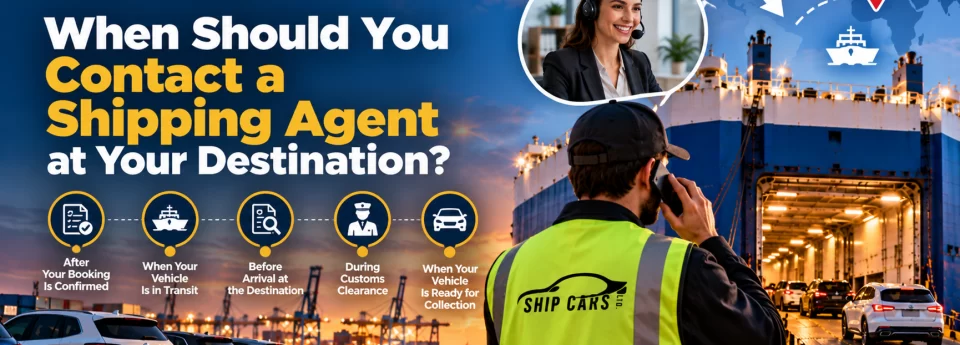
When Should You Contact a Shipping Agent at Your Destination?
Contact your destination shipping agent before you book your shipment — ideally during the planning stage, before any money changes hands. The destination agent handles customs clearance, port release, and final delivery at the other end. Engaging them early means knowing your full landed cost, having your documents in order before the vessel sails, and avoiding the port storage charges (which can reach £50–£200 per day) that accumulate when paperwork is not ready on arrival.
What Does a Destination Shipping Agent Actually Do?
When your vehicle arrives at a foreign port, it does not simply drive off the vessel and into your hands. A destination agent — also called a destination customs broker or clearing agent — is the person or company responsible for everything that happens at the arrival port on your behalf.
Their responsibilities typically include:
- Customs entry and clearance: Preparing and submitting the import declaration to the destination country’s customs authority, paying or arranging payment of import duty and taxes, and obtaining customs release.
- Port handling coordination: Liaising with the terminal to arrange release of the vehicle from the port once customs has cleared it.
- Biosecurity inspections: In countries with strict biosecurity requirements (Australia, New Zealand, USA), coordinating the mandatory inspection and, where necessary, cleaning or fumigation.
- Document management: Receiving and processing the bill of lading, commercial invoice, vehicle title or V5C, and any destination-specific import permits.
- Final delivery: In a door-to-door service, arranging onward transport from the port to your address. In a port-to-port service, releasing the vehicle to you or your nominated representative.
Without a competent agent managing this process, vehicles can be held at port, accumulate daily storage charges, miss customs filing deadlines, or — in extreme cases — be treated as abandoned and subject to seizure.
The Four-Stage Timeline: When to Make Contact
Stage 1 — Planning Stage (Before You Book Anything)
This is the right time to engage a destination agent.
Before you have chosen a shipping method, paid a deposit, or committed to a departure date, your destination agent can give you information that changes the entire shape of your plan:
- Import eligibility: Does the destination country allow right-hand drive vehicles? Are there age restrictions on imported vehicles? Does your specific model require modification to meet local standards?
- Full landed cost: What import duty, VAT or GST, port charges, and agent fees will you pay on arrival? This is information you need before deciding whether shipping is financially worthwhile.
- Required documentation: What paperwork must be prepared in the UK before the vehicle ships? Some destinations require notarised documents, apostille certification, or specific import permits that take weeks to obtain.
- Biosecurity requirements: For Australia and New Zealand in particular, what cleaning standard must the vehicle meet before loading in the UK? Knowing this in advance prevents expensive holds on arrival.
- Timeline: How long does customs clearance realistically take at that port? This affects when you need the vehicle and what your total transit window looks like.
Getting these answers at the planning stage means you ship with confidence — not with a list of unknowns that resolve expensively at the other end.
Stage 2 — On Booking (The Minimum Acceptable Point)
If you have not engaged a destination agent during planning, booking is the absolute latest acceptable point.
Once you have confirmed your shipment and received your booking reference, a series of time-sensitive processes begin:
- Your destination agent needs the bill of lading details and shipping documents to prepare the customs entry — ideally before the vessel sails, so the declaration is ready when the ship arrives.
- Many countries require pre-arrival customs filing. Missing these windows can delay clearance and trigger port storage charges from the day of arrival.
- A signed power of attorney (authorising the agent to act on your behalf with the destination customs authority) must be executed before the agent can file anything. This is a document you sign in the UK, so it needs to happen early.
- Some destination countries require the original bill of lading (not a copy) to be presented at customs. This document is in transit — the agent needs to know it is coming and how it is being sent.
Engaging an agent on the day of booking gives them maximum lead time. Waiting until the vessel has sailed reduces that window significantly.
Stage 3 — During Ocean Transit (Late, But Recoverable)
If your vehicle is already at sea and you have not yet arranged a destination agent, act immediately.
Transit times for international car shipping range from around two weeks (UK to Spain) to six weeks or more (UK to Australia or New Zealand). That window is your last opportunity to get a destination agent in place before the vessel arrives.
The risks of being in this position:
- Rushed agent selection: Finding a competent, trustworthy customs broker at short notice in a country you may not know well is difficult. Poor agent selection at this stage can cause more problems than it solves.
- Compressed document preparation time: If the agent needs notarised or apostilled documents from the UK, international courier time eats into an already short window.
- Pre-arrival filing deadlines: Some countries require advance customs filing within a specific number of days before vessel arrival. If the agent is not appointed in time, these deadlines are missed.
If your ShipCars shipment is already in transit and you are unsure about destination arrangements, contact us immediately — we can assist with destination agent referrals on most of the routes we serve.
Stage 4 — After the Vehicle Has Arrived at Port (Emergency)
If your vehicle has arrived at the destination port and you do not yet have an agent, you are now accruing costs.
Port storage charges — also called demurrage — begin as soon as a vehicle is discharged from the vessel and not immediately collected or cleared. Rates vary by port and country, but figures of £50 to £200 per day are typical. In some busy ports, charges are higher. The longer the vehicle sits, the larger the bill — and the bill must be paid before the vehicle is released.
In addition to storage costs, unclaimed vehicles can eventually be treated as abandoned cargo by the port authority, which may result in the vehicle being auctioned or destroyed under local law. The timeline for this varies significantly by country.
If you find yourself in this situation:
- Contact a specialist freight forwarder or customs broker at the destination immediately
- Gather all documents: bill of lading, V5C, proof of identity, purchase invoice
- Contact ShipCars if you booked through us — we will assist in coordinating an emergency clearance
The cost of Stage 4 is almost always significantly higher than it would have been at Stage 1 or 2.
Related: How to avoid demurrage charges when shipping a car →
What Information Does Your Destination Agent Need?
Whether you engage an agent at Stage 1 or Stage 2, have the following ready:
| Document / information | Why the agent needs it |
|---|---|
| Vehicle make, model, year, and VIN | To confirm import eligibility and prepare the customs entry |
| UK V5C registration document | Primary ownership document for export declaration and customs |
| Purchase invoice or proof of value | Customs uses this to assess import duty |
| Bill of lading (once issued) | Port release requires the original or a telex release |
| Your passport or ID | Required for customs declarations in most countries |
| Signed power of attorney | Authorises the agent to act on your behalf at customs |
| Import permit (where applicable) | Australia (ROVER approval), some Gulf states, and others require pre-approval |
| Evidence of biosecurity cleaning (where applicable) | Australia and New Zealand require a certified wash certificate |
The more of this your agent has in advance, the faster clearance proceeds on arrival.
The Cost of Getting the Timing Wrong
The table below summarises the practical impact of contacting your destination agent at each stage:
| Contact stage | Typical outcome |
|---|---|
| Planning (before booking) | Full landed cost known; documents prepared in time; no delays; no surprises |
| On booking | Good — agent has adequate lead time; pre-arrival filing achievable |
| During transit | Manageable if acted on immediately; rushed but recoverable in most cases |
| After arrival | Storage charges accumulating from day one; risk of missed deadlines; high stress and cost |
Do I Need to Find My Own Destination Agent?
If you book your international car shipping through ShipCars, we handle destination agent coordination as part of the service. We work with vetted agents at the main ports we serve, initiate contact on your behalf after booking, and act as the single point of contact throughout your shipment — so you are not managing two relationships across two time zones.
If you are arranging the shipping independently and need to source your own destination agent, look for:
- A licensed customs broker in the destination country
- Membership of the relevant national freight association (equivalent to BIFA in the UK)
- Specific experience with imported vehicles (not just general cargo)
- Clear, itemised fee structures with no vague “handling” charges
Avoid agents who cannot give you an itemised quote for their services, or who ask for payment in full before providing any documentation.
Get a ShipCars quote that includes destination agent coordination →
Frequently Asked Questions
When is the best time to contact a destination shipping agent?
The best time is during the planning stage — before you book your shipment. This gives the agent time to confirm import eligibility, advise on the full landed cost (duty, port fees, and agent charges), and specify exactly what documentation needs to be prepared in the UK before your vehicle ships.
What happens if I do not arrange a destination agent before my car arrives at port?
Port storage charges (demurrage) begin accruing as soon as the vehicle is discharged and not immediately released. Typical rates run from £50 to £200 per day depending on the port and country. In addition, some countries impose deadlines on customs filing — missing these results in additional penalties and delays on top of the storage charges.
Can I find my own destination agent instead of using the one my shipper recommends?
Yes. You are entitled to appoint your own customs broker at the destination. If you do, share their details with your UK shipping company at the time of booking so that the bill of lading and shipping documents can be directed to them. Make sure your agent is a licensed customs broker with experience in vehicle imports, not general cargo.
What documents does a destination agent need to clear my car through customs?
Typically: the bill of lading (or telex release confirmation), UK V5C, purchase invoice, your passport or photo ID, a signed power of attorney authorising the agent to act on your behalf, and any country-specific import permits (such as ROVER approval for Australia). Biosecurity cleaning certificates are required for Australia and New Zealand.
Do I need a destination agent if I book a door-to-door shipping service?
In a door-to-door service, destination customs clearance and port handling are typically included in the service — your shipper coordinates the destination agent on your behalf. However, you should confirm this explicitly and ask for the name of the destination agent as part of the booking confirmation. “Door-to-door” definitions vary between operators.
What does a destination agent charge?
Destination agent fees vary by country and port, and typically cover customs entry preparation, port handling liaison, and document processing. Some charge a flat fee; others charge a percentage of the customs value plus disbursements (the actual duty, taxes, and port charges paid on your behalf). Always request an itemised quote that separates the agent’s fee from the government and port charges they are paying on your behalf.
What is a power of attorney in car shipping and when do I need to sign one?
A power of attorney (POA) is a document authorising your destination agent to act on your behalf when dealing with the destination country’s customs authority. Without it, the agent cannot file customs declarations or receive documents on your behalf. It must be signed by you (the owner or importer of record) and is typically provided by the agent; it should be signed and returned before the vessel departs the UK.
What are demurrage charges and how do I avoid them?
Demurrage (also called port storage) is the charge levied by the destination port terminal when a vehicle or container is not collected within the free storage period — typically 3–7 days after vessel arrival, depending on the port. To avoid them: appoint a destination agent before your vessel sails, ensure all documents (especially the bill of lading) reach the agent in time, and respond promptly to any document requests. Read our full guide for more detail.
Related Guides
- How to avoid demurrage charges when shipping a car →
- RoRo car shipping explained →
- Container car shipping explained →
- How to ship a car from the UK to Australia →
- Car shipping to Spain →
- Get a free shipping quote — destination agent coordination included →


