


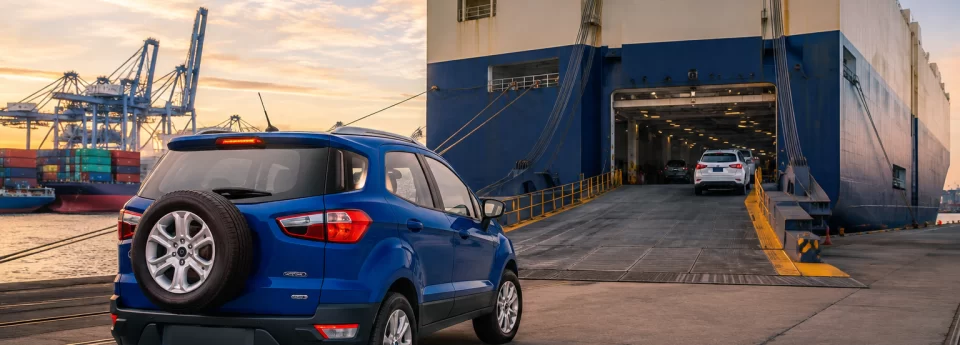
Shipping a Ford EcoSport Overseas
Ford EcoSport — Complete Buyer’s Guide for UK Owners
The Ford EcoSport is a subcompact crossover SUV produced by Ford between 2003 and 2022, across two distinct generations. The first generation was built exclusively in Brazil and never sold in the UK. The second generation — based on the Ford Fiesta B2E platform — entered the European market in June 2014 and was eventually produced at Ford’s Craiova plant in Romania from 2017 onwards. UK buyers had access to three engine options: the 1.0-litre EcoBoost three-cylinder turbo petrol (125 PS), the 1.5-litre Ti-VCT petrol (112 PS), and the 1.5-litre TDCi diesel (95 PS). The EcoSport was discontinued globally after the 2022 model year, with no direct replacement announced in the subcompact crossover segment.
Where the EcoSport Actually Came From — and Why It Matters
Most buyers in the UK had no idea they were purchasing a vehicle originally conceived for the Brazilian, Indian, and Russian markets. That context matters, because it shaped almost every design compromise in the car.
The second-generation EcoSport was unveiled as a concept at the New Delhi Auto Expo in January 2012 — not at Frankfurt or Geneva. The global product development brief was to create a single vehicle that could be assembled in eight countries and sold across 100 markets simultaneously. That ambition is precisely why early UK examples attracted criticism: the interior materials, build tolerances, and noise insulation were calibrated to a different standard than what European buyers expected from a Ford product.
Improvements With Time
From 2017, when production shifted to the Craiova facility in Romania, build quality improved noticeably. UK cars sourced from that point onwards showed tighter panel gaps, improved cabin materials, and better NVH (noise, vibration and harshness) refinement. If you are buying a used EcoSport in the UK, the production date is more relevant than the registration year. A 2016-registered Indian-built car is a materially different ownership experience from a 2018-registered Romanian-built example.
The Engines: What You Need to Know Before You Choose
Litre EcoBoost — The One Most People Bought
The 1.0-litre EcoBoost three-cylinder was the most popular engine in the UK EcoSport range. Ford developed this unit at its Dunton Technical Centre in Essex, and it is a genuinely clever piece of engineering — a cast-aluminium turbocharged block small enough, as Ford’s own marketing famously noted, to fit on an A4 sheet of paper.
In the EcoSport, it produced 125 PS and 170 Nm of torque, rising to 200 Nm on overboost. The quoted 0–62 mph time is 12.7 seconds — which tells you this is not a performance engine. It is an economy engine, and on a clear A-road it does that job reasonably well. What it does not do well is deal with sustained low-speed urban stop-start driving, where the three-cylinder vibration becomes noticeable and the turbo lag is more intrusive than the spec sheet suggests.
Things To Check On
The single most important thing to check on a used 1.0 EcoBoost is the coolant system. Early production examples (pre-2014) had documented issues with coolant leaks, sometimes progressing to head gasket failure. This was addressed through running changes in production, but it is worth verifying that coolant levels have been stable across the service history and that there are no signs of mixing in the expansion tank.
Litre TDCi Diesel — The Underrated Option
The 1.5-litre TDCi diesel produced 95 PS in UK specification. It is slower than the EcoBoost petrol, with a 0–62 mph time of 14.0 seconds, and noisier under load. What it offers in return is real-world fuel economy that the EcoBoost rarely achieves in practice — combined consumption of 64.2 mpg on the old NEDC cycle, which translates to a realistic 50–55 mpg on a mixed-use route. If you cover high annual mileage and the majority of it is dual carriageway or motorway, the diesel’s 52-litre tank and strong range characteristics make genuine economic sense.
Litre Ti-VCT Petrol — Honest but Unremarkable
The naturally aspirated 1.5-litre Ti-VCT four-cylinder was available with either a five-speed manual or a six-speed automatic. It produced 112 PS — less than the EcoBoost despite being a larger engine — and returned poorer fuel economy. It has one advantage that is genuinely worth noting: the absence of a turbocharger means there is one fewer thing to go wrong. Given that the Warrantywise Reliability Index identifies the turbocharger as the most common repair request on the EcoSport fleet, that is not a trivial point. At lower mileages and on a tight budget, the naturally aspirated 1.5 is the lowest-risk powertrain in the range.
The Gearbox Problem Nobody Talks About Enough
Pre-facelift EcoSports fitted with the six-speed PowerShift dual-clutch transmission had a documented and serious reliability issue. The dry clutch module was prone to oil contamination from leaking seals, which produced progressive juddering and jerking under acceleration. Ford faced legal action in multiple markets over this, and dealerships replaced clutch packs under warranty in considerable numbers.
The fix arrived with the 2018 mid-cycle refresh: Ford ditched the PowerShift entirely and replaced it with a conventional six-speed torque-converter automatic. If you are considering a used automatic EcoSport, this single detail should determine which version you look at. A pre-2018 PowerShift automatic is a risk. A post-2018 torque-converter automatic is a different and more dependable proposition.
Generation by Generation: The Used Market in Plain English
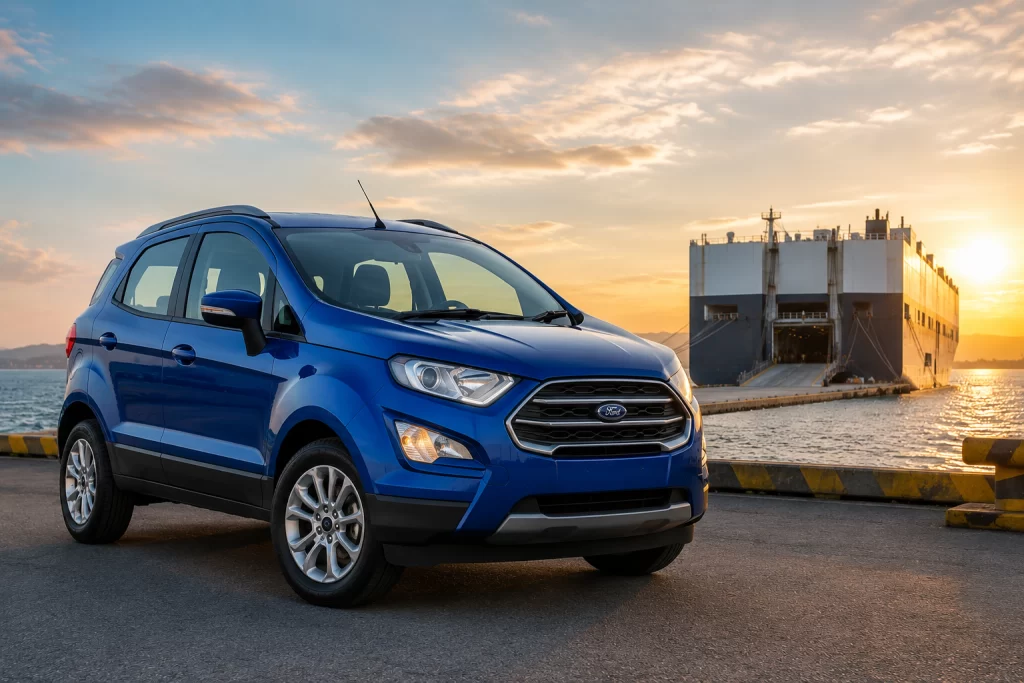
2014–2017 (First UK Generation, Indian-Built): These are the cheapest used examples and the most mixed in terms of quality. The PowerShift dual-clutch gearbox risk applies here. The interior is noticeably more basic than later cars. The 1.0 EcoBoost is the sensible engine choice; avoid PowerShift automatics from this era entirely.
2017–2018 (Romanian Production Begins, Pre-Facelift): A meaningful improvement in build quality. The PowerShift issue still applies to automatics in this period — check build date carefully, not just registration year.
2018–2022 (Facelifted, Romanian-Built): This is the version to buy if you are in the market for a used EcoSport. Revised styling, updated interior, physical controls replacing the touch-sensitive buttons, and the crucial switch to torque-converter automatic. Electronic stability control became standard across all trims from this point. The 2018 facelift also brought seven airbags to most trim levels, up from six on earlier cars.
What the EcoSport Got Right
The EcoSport’s raised ride height — approximately 200mm ground clearance — made it genuinely useful on poorly maintained rural roads and light off-road surfaces in a way that a standard Fiesta could not match. It was not an off-road vehicle, but it offered enough clearance to make unpaved tracks, waterlogged field entrances, and steep-sided rural dips manageable.
The boot capacity on pre-facelift cars measured 377 litres — competitive for the segment. The facelifted model’s capacity dropped to 333 litres but gained a clever adjustable floor that improved loading flexibility.
Distinctive Appearance
The side-hinged rear tailgate — modelled on traditional 4×4 practice — gave the EcoSport a distinctive appearance. In practice, it was inconvenient in tight car parks, particularly when the car was parked close to a wall. Ford acknowledged this indirectly by making no changes to it throughout the car’s entire production life.
You Can Also Read Our This Articles : Most Eco-Friendly Cars of 2026
Real Owner Experience
“We shipped our 2019 EcoSport from the UK to Cyprus after relocating — Ship Cars sorted the whole thing and kept us updated throughout. Car arrived in perfect condition.” — Maria T., Limassol
How Ship Cars Ltd Can Help You Ship Your EcoSport
Whether you are relocating abroad and want to take your EcoSport with you, buying one from overseas, or selling to a buyer in another country, Ship Cars Ltd handles the full process.
We regularly ship Ford vehicles — including EcoSport models — to destinations including Cyprus, Spain, Australia, the USA, Turkey, and South Africa, using both RoRo (Roll-on Roll-off) and container shipping .
- RoRo is the most cost-effective option for most destinations. Your EcoSport is driven directly onto the vessel and secured in the car deck for transit — no crating required.
- Container shipping provides an additional layer of protection and is particularly suited to higher-specification or privately imported vehicles.
Comprehensive Services We Provide
We can arrange car collection from any UK address using a trade plate driver or enclosed transporter, manage all export documentation, and provide a single point of contact throughout. Our Booking Manager Aarti is available to walk you through the process and provide a tailored quote for your specific route and requirements.
Ship Cars Ltd is ready to help you get Godzilla across the Atlantic safely. Get in touch today for a free, no-obligation quote and honest advice from a team that genuinely loves what they do. Contact us today for further information or visit our sailing schedule and get an instant quote to schedule your car shipping with us.


